On this page
How to identify it
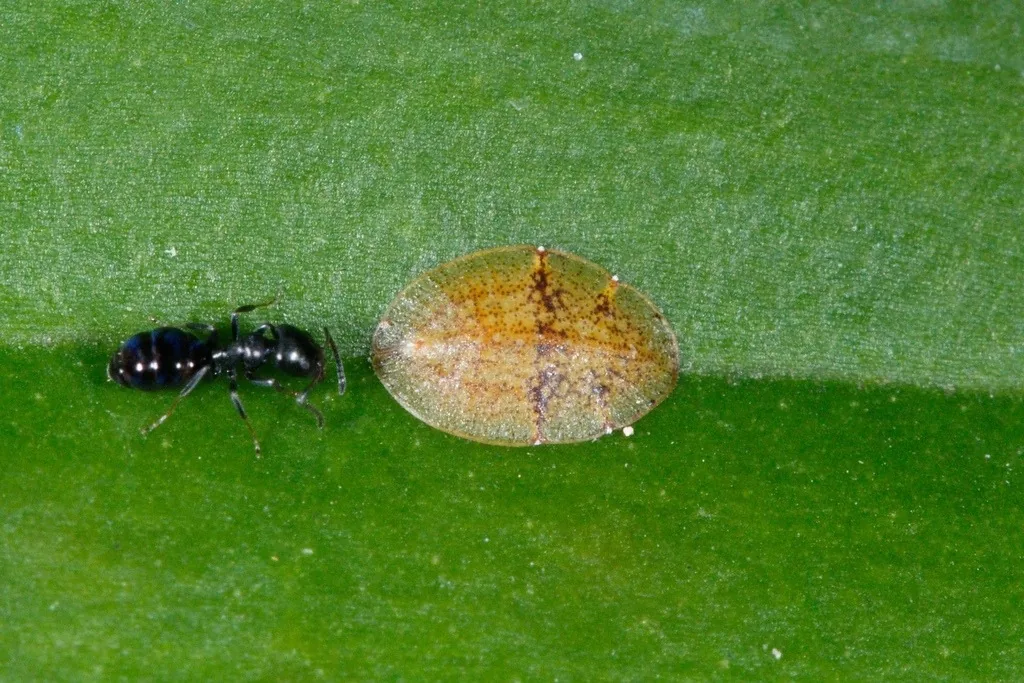
- Adult females are oval, up to 3/16 inch long and slightly domed, pale yellowish green to yellowish brown, often mottled with brown; older females are brown.[1]
- Crawlers and young nymphs are yellow and nearly flat; males are rare.[1][2]
- Shiny, sticky honeydew on leaves, sometimes landing more than an inch from the scale, is often the first sign.[2]
- Males are rare and look like tiny wasps or flies. Parasitized nymphs turn dark brown to black and convex.[1]
- Newly hatched crawlers are only about 0.4 mm long; second-stage nymphs reach about 1.0 mm.[2]
Look-alikes
| Look-alike | How to tell them apart |
|---|---|
| Mealybugs and aphids | They also excrete honeydew on houseplants, so look for the oval scales themselves on stems and leaf veins.[2] |
| Other soft scales | Hemispherical scale and nigra scale also produce honeydew on indoor plants.[2] |
Where it lives
It occurs worldwide and outdoors in the deep South, north along the East Coast to Virginia and on southern Vancouver Island; elsewhere it lives on indoor and greenhouse plants.[1][2]
Biology and life cycle
Females retain their eggs, and crawlers stay under the mother for a short time before settling, mostly on stems.[1][2]
Once they begin reproducing, females produce a few crawlers a day for three to four weeks or more, so generations overlap.[2]
A generation takes about 60 days, with three to seven generations a year depending on temperature.[1]
Only females are produced, by parthenogenesis. Crawlers spread on handled plants and drift short distances on air currents.[2]
UC IPM notes that most soft scales have one generation a year; brown soft scale is the exception, with females and nymphs present all year.[3][1]
It feeds on a huge range of plants and seems to prefer perennials, with ferns a favored host. Outdoors in California, UC IPM lists avocado, citrus, holly, manzanita and palm, where it becomes annoyingly abundant if ants tend it.[1][3]
Damage and signs
- Heavy infestations encrust stems and leaf stalks, cause wilting, early leaf drop and branch dieback, but seldom kill the plant.[1][2]
- Honeydew grows black sooty mold and attracts ants and wasps.[1][2]
- Honeydew can be squirted more than an inch, so sticky spots may land on leaves or other surfaces below the plant.[2]
- Ants that feed on the honeydew protect the scales from their natural enemies.[3]
Health risk
A plant pest. None of the sources here describes any risk to people or pets beyond sticky honeydew and sooty mold.[1][2][3]
Control
Prevention
Inspect plants every one to two weeks for fresh honeydew, especially on new growth and stems; continued fresh honeydew after treatment means scales are still alive.[2]
Before spraying, check whether the scales are alive: dead or parasitized scales fail to ooze fluid when squished. Continued fresh honeydew after treatment means live scales remain.[3][2]
Biological control
Outdoors, small parasitic wasps often keep it in check; no natural enemy reliably controls it indoors.[1][2]
Outdoors, UC IPM says controlling the ants that tend scales lets parasitic wasps and predators catch up; use sticky barriers on trunks or enclosed ant baits.[3]
Pesticides
Insecticidal soap or horticultural oil kills crawlers it contacts but needs repeated applications; NC State suggests waiting about 10 days between treatments and keeping treated plants out of direct sun.[1][2]
Colorado State says a soil-applied systemic insecticide (imidacloprid) gives good control on ornamental houseplants, but the indoor products are not allowed on food plants such as citrus grown for fruit or herbs; there, soaps and horticultural oils are the only options.[2]
Where it lives
It is one of the most widely distributed soft scales; ScaleNet lists it from 181 countries and on host plants in 144 families.[4]
GBIF's US records since 1990 are scattered across the country, with the most from California. Outside the warm South it lives mainly on indoor and greenhouse plants.[5][1]
Where sources disagree
Host range: Colorado State gives 125 plant families in 363 genera; the ScaleNet catalogue lists 144 families and 446 genera.[2][4]
Pyrethroid sprays outdoors: Colorado State lists pyrethroids among options for plants moved outdoors, noting they hit crawlers but not mature scales, while UC IPM recommends against persistent broad-spectrum sprays, pyrethroids included, for scale in landscapes because they kill natural enemies and pollinators.[2][3]
Natural enemies: NC State notes the parasitic wasp Metaphycus luteolus controls it in California, while Colorado State says no natural enemy reliably controls it indoors.[1][2]
Common questions
- What is the sticky stuff on my houseplant's leaves?
- Often honeydew from brown soft scale feeding on the stems and leaf veins above.[1][2]
- Will brown soft scale kill my plant?
- Seldom, but heavy infestations cause wilting, leaf drop and dieback.[1][2]
- Why didn't one spray work?
- Soap and oil kill only the scales they contact, and new crawlers keep appearing, so repeat treatments are needed.[1][2]
- Can I use a systemic insecticide on my indoor citrus?
- Not if you eat the fruit. Colorado State says the indoor imidacloprid products do not allow use on food plants, so use insecticidal soap or horticultural oil and repeat it.[2]
Sources
- NC State Extension, “Brown Soft Scale (Entomology Insect Notes).” content.ces.ncsu.edu/brown-soft-scale (accessed 2026-11-11)
- Colorado State University Extension, “Brown Soft Scale: A Common Insect Pest of Indoor Plants.” extension.colostate.edu/resource/brown-soft-scale-a-common-insect-pest-of-indoor-plants/ (accessed 2026-11-11)
- University of California Statewide IPM Program, “Pest Notes: Scales (Publication 7408).” ipm.ucanr.edu/PMG/PESTNOTES/pn7408.html (accessed 2026-11-11)
- ScaleNet (scale insect database begun at the USDA ARS Systematic Entomology Laboratory), “ScaleNet catalogue: Coccus hesperidum Linnaeus.” scalenet.info/catalogue/Coccus%20hesperidum/ (accessed 2026-11-11)
- Global Biodiversity Information Facility (GBIF), “Coccus hesperidum: US occurrence records since 1990 by state (GBIF occurrence search API).” api.gbif.org/v1/occurrence/search?taxonKey=5712981&country=US&hasGeospatialIssue=false&occurrenceStatus=PRESENT&year=1990%2C2026&facet=stateProvince&facetLimit=400&limit=0 (accessed 2026-11-11)
- iNaturalist, “Coccus hesperidum taxon page (order and family).” www.inaturalist.org/taxa/330200 (accessed 2026-11-11)