On this page
How to identify it
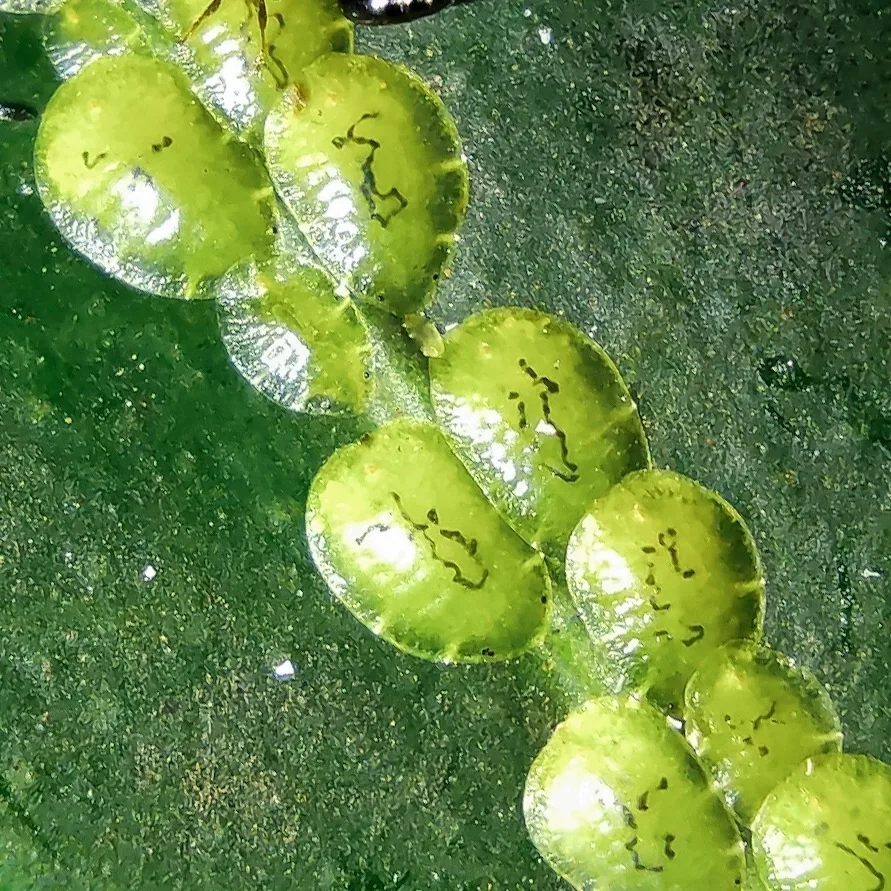
- Adult females are shiny pale green, oval and flat to moderately domed, with an irregular black U-shaped mark inside the body that you can see without a lens. UF/IFAS gives 2.5 to 3.25 mm for adults and describes them as elongate-oval and moderately convex.[1][2][10]
- With a hand lens you can see two black eye spots near the front edge.[1][2]
- Crawlers settle on the underside of leaves along the midrib and veins, and on leaf stalks, stems, young buds and fruit; the scales can also be found on upper leaf surfaces. On citrus, UF/IFAS says the scales line up along both sides of the midrib and side veins on the undersides of leaves, and on young shoots often form a solid mass.[1][10]
- Nymphs are flat, oval and yellowish green with six short legs. The eggs are whitish green and elongate.[1][2]
- Dead green scales turn light brown or buff and lose the black internal mark.[10]
Look-alikes
| Look-alike | How to tell them apart |
|---|---|
| Brown soft scale | Look for green scale's pale green, slightly see-through body with an irregular U-shaped pattern of black spots inside; that combination separates it from related soft scales in the field.[2][1] |
Where it lives
Thought to come from Brazil or East Africa, it now occurs in tropical and subtropical Africa, Asia, the Americas and Oceania, including Queensland, Australia. In cooler regions it can still establish in greenhouses and on indoor plants, as in a tropical greenhouse in Cornwall, England. GBIF has about 54 U.S. records since 1990, mostly from Florida, then Hawaii and California, and records from Brazil, Mexico and China. UF/IFAS says it was first found in Florida near Davie, Broward County, in May 1942 by State Plant Board grove inspectors, had been reported in 27 Florida counties as of 1976, and is most common in south Florida, both outdoors and in greenhouses.[1][2][3][4][10]
Biology and life cycle
It is recorded on 216 plant species in 200 genera, with a preference for coffee, guava and cacao. Other hosts include citrus, mango, papaya and tea, and ornamentals such as camellia, ficus, gardenia, ixora, jasmine and oleander. In Florida, UF/IFAS says its preferred host is the wild groundsel bush (Baccharis halimifolia), its preferred cultivated hosts are gardenia and ixora, and the Division of Plant Industry has recorded it on 174 hosts there since 1942.[1][10]
Females reproduce without mating, and males are very rare. Each female produces 50 to 600 eggs under her body, which hatch within minutes to a few hours. EFSA calls the species egg-laying, while ScaleNet describes it as ovoviviparous. UF/IFAS cites observations of some females finishing egg laying in eight days and others laying over 42 days.[1][2][10]
There are three nymphal stages. Crawlers pick the feeding site, older nymphs barely move, and adults don't move at all. In south Florida a generation takes 50 to 70 days in late summer; there are three to four generations a year in Queensland. UF/IFAS adds that crawlers wander over the plant or move to other plants, then settle on a leaf or green shoot and usually stay put unless the spot becomes unfavorable.[1][2][10]
Ants collect its honeydew. On coffee, one tree-nesting ant forms such a close partnership with the scale that outbreaks of a scale-killing fungus change where the ants forage, and most lady beetles cannot prey on ant-tended scales; one predator, Azya orbigera, gets around this because its larvae are covered in sticky wax the ants can't attack.[5][6][1]
On coffee, plants given more nitrogen and potassium developed more green scales over time.[7]
Damage and signs
- Heavy feeding curls leaves, drops tender twigs and weakens plants. Young trees in the first two years after transplanting suffer stunting, yellowing, leaf loss and fruit drop, and on coffee in Hawaii it is a serious pest of nursery stock and young trees though usually minor on healthy mature trees. UF/IFAS lists yellowing, leaf drop, reduced fruit set and loss of vigor when populations are large.[1][10]
- Sooty mold growing on the honeydew makes fruit and ornamental plants unsightly and unmarketable. It was the soft scale most often intercepted at U.S. ports of entry, 5332 times between 1995 and 2012. UF/IFAS adds that infested nursery plants can be quarantined until the scale is under control.[1][10]
Health risk
The sources treat it only as a plant pest; none mentions bites or other risk to people or pets.[1][2]
Control
Prevention
Inspect plants carefully, especially new ones. Honeydew, sooty mold and ants are signs to look closer, and sticky traps around stems can catch crawlers. UF/IFAS says scales usually reach greenhouses on infested plants, so inspect all plant material thoroughly before bringing it in.[1][10]
Avoid overfeeding: on coffee, high nitrogen and potassium fertilization led to more scales.[7]
Biological control
Lady beetles and parasitic wasps attack green scale; in Hawaii a lady beetle (Azya luteipes) brought it under control. The fungus Akanthomyces lecanii (formerly Verticillium lecanii) is an important natural control and can wipe out large colonies quickly in the rainy season. UF/IFAS says several fungi limit green scale on Florida citrus in some seasons, the white-fringed fungus most of all, but attempts to spread the fungus artificially to healthy scales failed. It also says controlling ants helps, because ants protect the scales from lady beetles and other predators.[1][10]
Pesticides
In greenhouse tests on potted gardenias, a 1 percent limonene spray killed 95 percent of green scales, 2 percent insecticidal soap 89 percent and 2 percent horticultural oil 88 percent. The limonene mix damaged some ferns, gingers and delicate flowers.[8][1]
Aim any spray at the leaf undersides along the veins and at young stems, where the crawlers settle. UF/IFAS likewise says to direct sprays at lower leaf surfaces and new growth for thorough coverage.[1][10]
Where the sources disagree
Origin: UF/IFAS says it is thought to be of Brazilian origin; EFSA says Brazil or East Africa.[10][1]
Australia: UF/IFAS says it occurs throughout the tropics except Australia; ScaleNet and EFSA include Queensland, Australia, in its range.[10][2][1]
Common questions
- What are the flat green bugs lined up on my gardenia or ixora leaves?
- Shiny pale green, oval scales in rows along the leaf veins, each with a black U-shaped mark inside, are green scales. Gardenia and ixora are among their ornamental hosts. UF/IFAS says gardenia and ixora are its preferred cultivated hosts in Florida.[1][2][10]
- Why are there so many ants on my plant with scale?
- Ants feed on the sweet honeydew green scales excrete. Where ants tend the scales, most lady beetles can't feed on them, so ants help protect the scale.[1][6]
- Can green scale live indoors?
- Yes. EFSA notes it can establish in greenhouses and on indoor plants even where outdoor conditions are too cool, and it has been found in a tropical greenhouse in England.[1]
Sources
- European Food Safety Authority (EFSA Journal), “EFSA Panel on Plant Health. Pest categorisation of Coccus viridis. EFSA Journal 23(7):e9582 (2025) (abstract).” pmc.ncbi.nlm.nih.gov/articles/PMC12290422/ (accessed 2026-11-11)
- ScaleNet (scale insect database begun at the USDA ARS Systematic Entomology Laboratory), “ScaleNet catalogue: Coccus viridis (Green, 1889).” scalenet.info/catalogue/Coccus%20viridis/ (accessed 2026-11-11)
- Global Biodiversity Information Facility (GBIF), “Coccus viridis: U.S. occurrence records since 1990 by state (GBIF occurrence search).” api.gbif.org/v1/occurrence/search?taxonKey=5163369&country=US&hasGeospatialIssue=false&occurrenceStatus=PRESENT&year=1990%2C2026&facet=stateProvince&facetLimit=400&limit=0 (accessed 2026-11-11). Exact count at access: 54 U.S. records since 1990 (Florida 33; Hawaii 16; California 4).
- Global Biodiversity Information Facility (GBIF), “Coccus viridis: occurrence records since 1990 by country (GBIF occurrence search).” api.gbif.org/v1/occurrence/search?taxonKey=5163369&hasGeospatialIssue=false&occurrenceStatus=PRESENT&year=1990%2C2026&facet=country&limit=0 (accessed 2026-11-11). Exact counts at access: 217 records since 1990; United States 54, Brazil 26, Mexico 22, China 19, Australia 11.
- Entomological Society of America (Environmental Entomology), “Macdonald AJ, Jackson D, Zemenick K. Indirect effects of a fungal entomopathogen, Lecanicillium lecanii, on a coffee agroecosystem ant community. Environmental Entomology 42(4):658-667 (2013) (abstract).” doi.org/10.1603/EN12287 (accessed 2026-11-11)
- Environmental Entomology, via PubMed, “Cheating on a mutualism: indirect benefits of ant attendance to a coccidophagous coccinellid (Liere and Perfecto 2008).” pubmed.ncbi.nlm.nih.gov/18348805/ (accessed 2026-11-11)
- Entomological Society of America (Environmental Entomology), “Fernandes FL et al. The effects of nutrients and secondary compounds of Coffea arabica on the behavior and development of Coccus viridis. Environmental Entomology 41(2):333-341 (2012) (abstract).” doi.org/10.1603/EN11003 (accessed 2026-11-11)
- Journal of Economic Entomology, via PubMed, “Limonene, a citrus extract, for control of mealybugs and scale insects (Hollingsworth 2005, USDA-ARS Hilo).” pubmed.ncbi.nlm.nih.gov/16022305/ (accessed 2026-11-11)
- iNaturalist, “Coccus viridis taxon page (order and family).” www.inaturalist.org/taxa/330203 (accessed 2026-11-09)
- University of Florida IFAS Extension, EDIS (Featured Creatures), “Green Scale, Coccus viridis (Green), EENY-253/IN436 (Featured Creatures).” ask.ifas.ufl.edu/publication/IN436 (accessed 2026-11-14)