On this page
How to identify it
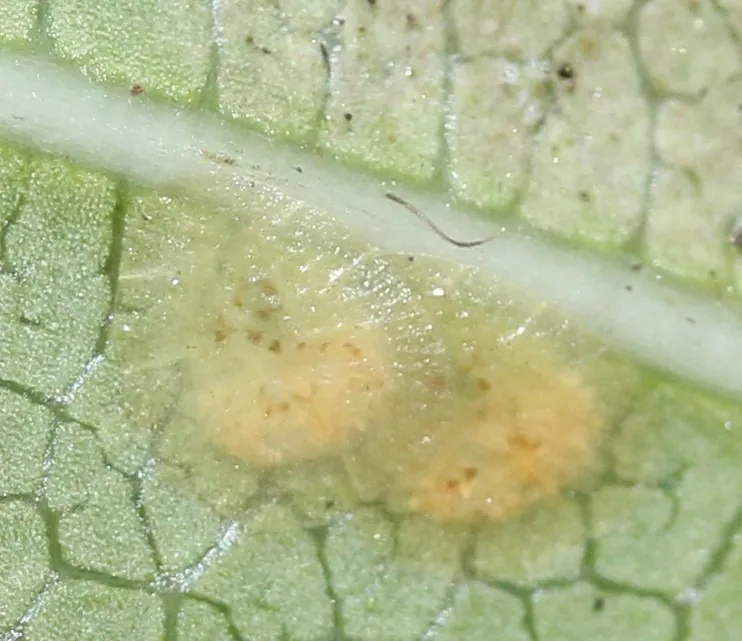
- The adult female is flat and 4 to 5 mm long, covered by a shiny, pale-green, almost see-through shield.[1]
- The body is nearly triangular: bluntly pointed at the front and broadly rounded at the back.[1]
- As she produces eggs, the female turns brown, opaque and a little more domed.[1]
- Crawlers are flat and light yellow. UF/IFAS notes that the scales on Florida mango, this one included, are found on the upper or lower surfaces of leaves and also on the fruit.[1][3]
Look-alikes
| Look-alike | How to tell them apart |
|---|---|
| Pyriform scale (Protopulvinaria pyriformis) | Another soft scale that UF/IFAS lists among the scales infesting mango in Florida. ScaleNet notes that live specimens of mango shield scale look very similar to pyriform scale, so a close look or expert identification may be needed.[1][3] |
Where it lives
Its native range is uncertain. It occurs widely in tropical and warmer subtropical regions around the world, and ScaleNet records it in the United States from Florida and Texas. UF/IFAS lists it among the scales that infest mango in Florida.[2][1][3]
Biology and life cycle
Females generally reproduce without mating, and males are rare.[1][2]
It has two to three generations a year; in Israel's coastal plain there are three.[2][1]
It feeds on plants in more than 86 genera, including mango, citrus, avocado, hibiscus and myrtle.[2]
Damage and signs
- It damages mango by sucking plant juices, and its honeydew grows sooty mold on the leaves, which cuts photosynthesis.[1]
- Heavy infestations reduce tree vigor and leaf size and cause yellowing, leaf drop and the death of branches.[1]
- Besides being a serious mango pest, it is an occasional pest of a range of ornamental plants.[2]
Health risk
The sources treat it only as a plant pest; none mentions bites or any risk to people or pets.[1][2]
Control
Prevention
Before spraying, check whether many of the scales are already dead or parasitized; if so, delay treatment and check again later.[4]
Biological control
Small parasitic wasps attack it. UF/IFAS notes that scales on mango are frequently parasitized by small wasps and pictures Microterys nietneri, an encyrtid wasp that attacks soft scales; ScaleNet also lists Coccophagus and Metaphycus species among its natural enemies.[1][3]
Ants that tend the scales for honeydew can reduce parasitism, so control them with sticky barriers on trunks or insecticide baits, and avoid persistent broad-spectrum insecticides that kill natural enemies.[1][4]
Pesticides
Where treatment is needed, a thorough spray of horticultural oil timed to when crawlers are active controls most scales.[4]
Common questions
- What are the flat green scales on my mango leaves?
- Mango shield scale is a likely suspect: a flat, shiny, pale-green, nearly triangular scale 4 to 5 mm long that turns brown as it lays eggs.[1]
- Does mango shield scale only attack mango?
- No. It feeds on plants in more than 86 genera, including citrus, avocado, hibiscus and myrtle.[2]
- Will mango shield scale kill my tree?
- Heavy infestations can reduce vigor, cause yellowing and leaf drop and kill branches.[1]
- Is mango shield scale the same as mango scale?
- No. UF/IFAS lists them as two separate scales on Florida mango: mango shield scale (Milviscutulus mangiferae) and mango scale (Aulacaspis tubercularis).[3]
Sources
- ScaleNet (scale insect database begun at the USDA ARS Systematic Entomology Laboratory), “ScaleNet catalogue: Milviscutulus mangiferae (Green).” scalenet.info/catalogue/Milviscutulus%20mangiferae/ (accessed 2026-11-12)
- European Food Safety Authority (EFSA Journal), “Pest categorisation of Milviscutulus mangiferae (EFSA Panel on Plant Health 2023, EFSA Journal 21: e07846; PubMed abstract).” doi.org/10.2903/j.efsa.2023.7846 (accessed 2026-11-09)
- University of Florida IFAS Extension (EDIS), “Mango Pests and Beneficial Insects, ENY-413/IG073 (D. Carrillo, R. Duncan and J. Peña).” ask.ifas.ufl.edu/publication/IG073 (accessed 2026-11-14)
- University of California Statewide IPM Program, “Pest Notes: Scales (UC ANR Publication 7408).” ipm.ucanr.edu/home-and-landscape/scales/ (accessed 2026-11-09)
- iNaturalist, “Milviscutulus mangiferae taxon page (order and family).” www.inaturalist.org/taxa/507163 (accessed 2026-11-09)