On this page
How to identify it
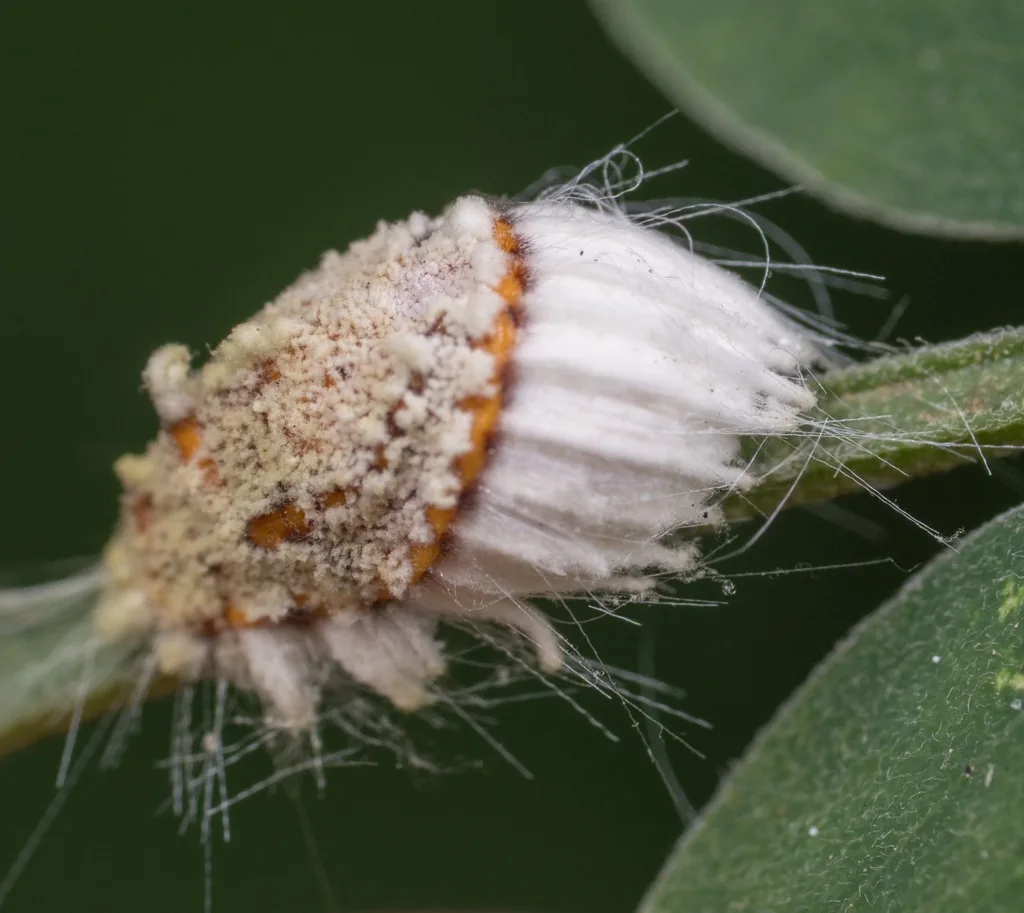
- Adult females are orangish brown to rusty red with black legs and antennae; NC State gives about 4.5 mm for the body, which is often hidden by wax. UF/IFAS says the mature 'females' (actually hermaphrodites) are bright orange-red, yellow or brown and partly or entirely covered with yellowish or white wax, and that it is the only Icerya species in Florida.[1][3][4]
- The trademark is the long, white, fluted egg sac attached to the female. NC State counts 14 to 16 ridges on it. It grows two to three times as long as the female (UC IPM; Clemson says two to 2 1/2 times), and female plus sac can reach almost 1/2 inch. UF/IFAS agrees that the sac is frequently two to 2.5 times longer than the body.[1][3][5][4]
- UC IPM puts 600 to 800 red eggs in each sac; Clemson says there may be hundreds. UF/IFAS, citing a 1901 Florida study, gives about 1000 red eggs per sac.[1][2][5][4]
- Crawlers are red with black legs and antennae and settle along leaf veins. UF/IFAS describes newly hatched nymphs as bright red with dark antennae and thin brown legs. This is the main dispersal stage: they can be blown by wind to new places, crawl to nearby plants, or possibly hitchhike on other animals.[1][5][4]
- Unlike most scales, it keeps its legs and can move throughout its life.[1][3]
- Males are rare: UC IPM describes a minute, red-winged insect that is seldom seen, and NC State a slender, reddish-purple insect about 3 mm long with two wings. UF/IFAS says males are winged, with a dark red body and dark antennae.[1][3][4]
Look-alikes
| Look-alike | How to tell them apart |
|---|---|
| Vedalia beetle larvae | Reddish vedalia larvae feed on top of the egg sacs and chew into them, and vedalia lays oblong red eggs under the scale or on its sac; scale crawlers are red with black legs and antennae.[1][2] |
Where it lives
Tropical and subtropical areas worldwide. In the United States it occurs in southern California, Arizona, the Gulf Coast states and North Carolina at least as far as Raleigh; winter lows of about 10 degrees F are said to limit it outdoors, though it survives in greenhouses in colder places. UF/IFAS says it is now widespread throughout the world wherever citrus is grown and has been reported from most Florida counties.[3][4]
Biology and life cycle
Eggs hatch in a few days in warm weather but can take up to two months in winter (UC IPM); NC State gives three weeks in summer to eight weeks in winter. UF/IFAS also says a few days to two months, depending on temperature.[1][2][3][4]
Young scales settle on twigs and leaf veins, then move to branches and the trunk as they grow; first nymphs can crawl up to a yard in 10 minutes.[1][2][3]
Females don't need to mate to reproduce. Genetic work shows these 'females' are really hermaphrodites that usually fertilize themselves, though rare outbreeding with males also happens. UF/IFAS explains that self-fertilization produces only hermaphrodites, while mating with a male produces more males as well as hermaphrodites.[1][2][6][4]
UC IPM gives two to three generations a year in landscapes and three in citrus, with the life cycle taking about three months in warm weather; NC State estimates 2 to 2.5 generations a year in North Carolina.[1][2][3]
It likes moist, cool conditions and does well in citrus trees with dense canopies.[2]
After three molts the adult starts laying eggs and secreting the egg sac. As the sac grows, the scale's abdomen tilts more and more until it seems to be standing on its head.[4]
Damage and signs
- It sucks sap from leaves, twigs, branches and trunks. Extremely heavy infestations cause leaf drop and twig dieback; older trees lose vigor, but young trees can be severely stunted or killed.[1][5]
- It excretes honeydew, which brings black sooty mold and ants. In navel orange trials, more adult scales per branch meant fewer and smaller fruit and more sooty-mold-marked fruit.[1][7]
- Hosts include citrus, cocculus, nandina and pittosporum in California and many woody ornamentals; in North Carolina nandina and pittosporum are the most frequently reported hosts. In Florida it is most often collected on citrus and pittosporum.[1][5][3][4]
- UF/IFAS says it can severely damage trees, resets and nursery stock, causing decreased vigor, fruit drop and leaf loss. Most damage comes from young nymphs that settle in rows along the midrib and veins of leaves and on small twigs; older nymphs move to larger twigs, adults settle on branches and trunk, and it is seldom found on fruit.[4]
Health risk
It feeds only on plants; none of the sources describes any risk to people.[1][3]
Control
Prevention
Keep ants out of trees with sticky trunk bands on a protective wrap, or with ant baits, and keep dust down, so natural enemies can work.[1]
Traps and physical control
In citrus, opening up the canopy by pruning out suckers, dead and crossing limbs makes trees less favorable to the scale.[2]
Biological control
Look for vedalia beetles, their red eggs and larvae on egg sacs, or round exit holes left by the Cryptochaetum fly; if they are present, no spray is needed.[1][2]
Pesticides
Don't use imidacloprid: it doesn't kill cottony cushion scale but poisons vedalia beetles, and outbreaks have followed its use. A California citrus trial found foliar imidacloprid did not control the scale and disrupted biological control, and NC State reports disappointing results with imidacloprid and dinotefuran.[1][8][3]
Pyrethroids, neonicotinoids and insect growth regulators are toxic to vedalia, and cottony cushion scale flares in San Joaquin Valley citrus after they are used for other pests.[2]
If natural enemies are absent and crawlers are active, horticultural oil is least disruptive; double-sided sticky tape around twigs shows when crawlers hatch. Clemson gives 1% oil on tender growth and 2% on mature foliage, applied between 45 and 85 degrees F.[1][5]
Where sources disagree
Egg hatch: UC IPM says a few days in warm weather and up to two months in winter; NC State says three weeks in summer to eight weeks in winter.[1][3]
Generations: UC IPM gives two to three a year in landscapes and three in citrus; NC State gives 2 to 2.5 in North Carolina.[1][2][3]
When vedalia arrived: NC State says it was brought from Australia in 1888; UC IPM says the 1890s. UF/IFAS also gives 1888 for its release in California.[3][1][2][4]
Treatment threshold in navel oranges: UC IPM's citrus guidelines treat when live adult females exceed 4 per 2-foot branch; a 2022 field study supports a threshold below 2 adult females per branch, checked in May and June.[2][7]
Eggs per sac: UC IPM gives 600 to 800; UF/IFAS, citing a 1901 Florida study, gives about 1000; Clemson says hundreds.[1][4][5]
Family name: UF/IFAS's profile files it under Margarodidae, while iNaturalist and the 2022 citrus study place it in Monophlebidae.[4][9][7]
A famous biological control story
Introduced to California from Australia in 1868 or 1869, the scale devastated citrus there. The vedalia beetle, brought from Australia, cut it to non-pest status within 18 months, the first successful biological control of an insect pest; a parasitic fly, Cryptochaetum iceryae, was also introduced.[3][1][2]
UF/IFAS says the species was described in 1878 from New Zealand specimens on kangaroo acacia and named for Dr. Purchas, who sent them. It is apparently native to Australia and reached California on acacia plants around 1868 or 1869.[4]
Florida got it by accident. In 1893 a nursery in Keene (Pinellas County) asked about using vedalia beetles against other scales; the California party sent beetles along with cottony cushion scales as their food, and the packing container was left near a citrus tree that became infested. Those trees were destroyed, but infested trees turned up again in late 1898, presumably from a new introduction on nursery stock in about 1895.[4]
Common questions
- What is the white fluted insect on my citrus?
- Likely cottony cushion scale; the ridged white cottony egg sac attached to an orange-brown female is its trademark.[1][3]
- Should I spray cottony cushion scale?
- Usually not. Natural enemies give excellent control unless insecticides, dust or ants disrupt them.[1][2]
- Why is my cocculus always infested?
- Vedalia beetles avoid Cocculus laurifolius, so it is often heavily infested, especially away from the coast.[1]
- Is cottony cushion scale found in Florida?
- Yes. UF/IFAS says it has been reported from most Florida counties, most often on citrus and pittosporum, and it is the only Icerya species in the state.[4]
Sources
- University of California Statewide IPM Program, “Pest Notes: Cottony Cushion Scale (Publication 7410).” ipm.ucanr.edu/PMG/PESTNOTES/pn7410.html (accessed 2026-11-14)
- University of California Statewide IPM Program, “Citrus Pest Management Guidelines: Cottony Cushion Scale.” ipm.ucanr.edu/agriculture/citrus/cottony-cushion-scale/ (accessed 2026-11-14)
- NC State Extension, “Cottony Cushion Scale.” content.ces.ncsu.edu/cottony-cushion-scale (accessed 2026-11-14)
- University of Florida/IFAS Extension (Featured Creatures), “Cottony Cushion Scale, Icerya purchasi Maskell, EENY-034/IN161.” ask.ifas.ufl.edu/publication/IN161 (accessed 2026-11-14)
- Clemson Cooperative Extension Home & Garden Information Center, “Citrus Insects & Related Pests.” hgic.clemson.edu/factsheet/citrus-insects-related-pests/ (accessed 2026-11-14)
- Evolution, via PubMed, “Sex, males, and hermaphrodites in the scale insect Icerya purchasi (Mongue et al. 2021).” pubmed.ncbi.nlm.nih.gov/33844310/ (accessed 2026-11-14)
- Journal of Economic Entomology, via PubMed, “Impact of Icerya purchasi on navel orange production and fruit quality (Grafton-Cardwell et al. 2022).” pubmed.ncbi.nlm.nih.gov/36000789/ (accessed 2026-11-14)
- Journal of Economic Entomology, via PubMed, “Role of imidacloprid in integrated pest management of California citrus (Grafton-Cardwell et al. 2008).” pubmed.ncbi.nlm.nih.gov/18459411/ (accessed 2026-11-14)
- iNaturalist, “Icerya purchasi taxon page (order and family).” www.inaturalist.org/taxa/60921 (accessed 2026-11-14)