On this page
How to identify it
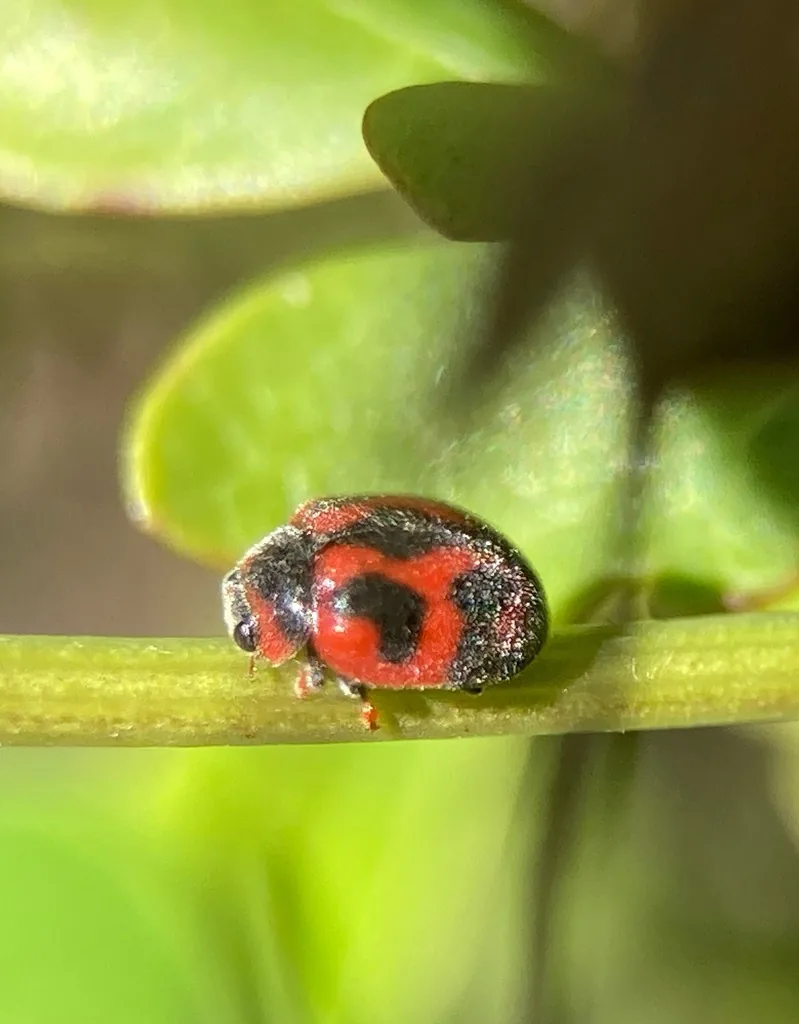
- Adults are about 1/8 inch (3 mm) long, oval and covered with fine hairs, irregularly marked in red and black.[1]
- Some individuals are mostly black and others mostly red, and the hairs can make them look grayish.[1]
- Eggs are red and oblong, easiest to see on the white egg sacs of cottony cushion scale.[1]
- Older larvae are dark pink to bluish gray with black bumps and grow to about 1/4 inch.[1]
Look-alikes
| Look-alike | How to tell them apart |
|---|---|
| Cottony cushion scale crawlers | Both are small, red and oblong, but scale crawlers have black legs and forward-pointing black antennae; young vedalia larvae have red legs and no obvious antennae.[1] |
Where it lives
Two related beetles, Novius cardinalis and N. koebelei, were brought to California from Australia in the 1880s; N. koebelei lacks the black stripe down the middle of the back. Vedalia is the key enemy of cottony cushion scale in Central Valley citrus.[1][2]
Biology and life cycle
Females lay several hundred eggs over a life of one to three months, and along the coast it can breed year-round.[1]
Egg to adult takes four to six weeks in warm weather, and it can finish four generations in the time cottony cushion scale completes one. Pupae are reddish and twitch when touched.[1][2]
Egg laying stops and larvae develop slowly when days top 90 degrees F.[1]
Damage and signs
- UC IPM says it feeds on mealybugs and scales that make egg sacs, especially cottony cushion scale; young larvae eat the eggs inside the sac, and older larvae and adults eat every stage.[1]
- Cottony cushion scale was a major citrus pest in the 1880s and still flares in citrus when the beetle is knocked out.[2][4]
Health risk
UC IPM describes it only as a scale predator, with no mention of any risk to people.[1]
Control
Biological control
Arriving in Central Valley citrus in March or April, adults can clear a serious infestation in four to six weeks if not disrupted.[1]
Pyrethroids, neonicotinoids and insect growth regulators are what usually set off scale outbreaks; some IGRs stop larvae from pupating or eggs from hatching, and in lab tests imidacloprid and cyfluthrin cut adult survival.[2][4]
Along the coast, a tiny parasitic fly, Cryptochaetum iceryae, does much of the work instead, and the two share middle areas.[1]
No commercial insectary sells vedalia, so if a grove has none, UC IPM suggests moving beetles in from an orchard that does. Controlling ants helps too.[2]
Common questions
- Why is the vedalia beetle famous?
- USDA ARS says its 1888-89 introduction under C. V. Riley saved California's young citrus industry from cottony cushion scale, one of the earliest classical biological control successes in the U.S.[3][2]
- What does it eat besides cottony cushion scale?
- UC IPM says it eats mealybugs and other scales that form egg sacs, though cottony cushion scale is its main prey.[1]
- Why did my vedalia beetles disappear in summer?
- Heat slows them: egg laying stops and larvae develop slowly once temperatures pass 90 degrees F.[1]
- When did vedalia arrive in California?
- Sources differ. USDA ARS dates the import to 1888-89 and UC IPM's natural enemies page to the 1880s, while UC IPM's citrus guidelines say the early 1890s.[3][1][2]
- Can I buy vedalia beetles?
- No. UC IPM says no commercial insectary rears them, so growers move beetles from another orchard.[2]
Sources
- University of California Statewide IPM Program, “Vedalia (Natural Enemies Gallery).” ipm.ucanr.edu/natural-enemies/vedalia/ (accessed 2026-11-13)
- UC Statewide IPM Program (UC IPM), “Cottony Cushion Scale (Citrus Pest Management Guidelines).” ipm.ucanr.edu/agriculture/citrus/cottony-cushion-scale/ (accessed 2026-11-13)
- USDA Agricultural Research Service, “Timeline of Insect Research.” www.ars.usda.gov/oc/timeline/insect/ (accessed 2026-11-13)
- Journal of Economic Entomology, 2003 (via PubMed), “Conserving vedalia beetle, Rodolia cardinalis (Mulsant) (Coleoptera: Coccinellidae), in citrus: a continuing challenge as new insecticides gain registration (abstract).” pubmed.ncbi.nlm.nih.gov/14650510/ (accessed 2026-11-13)
- Global Biodiversity Information Facility (GBIF), “Novius cardinalis (Mulsant, 1850) (GBIF Backbone Taxonomy).” api.gbif.org/v1/species/10952526 (accessed 2026-11-13)