On this page
How to identify it
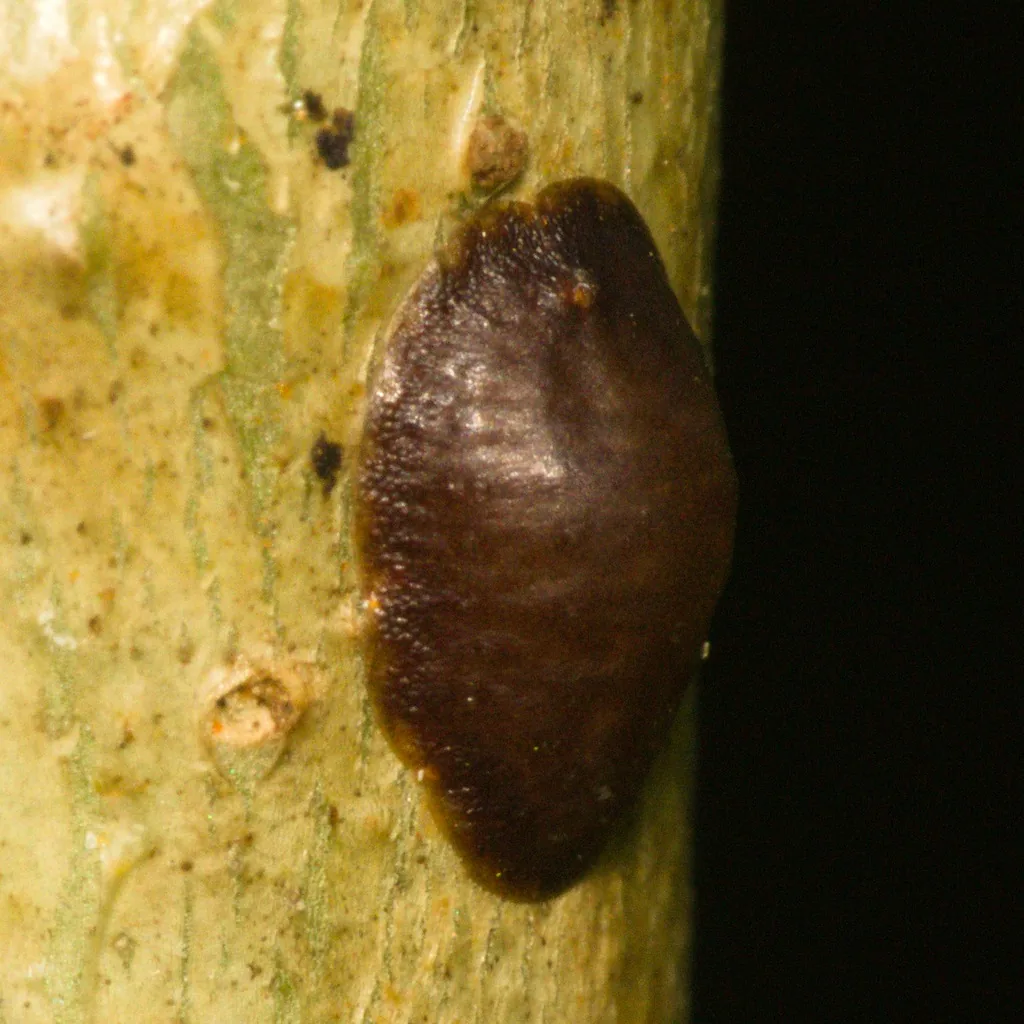
- Adult female elongate-oval, shiny and dark brown, 3 to 4 mm long; at maturity the back is strongly hardened and marked with a network of polygons, each with a minute pore at its center.[1]
- Shape depends on where it settles: scales on leaves are broad and only slightly convex, while those on stems or leaf midribs are elongate and much more convex.[1]
- Immature stages and young adults are translucent yellow and sometimes mottled, so a colony shows pale young scales beside dark mature females.[1]
- A soft scale (family Coccidae): the cover is the insect's own body wall and cannot be lifted off, and the insect excretes sticky honeydew on which blackish sooty mold grows.[3]
- Found on an unusually wide range of hosts, more than 80 plant families by one count and 101 in ScaleNet, including hibiscus, Ficus elastica and F. religiosa, oleander, avocado, mango, schefflera and ixora.[1][2]
Look-alikes
| Look-alike | How to tell them apart |
|---|---|
| Black scale (Saissetia oleae) | The soft scale UC IPM calls black scale; nigra scale shares the 'black scale' name in some catalogues but belongs to a different genus and is described as a shiny, elongate-oval, dark brown insect 3 to 4 mm long.[1][3] |
| Brown soft scale | Another common soft scale on indoor and landscape plants; UC IPM notes it has multiple generations with females and nymphs present year-round, whereas most soft scales have one generation a year.[3] |
| Other soft scales | UC IPM's soft scales grow up to 1/4 inch with a smooth, cottony or waxy surface and a cover that is the body wall itself; nigra scale is the shiny dark brown one whose shape changes with the plant part it settles on.[3][1] |
Where it lives
A cosmopolitan pest of the tropics and subtropics. ScaleNet lists 15 mainland states plus Hawaii, from Alabama, Florida and Texas to California, Kansas, New York and Washington; most U.S. GBIF records come from California and Florida, and worldwide GBIF records are most numerous in Australia.[1][2][7]
Biology and life cycle
Nigra scale is parthenogenetic, reproducing without males, cosmopolitan and polyphagous, feeding on plants from more than 80 families.[2]
Its life history, ecology and natural enemies were studied in California by Smith in 1944. In the laboratory it develops on squashes and sprouting potato tubers; on squash at 24 C (75 F) a generation takes 45 to 60 days. In Tamaulipas, Mexico, at least two complete generations a year were observed on mistletoe.[1]
Genetic analyses of mitochondrial and nuclear genes plus ecological niche modelling indicate that what is called P. nigra comprises at least two ecotypes that differ particularly in the temperatures and moisture they tolerate; some countries may hold only one, so introducing another lineage could expand the pest's range.[2]
Like other soft scales it feeds on phloem sap and excretes abundant honeydew. Natural enemies recorded on it include Metaphycus and Coccophagus parasitic wasps.[3][1]
Fun fact: there are no males. Nigra scale reproduces without mating, so a single scale can start a new colony.[2][5]
Damage and signs
- ScaleNet rates it a potential pest of litchi in Israel; its damage elsewhere is that of a honeydew-producing soft scale on ornamentals and fruit trees. Scales in large numbers can weaken a plant, slow its growth, yellow the leaves and cause premature leaf drop and dieback, and the honeydew, sooty mold and ants it attracts can be a nuisance even when the plant itself is not harmed.[1][3]
- The University of Hawaii says it attacks foliage, stems and fruit and may also attack roots. In southern China it is described as an important pest of rubber trees.[5][8]
Health risk
A plant-feeding scale insect; neither the catalogue nor UC IPM reports any risk to people or pets.[1][3]
Control
Prevention
Soft scales usually spread on infested plants, so inspect any new hibiscus, ficus or other host carefully before you bring it home or plant it.[5]
Sanitation
Inspect trunks for ants during the growing season and control honeydew-seeking ants, which protect scales from their natural enemies.[3]
Keep plants vigorous with suitable water, mulch and fertilizer, and prune, bag and throw away heavily infested branches. If the scales are heavily parasitized (look for tiny round exit holes), leave pruned branches on the ground for 3 to 4 weeks so the wasps and lady beetles can emerge.[5]
Traps and physical control
Wrap double-sided sticky tape around infested twigs in spring and change it weekly to catch crawlers; spray only after crawler numbers on the tape have peaked and begun to decline.[3]
Biological control
Many scales are well controlled by predators and parasitic wasps unless those natural enemies are disrupted by ants, dust or persistent broad-spectrum insecticides. Nigra scale's recorded enemies include Metaphycus and Coccophagus wasps; before spraying, check a sample of scales to see whether they are already dead or parasitized.[3][1]
Two parasitic wasps are well studied. In China Coccophagus japonicus is the dominant natural enemy of nigra scale, and in lab tests Metaphycus parasaissetiae parasitized it most efficiently at 30 C. In wet, humid weather insect-attacking fungi such as Verticillium and Paecilomyces also control soft scales, but they need relative humidity above 80 percent for 8 to 10 hours.[8][9][5]
Pesticides
A well-timed, thorough spray of horticultural (narrow-range) oil in the dormant season or soon after crawlers are active gives good control of most scales. Insecticidal soap, neem oil and other botanical oils are low-toxicity contact alternatives that need complete coverage of shoot terminals and leaf undersides, and may need repeating where the scale has more than one generation a year.[3]
For heavy infestations where natural control fails, the University of Hawaii says imidacloprid can be applied as a foliar spray, trunk injection or soil treatment; dinotefuran is available only to professional applicators. UC IPM adds that systemic insecticides are warranted mainly on large plants or hosts especially sensitive to scale damage, and that a plant damaged year after year may be better replaced with one suited to the site.[5][3]
Where sources disagree
Host range: Lin and colleagues say it feeds on plants from more than 80 families, ScaleNet counts 101 families and 297 genera, and EPPO rates Ficus benjamina, English ivy, Chinese hibiscus and herbaceous ornamentals as its major hosts.[2][1][6]
How many kinds there are: catalogues treat it as one species, but the 2017 genetic study found at least two ecologically different lineages, a temperate one and a subtropical-tropical one.[1][2]
Common questions
- How is nigra scale different from the black scale on my olive and citrus?
- Black scale (Saissetia oleae) is a different genus. Nigra scale is an elongate-oval, shiny dark brown soft scale 3 to 4 mm long that is flat on leaves and humped on stems; some catalogues also call it black scale, hibiscus scale or pomegranate scale, which causes the confusion.[1][3]
- Why does the same scale look flat on leaves and humped on stems?
- ScaleNet notes the body shape varies with the substrate: specimens on leaves are broad and only slightly convex, while those on stems or leaf midribs are elongate and much more convex.[1]
- Is one spray enough?
- Horticultural oil timed to the dormant season or to crawler activity controls most scales, but contact sprays need thorough coverage and may need repeating when a scale has more than one generation a year; in warm conditions nigra scale completed a generation in 45 to 60 days in laboratory tests.[3][1]
- Do I need to spray?
- Often not. Many soft scales are kept in check by parasitic wasps, lady beetles and fungi; check scales for exit holes before spraying, control ants, and save horticultural oil or a systemic product for heavy infestations.[5][3]
Sources
- ScaleNet (scale insect database begun at the USDA ARS Systematic Entomology Laboratory), “ScaleNet catalogue: Parasaissetia nigra (Nietner, 1861).” scalenet.info/catalogue/Parasaissetia%20nigra/ (accessed 2026-11-12)
- PLoS One, abstract via PubMed, “Species delimitation in asexual insects of economic importance: the case of black scale (Parasaissetia nigra), a cosmopolitan parthenogenetic pest scale insect (Lin et al. 2017, PLoS One 12(4):e0175889; PubMed 28459805).” doi.org/10.1371/journal.pone.0175889 (accessed 2026-11-12)
- University of California Statewide IPM Program, “Pest Notes: Scales (UC ANR Publication 7408).” ipm.ucanr.edu/home-and-landscape/scales/ (accessed 2026-11-12)
- iNaturalist, “Parasaissetia nigra taxon page (order and family).” www.inaturalist.org/taxa/330206 (accessed 2026-11-12)
- University of Hawaii at Manoa, College of Tropical Agriculture and Human Resources, “Hawai'i Landscape Plant Pest Guide: Sucking Insects (IP-36).” www3.ctahr.hawaii.edu/oc/freepubs/pdf/IP-36.pdf (accessed 2026-11-12)
- EPPO Global Database, “Parasaissetia nigra (SAISNI): host plants.” gd.eppo.int/taxon/SAISNI/hosts (accessed 2026-11-12)
- Global Biodiversity Information Facility (GBIF), “Parasaissetia nigra: occurrence records.” www.gbif.org/species/8198400 (accessed 2026-11-12). State and country counts from the GBIF occurrence API, read 2026-11-12.
- Insects 15(10), 2024 (Sun et al.), via PubMed, “Effects of high-temperature stress on biological characteristics of Coccophagus japonicus Compere.” pubmed.ncbi.nlm.nih.gov/39452377/ (accessed 2026-11-12). Cited from the PubMed abstract.
- Ying Yong Sheng Tai Xue Bao 21(8), 2010 (Zhang et al.), via PubMed, “Control effect of parasitic Metaphycus parasaissetiae on host Parasaissetia nigra.” pubmed.ncbi.nlm.nih.gov/21043131/ (accessed 2026-11-12). Cited from the English PubMed abstract.