On this page
How to identify it
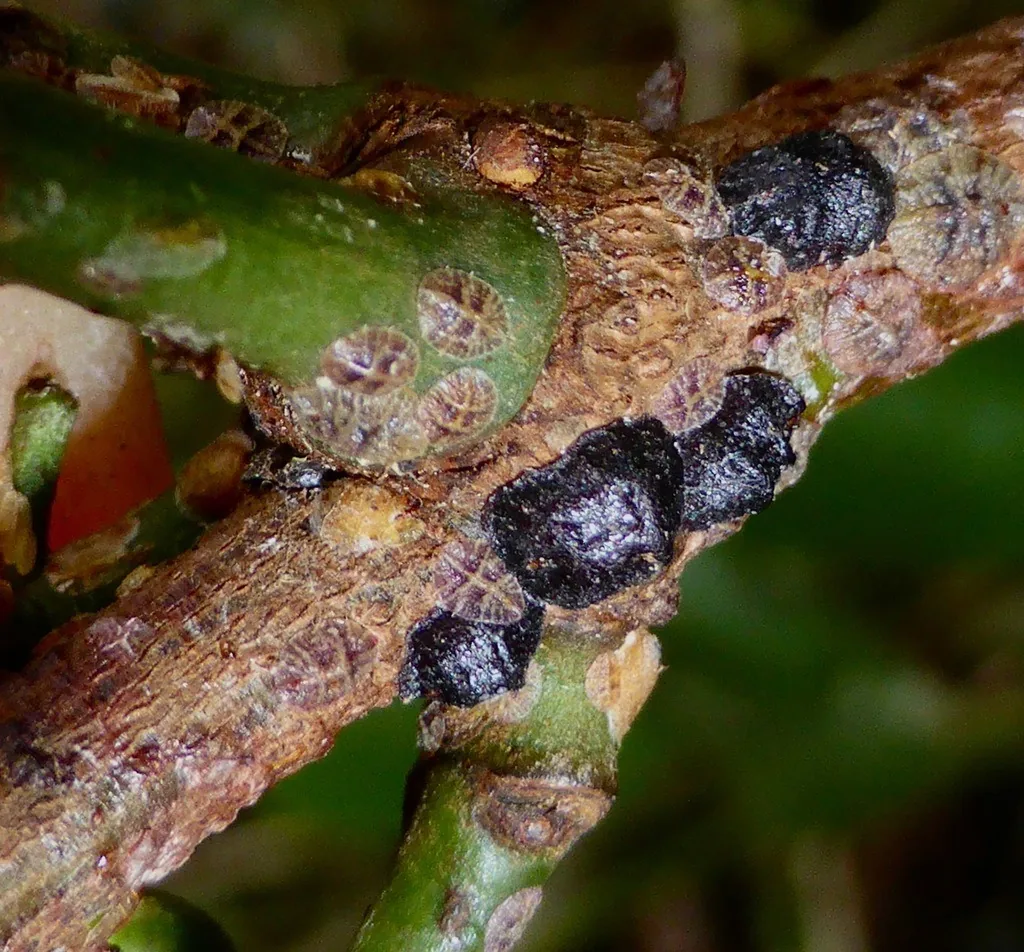
- Adult females are dark brown to black and dome-shaped with a raised H on the back. UC IPM says up to 1/5 inch long; Queensland's government describes them as about 2 mm across.[1][3]
- Crawlers are tiny (1/64 inch), pale yellow to light brown, and settle along leaf veins before moving to twigs.[1][3]
- Infestations bring sticky honeydew and black sooty mold.[1]
- Before egg laying, the swelling third-stage nymph is called the rubber stage: ash gray to brown, 1/16 to 1/5 inch, already showing the H.[1]
Look-alikes
| Look-alike | How to tell them apart |
|---|---|
| Cottony cushion scale | A different scale with a white fluted egg sac rather than a dark H-ridged shell.[1][2] |
Where it lives
Native to southern Africa and in California since before 1880, it occurs across the southern and western US, Mexico and Central America. Olive and citrus are its main crops, and it also takes oleander, privet, rose, pistachio, gardenia and many others.[1][3]
Biology and life cycle
California's coast sees two generations a year; inland valleys usually get one, sometimes with a partial second.[1][4]
Males have never been recorded in California. Each female can lay over 2,000 eggs under her body, and they turn from pale yellow to orange.[1]
It favors the coast and dense, unpruned parts of trees, where young scales escape heat and dry air; open trees rarely support much of it.[1][4]
Ants tend the scale for honeydew and drive off its natural enemies.[1][3]
Damage and signs
Health risk
It feeds on plants; neither UC IPM nor the Queensland Government lists any risk to people.[1][3]
Control
Traps and physical control
Pruning is the best cultural control: open up dense canopies so young scales lose the cool, humid shelter they need, and cut out infested branches. Small numbers can be scraped or crushed by hand.[1][4]
Keep ants off with sticky barriers around trunks, and prune branches that bridge to other plants so ants can't get around the barrier.[1]
Biological control
Parasitic wasps such as Scutellista caerulea and Metaphycus helvolus control it in coastal and northern California, though not in the southern San Joaquin Valley; round exit holes in scales show they're at work.[1][4]
The mealybug ladybird Cryptolaemus montrouzieri feeds on it and can be bought and released in spring and summer. It's often already present but is easily killed by harsh insecticides.[3]
Pesticides
UC IPM says few home gardeners in most of California ever need to spray. If numbers are high and parasitism low, narrow-range oil works on crawlers but not on rubber-stage or adult scales; test it on a few leaves first. Broad-spectrum insecticides disrupt the parasites that keep it in check.[1][4]
Research on new natural enemies
In Moroccan lab and screenhouse trials, the predatory mite Amblyseius swirskii cut black scale egg and nymph numbers sharply, and the authors call it promising for olive IPM. That's experimental work, not yet a field recommendation.[5]
Common questions
- What is the black, H-marked scale on my olive tree?
- It's black scale; the H-shaped ridge on the female is its trademark.[1]
- When does oil work best?
- Only during the crawler stage; once scales reach the rubber stage or adulthood, oil doesn't work. Check honeydew and crawler activity before deciding to spray at all.[1][4]
- Do ants make black scale worse?
- Yes. Ants farm the honeydew and chase away the wasps and beetles that eat or parasitize the scale, so keeping ants off the plant helps.[3][1]
Sources
- University of California Statewide IPM Program, “Pest Notes: Black Scale (Publication 74160).” ipm.ucanr.edu/PMG/PESTNOTES/pn74160.html (accessed 2026-11-12)
- University of California Statewide IPM Program, “Pest Notes: Cottony Cushion Scale (Publication 7410).” ipm.ucanr.edu/PMG/PESTNOTES/pn7410.html (accessed 2026-11-12)
- Business Queensland, Queensland Government, “Black scale.” www.business.qld.gov.au/industries/farms-fishing-forestry/agriculture/biosecurity/plants/insects/horticultural/black-scale (accessed 2026-11-12)
- UC Statewide IPM Program (UC IPM), “Black Scale (Olive Pest Management Guidelines).” ipm.ucanr.edu/agriculture/olive/black-scale/ (accessed 2026-11-12)
- Bulletin of Entomological Research, 2026 (via PubMed), “Predation efficiency of Amblyseius swirskii Athias-Henriot (Acari: Phytoseiidae) against Saissetia oleae (Oliver) (Hemiptera: Coccidae) for sustainable biological control in olive cultivation (abstract).” pubmed.ncbi.nlm.nih.gov/41414794/ (accessed 2026-11-12)
- Global Biodiversity Information Facility (GBIF), “Saissetia oleae (Olivier, 1791) (GBIF Backbone Taxonomy).” api.gbif.org/v1/species/9078997 (accessed 2026-11-12)