On this page
How to identify it
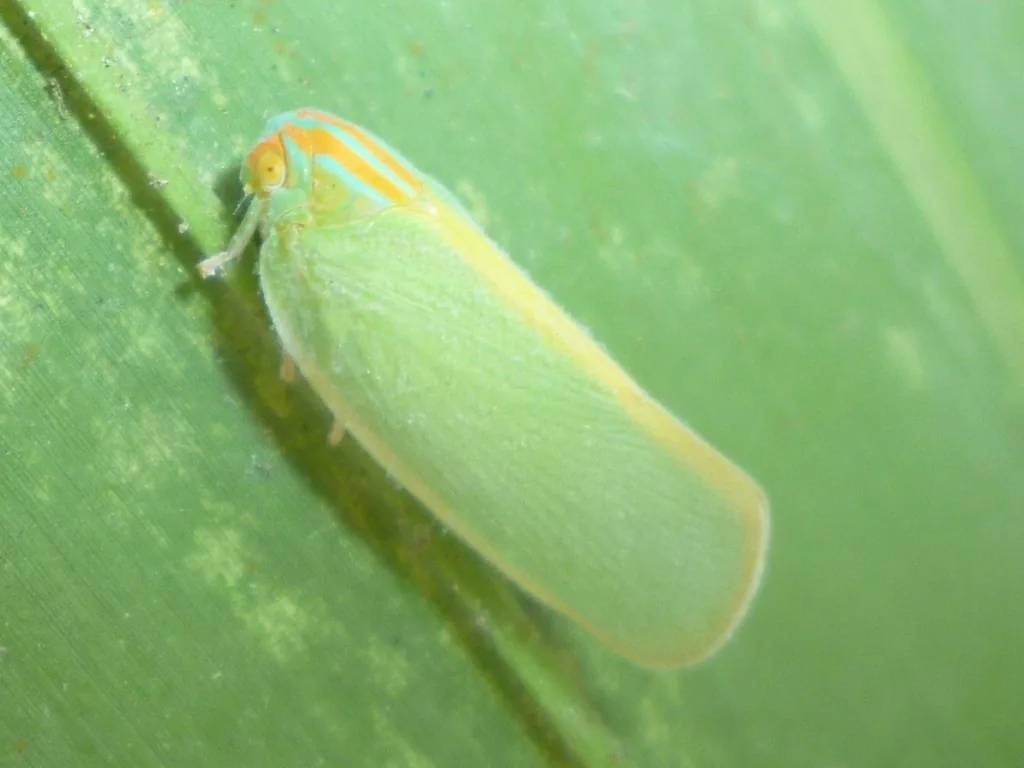
- Adults are about 11 mm (just under 1/2 inch) long and flattened from side to side. The ground color is blue-green, with two lengthwise reddish stripes on top of the thorax, two orange patches on the face, and orange-yellow along the rear edge of the folded forewings. UF/IFAS says their triangular, side-flattened shape makes them look like tiny colorful sailboats, and the compound eyes are orange.[1][3]
- Nymphs are green with faint orange stripes and trail silky white filaments from the abdomen. They sit scattered or in small groups, partly hidden under flocculent white wax. UF/IFAS says no other insect of similar appearance is known on palms in Florida.[1][3]
- Adults are reluctant to fly; disturbed, they jump and fly off in a swift, erratic path, usually landing back on the same or a nearby leaf.[1]
Look-alikes
| Look-alike | How to tell them apart |
|---|---|
| Northern flatid planthopper and other pale green planthoppers | Several flatid and acanaloniid planthoppers in Florida are also pale green and flattened from side to side, but only the palm flatid has the reddish stripes. Ormenoides venusta can show faint orange marks but is usually 2-4 mm shorter. UF/IFAS adds that no other species of similar appearance is known to occur on palms in Florida, and very few flatids occur on palms anywhere.[1][3] |
| Citrus flatid planthopper | The citrus flatid planthopper has a waxy coating that makes it look gray or tan, with two or more dark spots near the base of the wing, and feeds on a wide variety of plants rather than mainly palms.[4] |
Where it lives
Southeastern Georgia, peninsular Florida and Cuba, with only one unconfirmed Florida Panhandle record in the state's files; the University of Delaware planthopper project also lists Jamaica. GBIF's US records since 1990 come mostly from Florida, with smaller numbers from Georgia and South Carolina and a few from Alabama. UF/IFAS says it may be present, though unrecorded, wherever cabbage palmetto grows, perhaps from the Gulf Coast to Louisiana and up the Atlantic Coast through the Carolinas. It has been intercepted in California on nursery plants from Florida but is not known to be established there.[1][2][5][3]
Biology and life cycle
Fan-leaved palms are the preferred hosts. In Florida it has been taken on cabbage palm, scrub palmetto, saw palmetto, Chinese fan palm, Washington palm, Pritchardia fan palms, silver latania and Canary Island date palm, and probably others.[1][2]
Both nymphs and adults prefer the underside of the leaf. Nymphs feed in the valleys of the folded fan leaf, while adults cling to the ridges and the tough leaf stalks.[1]
Individuals tend to gather; one observer in Miami counted 50 adults on a single Pritchardia leaf. A 1961 study recorded soft sounds (timbal vibrations) from Miami specimens, which they use to communicate. UF/IFAS reports a more recent unpublished count of 238 nymphs and 162 adults on a single frond of Sabal maritima.[1][3]
Florida's 1965 circular reports nymphs usually in late April and May, adults common from mid or late May through most of July, and few records after that; it notes there may be more than one brood a year but precise information is lacking.[1]
Collectors find it by searching palms, and it sometimes comes to lights.[2]
UF/IFAS says it completes one generation a year. The eggs have not been seen but are probably inserted into palm tissue in late summer and hatch in January; first instar nymphs appear on cabbage palmetto by the second week of January, and in southern Florida adults appear as early as May.[3]
UF/IFAS says nymphs pass through five instars, growing from about 1.4 mm to about 4.7 mm. By summer only adults remain, and neither stage is on palms in late summer.[3]
UF/IFAS says both stages prefer older, more horizontal fronds. The natural hosts are probably cabbage palmetto and saw palmetto; all recorded palm hosts have fan-shaped fronds, and one Broward County record came from croton.[3]
Damage and signs
- Injury to the palm is slight and usually not visible. The white, waxy fluff the nymphs produce is unsightly and may bother growers.[1]
- It is being studied as a possible disease carrier. It is one of three planthoppers suspected of spreading the phytoplasma behind Texas Phoenix palm decline, and specimens have screened positive for Candidatus Phytoplasma palmae; the University of Delaware's planthopper project lists it as possibly a disease vector.[6][2]
- UF/IFAS says populations usually number no more than several per frond, but dense ones draw a lot of sap: heavily infested fronds turn sticky with honeydew and carry thick crusts of sooty mold.[3]
Health risk
It feeds only on plant sap. Florida's Division of Plant Industry and the University of Delaware planthopper project describe palm feeding only and mention no risk to people.[1][2]
Control
Prevention
Control is usually not necessary. If the wax is a problem on a prized palm, have the insect identified first; the insecticide advice in Florida's 1965 circular is out of date, so ask your county extension office for current options and follow the label. UF/IFAS says populations are generally sparse and the insect has not been considered economically important enough to justify research on chemical controls.[1][3]
Check the undersides of fronds, especially on fan palms and palmettos, for the green, orange-striped nymphs and their cottony wax.[1]
Traps and physical control
UF/IFAS says that when a few specimen palms become heavily infested, it may be possible to remove the insects with simple physical means such as a strong water spray.[3]
Where sources disagree
Where it lives: Florida's circular lists southeastern Georgia, peninsular Florida and Cuba, while the University of Delaware planthopper project adds Jamaica, and GBIF also holds a few US records from South Carolina and Alabama.[1][2][5]
Life cycle timing: UF/IFAS says there is one generation a year, with nymphs on palms from January and adults as early as May, while Florida's 1965 circular reports nymphs usually in late April and May and says there may be more than one brood a year.[3][1]
Common questions
- What are the blue-green insects under my palm fronds?
- Likely palm flatid planthoppers, which are blue-green with reddish stripes on the thorax and gather on the undersides of fan palm and palmetto leaves.[1]
- What is the white cottony stuff on my palm leaves?
- If it sits on the underside of the frond with small green, orange-striped insects under it, it is the waxy fluff of palm flatid planthopper nymphs.[1]
- Should I spray my palm for flatid planthoppers?
- Usually not. Florida's Division of Plant Industry says control usually is not necessary because injury to the palm is slight.[1]
- Can I just hose them off?
- For a few heavily infested specimen palms, yes. UF/IFAS says simple physical means such as a strong water spray may get rid of them, and control is seldom needed otherwise.[3]
Sources
- Florida Department of Agriculture and Consumer Services, Division of Plant Industry, “Ormenaria rufifascia (Walker), a planthopper pest of palms, Entomology Circular No. 37 (F. W. Mead, June 1965; copy hosted by the Florida State Collection of Arthropods).” thefsca.org/wp-content/uploads/2025/10/ent037.pdf (accessed 2026-11-14)
- University of Delaware, Department of Entomology and Wildlife Ecology (C. R. Bartlett), “Genus Ormenaria Metcalf and Bruner, 1948 (Planthoppers of North America).” sites.udel.edu/planthoppers/north-america/north-american-flatidae/genus-ormenaria-metcalf-and-bruner-1948/ (accessed 2026-11-11)
- University of Florida IFAS Extension (EDIS), “Flatid Planthopper, Ormenaria rufifascia (Walker), EENY351/IN643 (Featured Creatures; F. Howard and S. E. Halbert).” ask.ifas.ufl.edu/publication/IN643 (accessed 2026-11-14)
- Missouri Department of Conservation, “Citrus Flatid Planthopper, Field Guide.” mdc.mo.gov/discover-nature/field-guide/citrus-flatid-planthopper (accessed 2026-11-11)
- Global Biodiversity Information Facility (GBIF), “Ormenaria rufifascia: US occurrence records since 1990 by state (GBIF occurrence search API).” api.gbif.org/v1/occurrence/search?taxonKey=2069178&country=US&hasGeospatialIssue=false&occurrenceStatus=PRESENT&year=1990%2C2026&facet=stateProvince&facetLimit=400&limit=0 (accessed 2026-11-11)
- Current Microbiology, via PubMed, “Bacterial community composition of three candidate insect vectors of palm phytoplasma (Texas Phoenix Palm Decline and Lethal Yellowing) (Powell et al. 2015).” pubmed.ncbi.nlm.nih.gov/25298076/ (accessed 2026-11-11)
- iNaturalist, “Ormenaria rufifascia taxon page (order and family).” www.inaturalist.org/taxa/179705 (accessed 2026-11-11)