On this page
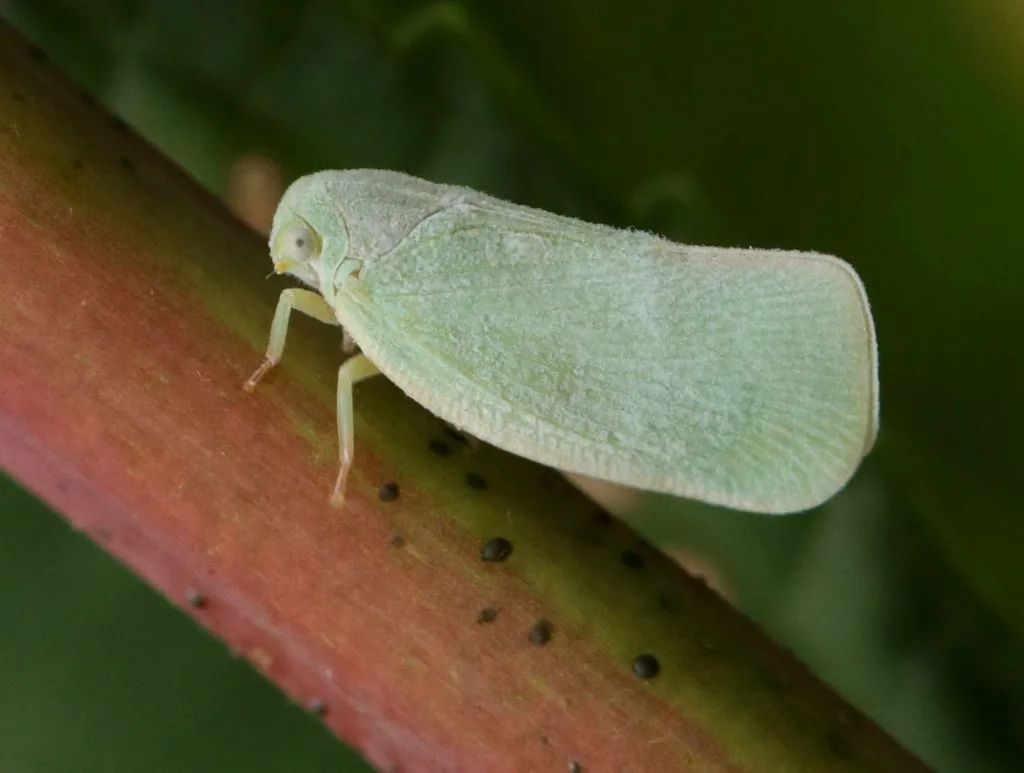
How to identify it
- Adult color is described differently. NC State calls the adults snowy white; a Delaware planthopper key describes the green-bodied Flatormenis of that region as having wings slightly longer than wide and squared off at the tip.[1][3]
- Planthoppers in general are small jumping insects whose antennae sit low on the sides of the face, below the eyes; the Missouri Department of Conservation says most species are under 1/2 inch.[2]
- Nymphs cover themselves in white, fluffy wax that can hide the insect completely and stays on leaves and stems after the nymph moves or the adult emerges.[1][2]
- Touch the fluff and a nymph often jumps several inches, which mealybugs, woolly aphids and soft scales never do.[1]
Look-alikes
| Look-alike | How to tell them apart |
|---|---|
| Citrus flatid planthopper | In the Delaware key, the citrus flatid planthopper (Metcalfa pruinosa) has a gray to blackish body and one row of small cells along the wing margin, while the green Flatormenis has a green body and two rows.[3] |
| Mealybugs | Mealybugs also wear white wax but crawl slowly or not at all when disturbed; planthopper nymphs jump.[1] |
Where it lives
NC State reports nymphs from April on the coastal plain through June at higher elevations. GBIF holds more than 12,000 U.S. records since 1990, most of them from Virginia, Maryland, North Carolina and Massachusetts.[1][4]
Biology and life cycle
Eggs spend the winter inserted in a zipper-like row in the bark of the current year's growth of a woody host, often a tree such as black walnut.[1]
Nymphs hatch in spring, from April on the coastal plain to June at higher elevations, and often drop to understory plants to feed.[1]
Development from egg to adult takes about 178 days; adults live several weeks and are out from late June to late September, and there is one generation a year.[1]
Like other planthoppers it drinks plant sap through strawlike mouthparts, and it excretes honeydew as it feeds.[2][1]
Damage and signs
- NC State says it does little real damage to crape myrtle, gardenia, azalea and other woody ornamentals. The Delaware survey found the green Flatormenis there on a variety of host plants.[1][3]
- If it became extremely abundant, sooty mold growing on its honeydew could darken the host plant.[1]
- Some other planthoppers spread plant viruses, but NC State says this has not been documented for the snowy planthopper.[1][2]
Health risk
It feeds only on plant sap; none of the sources reports any harm to people or pets.[1][2]
Control
Prevention
Avoid high rates of nitrogen fertilizer, which favor planthoppers.[1]
Biological control
Tiny dryinid wasps and spiders attack it. Unless the planthoppers are extremely abundant, NC State advises no control, since most insecticides also harm beneficial insects.[1]
Pesticides
If they are causing noticeable damage, NC State says they should be susceptible to most contact insecticides sold for home gardens, and no resistance has been shown. Read and follow the label.[1]
A name in flux
NC State notes that older papers call this insect Anormenis septentrionalis.[1]
The 2011 Delaware planthopper survey instead files the insects reported under that name as Flatormenis chloris, a species it found among the five most common planthoppers in its samples. Until the names settle, older reports may use any of these names.[3]
Natural enemies and lanternfly biocontrol
Dryinid wasps and spiders prey on snowy planthoppers.[1]
When scientists tested Anastatus orientalis, an egg parasitoid being studied against the invasive spotted lanternfly, against native insects from the eastern United States, the wasps did not develop in any of the northern flatid planthopper egg masses offered, though those eggs were older than most in the test.[5]
Planthoppers in turn feed praying mantises, assassin bugs, spiders and other predators.[2]
Common questions
- What is the white fluff on my shrub that jumps?
- Most likely a planthopper nymph, such as the northern flatid planthopper, hiding under the wax it secretes; mealybugs and scales don't jump.[1][2]
- Will snowy planthoppers kill my plants?
- Rarely. NC State says they do little real damage; only in very large numbers might honeydew and sooty mold darken the plant.[1]
Sources
- NC State Extension, “Snowy Planthopper (PDIC Factsheet).” content.ces.ncsu.edu/snowy-planthopper-4 (accessed 2026-11-11)
- Missouri Department of Conservation, “Planthoppers (Field Guide).” mdc.mo.gov/discover-nature/field-guide/planthoppers (accessed 2026-11-11)
- ZooKeys, via PubMed Central, “Planthoppers of Delaware (Hemiptera, Fulgoroidea), excluding Delphacidae, with species incidence from adjacent states (Bartlett, Adams and Gonzon 2011).” pmc.ncbi.nlm.nih.gov/articles/PMC3082965/ (accessed 2026-11-11). PMID 21594086
- Global Biodiversity Information Facility (GBIF), “Flatormenis proxima: U.S. occurrence records since 1990 by state (GBIF occurrence search).” api.gbif.org/v1/occurrence/search?taxonKey=8052787&country=US&hasGeospatialIssue=false&occurrenceStatus=PRESENT&year=1990%2C2026&facet=stateProvince&facetLimit=400&limit=0 (accessed 2026-11-11)
- Frontiers in Insect Science, via PubMed Central, “Assessing the host range of Anastatus orientalis, an egg parasitoid of spotted lanternfly, using eastern U.S. non-target species (Broadley et al. 2023).” pmc.ncbi.nlm.nih.gov/articles/PMC10926408/ (accessed 2026-11-11). PMID 38469478
- iNaturalist, “Flatormenis proxima taxon page (order and family).” www.inaturalist.org/taxa/415285 (accessed 2026-10-06)