On this page
How to identify it
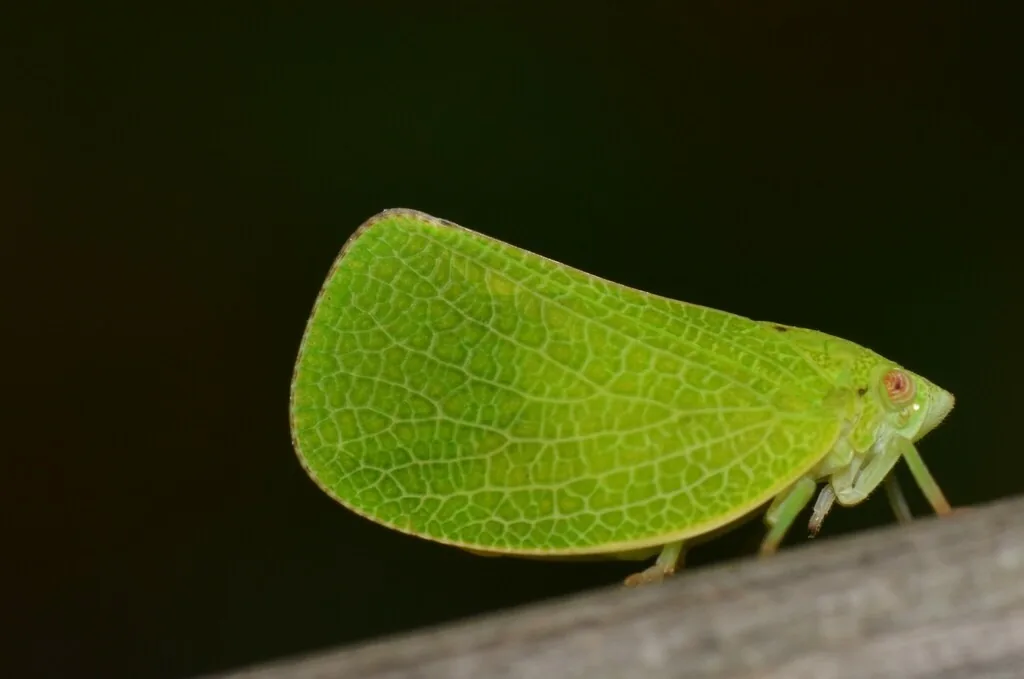
- Adults hide on plants by day, camouflaged by color and texture: snugged against a stem, one looks a lot like a seed pod, leaf, bract or stipule. They are bright green (occasionally pink), less than half an inch long, flattened from side to side, with triangular forewings bearing a network of veins.[3][2]
- Like other planthoppers, it has antennae set low on the sides of the head, below the eyes, with two thick basal segments and a thin bristle at the tip.[4]
- Its head comes to a point: in the University of Delaware's key, Acanalonia conica is the U.S. exception to the usual blunt or rounded head of its genus, and its hind legs lack side spines.[5]
- Nymphs look like tiny toads, mottled gray and humped, and often secrete so much white, fluffy wax that they disappear under it.[1]
- A disturbed nymph often jumps 12 to 18 inches.[1]
Look-alikes
| Look-alike | How to tell them apart |
|---|---|
| Leafhoppers, treehoppers and spittlebugs | MDC separates planthoppers from these relatives: treehoppers have an enlarged shield behind the head that covers the abdomen, leafhoppers have rows of small spines on the hind shins, and spittlebugs have only one or two stout spines there. The University of Delaware's key shows the hind shin of this species without side spines.[4][5] |
| Flatid planthoppers | The University of Arkansas Arthropod Museum says it looks very much like some flatid planthoppers but lacks the parallel veins along the leading edge of the forewing that mark that family. Nymphs of both families sometimes feed together in mixed groups.[2][1] |
Where it lives
Native to North America: the University of Arkansas Arthropod Museum gives its range as New England to Florida and west to Nebraska and Texas, and the University of Delaware notes its family is absent from the northwestern U.S. except for recent reports of this species. GBIF's U.S. records since 1990 are densest in Maryland, Ohio, Virginia, North Carolina and Pennsylvania. It has been introduced into Europe, where the University of Delaware says it is becoming widespread, citing first records from Italy (2004), Romania (2017) and, in 2024, Alsace in France and the Netherlands.[2][5][6]
Biology and life cycle
It feeds on many kinds of herbs, shrubs and trees, sucking sap through straw-like mouthparts. The University of Wisconsin-Milwaukee Field Station lists basswood, wild grape, catnip, goldenrod, milkweeds and ginseng among its food plants, and the University of Arkansas adds grasses.[1][3][2]
There is one generation a year, the same as in other acanaloniids that have been studied. Eggs are produced in late summer and early autumn; females use a sword-shaped egg-layer to insert them into bark or other woody tissue, where they spend the winter, and they hatch the following spring.[1][5][2]
Nymphs feed through the bark of twigs and stems, and development can take more than 300 days. They sometimes feed in mixed groups with other planthopper nymphs.[1]
Its enemies include dryinid wasps, whose larvae develop inside the nymphs and kill them, Leptus mites, and a caterpillar, Epipyrops barberiana, that feeds on nymphs and adults. The wax may help shield nymphs from dryinid wasps.[1]
Fun fact: the wax is not just a disguise. In a 2024 high-speed video study of another planthopper's nymphs, drag on the wax 'tails' kept them from tumbling in midair: nymphs with wax landed on their feet 98.5% of the time, but only 35.5% of the time with the wax removed.[7]
Damage and signs
- Direct feeding does not seem to harm the health of most ornamental plants.[1]
- Like other planthoppers it excretes sticky honeydew, and sooty mold fungi can grow on it and darken leaves and stems; the mold does not infect the plant.[1]
- Planthoppers have been reported as pests of ginseng, a crop whose appearance matters to buyers. In Europe, where this species was recently introduced, NC State says it is considered a greater threat than in North Carolina, and the University of Arkansas and University of Wisconsin-Milwaukee both note concern that it may become a pest there.[1][2][3]
- The University of Arkansas Arthropod Museum says populations are usually small and unable to seriously damage their host plants.[2]
Health risk
NC State calls it virtually harmless, and none of the sources (NC State, MDC, the University of Arkansas, the University of Wisconsin-Milwaukee) mentions any bite, sting or other risk to people.[1][4][2][3]
Control
Prevention
Usually no control is needed. It does relatively little damage to ornamentals, and few planthoppers are pests of landscape plants.[1][4]
Traps and physical control
If the nymphs bother you, first try knocking them off with a stream of water from a garden hose.[1]
Biological control
Natural enemies, including dryinid wasps, Leptus mites and a predatory caterpillar, attack the nymphs.[1]
Pesticides
NC State considers resistance unlikely, so any insecticide labeled for home landscape use should give adequate control if treatment is truly needed.[1]
Common questions
- What is the white fluff on my shrub's twigs?
- It may be green cone-headed planthopper nymphs, which can secrete enough white, fluffy wax to hide completely. The fluff may help protect them from predators such as dryinid wasps.[1]
- Will green cone-headed planthoppers hurt my plants?
- Rarely. Their feeding does not seem to harm most ornamentals, though sooty mold can grow on the honeydew they excrete.[1]
- How long does a planthopper take to grow up?
- Eggs laid in bark hatch the next spring, and development may take more than 300 days; there is one generation a year.[1]
- Why is it called a planthopper?
- Because it hops: a disturbed nymph often jumps 12 to 18 inches.[1]
- Is the white fluff on my shrub woolly aphids?
- It may not be. The University of Wisconsin-Milwaukee Field Station notes that from a distance a group of these planthopper nymphs can look like woolly aphids, so look twice, and wax strands often stay on branches after the nymphs grow up and leave.[3]
Sources
- NC State Extension, “Green Coneheaded Planthopper (PDIC factsheet, J. Baker; published 2015, reviewed 2019).” content.ces.ncsu.edu/green-coneheaded-planthopper (accessed 2026-11-12)
- University of Arkansas Arthropod Museum, “Green coneheaded planthopper.” arthropod.uark.edu/coneheaded-planthopper/ (accessed 2026-11-12)
- University of Wisconsin-Milwaukee Field Station, “Acanalonia Planthoppers (Family Acanaloniidae) (Bug of the Week).” uwm.edu/field-station/bug-of-the-week/acanalonia-planthoppers/ (accessed 2026-11-12)
- Missouri Department of Conservation, “Planthoppers (Field Guide).” mdc.mo.gov/discover-nature/field-guide/planthoppers (accessed 2026-11-12)
- University of Delaware, Planthoppers of North America, “North American Acanaloniidae.” sites.udel.edu/planthoppers/north-america/north-american-acanaloniidae/ (accessed 2026-11-12)
- Global Biodiversity Information Facility (GBIF), “Acanalonia conica: U.S. occurrence records since 1990 by state (GBIF occurrence search).” api.gbif.org/v1/occurrence/search?taxonKey=2064632&country=US&hasGeospatialIssue=false&occurrenceStatus=PRESENT&year=1990%2C2026&facet=stateProvince&facetLimit=400&limit=0 (accessed 2026-11-12)
- Integr Comp Biol 2024;64(2):619-631, via PubMed, “Wax "Tails" Enable Planthopper Nymphs to Self-Right Midair and Land on Their Feet.” pubmed.ncbi.nlm.nih.gov/38982316/ (accessed 2026-11-12)
- iNaturalist, “Acanalonia conica taxon page (order and family).” www.inaturalist.org/taxa/84806 (accessed 2026-11-09)