On this page
How to identify it
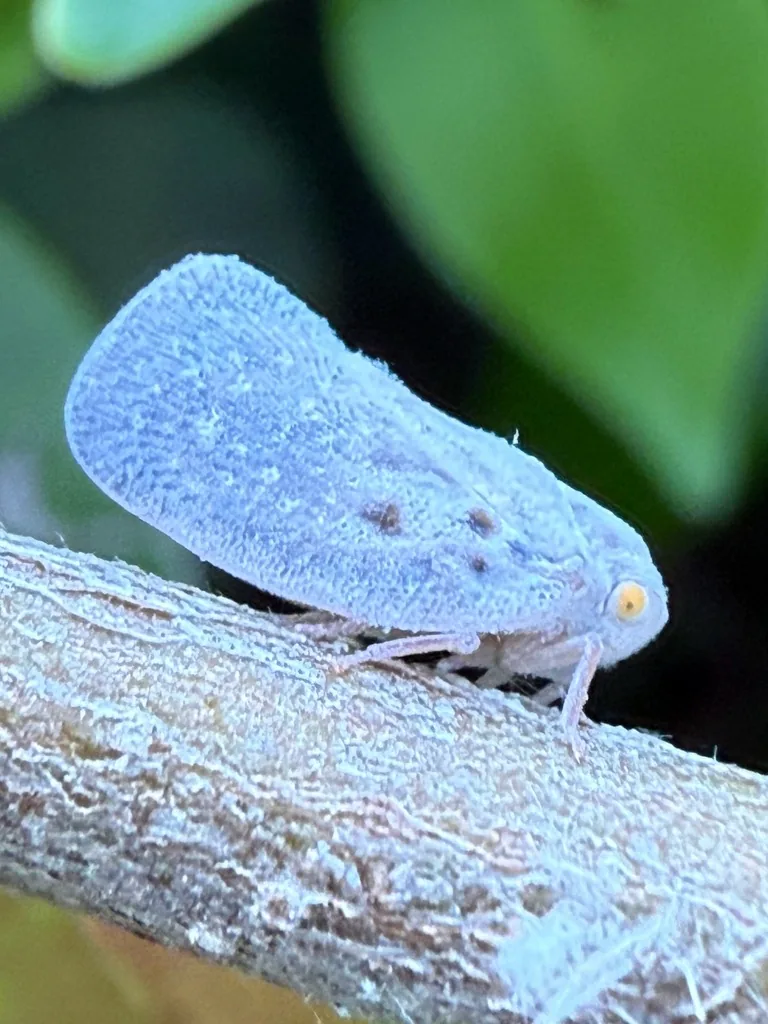
- Adults are about 1/4 inch long and dark bluish-black under a white waxy bloom that makes them look whitish, bluish-white, gray or tan. The eyes are orange or reddish, and there are two or more dark spots near the base of the wing.[1][2]
- Flatid planthoppers hold their large, angular front wings upright against the body, so from above they look wedge-shaped and flattened from side to side.[3]
- Nymphs are wide, flat and pale green with red eyes, grow to 3/16 inch, and wrap themselves and the stem in a thick nest of fluffy white wax.[1][3]
- Adults and nymphs jump when disturbed; NC State says nymphs can leap 12 to 18 inches.[1][3]
Look-alikes
Where it lives
Native to North America. GBIF lists about 17,100 US records since 1990 from more than 35 states, most from Texas and the eastern half of the country and only a handful from Colorado and Utah; a 2024 climate model ranks the eastern United States among the best-suited regions for it worldwide. It has also spread to southern Europe and Korea.[2][4][7][5]
Biology and life cycle
Females insert eggs into the bark of the current year's growth, where they spend the winter. Nymphs hatch in spring and summer and suck sap from bark and leaves; adults appear in summer, a little over 5 months after the egg was laid. There is one generation a year in the Carolinas.[1][3]
Nymphs molt five times before becoming adults.[3]
In Korea, where it is an invader, many newly hatched nymphs drop from the trees where eggs overwintered and move to other host plants.[5]
Damage and signs
- It feeds on a wide range of trees, shrubs, vines and herbaceous plants and is commonly reported on shrubs in North Carolina.[1][2]
- The wax and the honeydew it excretes make plants sticky and unsightly, and sooty mold can grow on the honeydew.[1]
- It seldom injures healthy plants in its native North America; NC State says it is rarely numerous enough to kill twigs, and Clemson calls it mainly a cosmetic problem that lasts about a month.[2][1][3]
Health risk
It feeds on plant sap; none of the sources describes any risk to people or pets.[1][2][3]
Control
Traps and physical control
Knock nymphs and adults off with a strong stream of water from the hose.[1]
Or rub them off gently by hand, or simply wait a few weeks; Clemson says they leave without a trace.[3]
Biological control
In Europe, where it is an invasive pest, the parasitic wasp Neodryinus typhlocybae was introduced against it and has been effective.[6]
Pesticides
No insecticide is labeled specifically for planthoppers, but NC State says contact insecticides such as pyrethroids applied for other labeled pests should suppress them. Pyrethroids are toxic to fish, so keep them away from pools, ponds and streams. Follow the label.[1]
Where sources disagree
Pest or nuisance? In North America, NC State, MDC and Clemson describe it as a minor, mostly cosmetic insect. In southern Europe and Korea, where it was introduced, it damages orchards, vineyards, crops and landscape plants.[1][2][3][5]
Common questions
- What is the white fluffy stuff on my shrub twigs?
- Often citrus flatid planthopper nymphs under their wax. If the fluff hides tiny insects that jump when you touch the stem, they are planthoppers rather than mealybugs.[1][3]
- Are flatid planthoppers harmful?
- Rarely to healthy plants in North America. Mostly they make plants sticky and unsightly for a few weeks.[2][1][3]
- How do I get rid of them?
- Hose them off or rub them off; they usually disappear on their own within a few weeks.[1][3]
Sources
- NC State Extension, “Citrus Flatid Planthopper (PDIC Factsheet).” content.ces.ncsu.edu/citrus-flatid-planthopper (accessed 2026-11-11)
- Missouri Department of Conservation, “Citrus Flatid Planthopper, Field Guide.” mdc.mo.gov/discover-nature/field-guide/citrus-flatid-planthopper (accessed 2026-11-11)
- Clemson Cooperative Extension Home & Garden Information Center, “Question of the Week: Planthopper.” hgic.clemson.edu/question-of-the-week-planthopper/ (accessed 2026-11-11)
- Journal of Insect Science, via PubMed, “Predicting suitable areas for Metcalfa pruinosa under climate change and implications for management (Zhao et al. 2024).” pubmed.ncbi.nlm.nih.gov/38717262/ (accessed 2026-11-11)
- Insects, via PubMed, “Egg hatching and first instar falling models of Metcalfa pruinosa (Kim et al. 2020).” pubmed.ncbi.nlm.nih.gov/32503226/ (accessed 2026-11-11)
- Heliyon, via PubMed, “Phenology model development for Neodryinus typhlocybae and its synchrony with Metcalfa pruinosa (Baek et al. 2024).” pubmed.ncbi.nlm.nih.gov/38434306/ (accessed 2026-11-11)
- Global Biodiversity Information Facility (GBIF), “Metcalfa pruinosa: US occurrence records since 1990 by state (GBIF occurrence search API).” api.gbif.org/v1/occurrence/search?taxonKey=2068870&country=US&hasGeospatialIssue=false&occurrenceStatus=PRESENT&year=1990%2C2026&facet=stateProvince&facetLimit=400&limit=0 (accessed 2026-11-11)
- iNaturalist, “Metcalfa pruinosa taxon page (order and family).” www.inaturalist.org/taxa/126209 (accessed 2026-11-11)