On this page
How to identify it
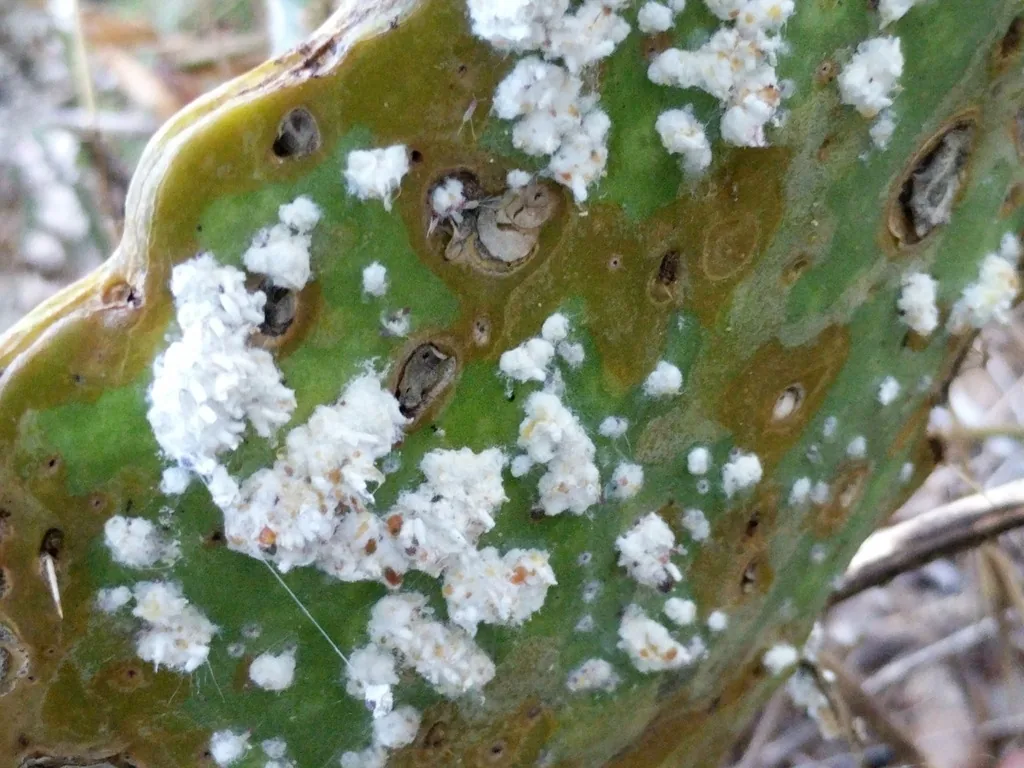
- Look for conspicuous white, cottony masses of wax on the pads. Scrape some off with a knife and crush it on paper: a deep red smear means cochineal.[1]
- The wax shelters the immobile females, which make the red pigment, and their egg masses. Young crawlers move about before settling and spinning their own wax. A UF/IFAS Extension article says the wingless females make the white wax for sun protection and the carminic acid as a defense against predators.[1][2]
Where it lives
Cochineal is native to the Americas, where it lives on prickly pear, and it often colonizes prickly pear in Arizona landscapes. GBIF has about 1,200 U.S. records of the genus since 1990, mostly from Florida, Texas, Colorado, California, New Mexico and Arizona; many records outside the U.S. come from Spain, South Africa and Australia. GBIF has only one U.S. record of Dactylopius coccus. UF/IFAS Gardening Solutions lists cochineal among the insects that can disfigure prickly pear grown in Florida.[1][3][4][5][6]
Biology and life cycle
Eggs hatch into crawlers that feed for about three weeks before settling and becoming immobile; the crawler stage is when the insects spread from one cactus to another. Warmer areas have several generations a year.[1]
In a central Mexico prickly pear plantation, wild cochineal (Dactylopius opuntiae) was most abundant in summer and fall and least abundant in spring.[7]
Six predators were found feeding on it there. The most active were a moth, Laetilia coccidivora, and a lady beetle, Hyperaspis trifurcata, and their numbers rose and fell with the cochineal.[7]
Damage and signs
- Sources differ on how much harm it does. University of Arizona Extension says the damage to prickly pear is usually negligible, though a heavily colonized plant can decline. UC IPM lists prickly pear (Opuntia and Nopalea) as susceptible to severe decline and death, and other cacti as usually not damaged.[1][8]
- Wild cochineal is one of the main pests in prickly pear plantations in central Mexico.[7]
- The Aztecs used cochineal for dye and paint. It is still produced in Mexico and India as carmine, a red color for foods, drinks, cosmetics and artists' paints. UF/IFAS adds that Spain kept the source of the dye secret for 200 years, that it became Spain's second most valuable export after silver, and that it colored the British Army's red coats. It takes 70,000 insects to make one pound of dye, and most of the world's commercial supply now comes from Peru.[1][2]
Health risk
The extension sources describe only the insect's effect on the plant and mention no risk from the insects themselves. Carmine dye made from them can cause allergic reactions in a few people, including anaphylaxis: in one clinic study about 3 percent of patients tested for food-additive allergy reacted to carmine on a skin test.[1][9][10]
Control
Prevention
Don't overwater. UF/IFAS Gardening Solutions says prickly pear does best in poor, sandy, well-drained soil and full sun; in moist, rich soil growth turns soft, and scale, mealybugs and cochineal insects, along with root and stem rot, can occur when the plants are overwatered.[6]
Sanitation
If a plant is badly colonized and declining, prune off the worst pads at the joints and throw them away.[1]
Traps and physical control
Blast colonies with a strong stream of water from a high-pressure hose nozzle to expose and weaken the insects.[1]
Biological control
Predators can keep cochineal in check. In the Mexican plantation, which had gone without insecticides since 2000, predator numbers rose with cochineal numbers, and the researchers concluded the pest was likely being held in check naturally.[7]
Pesticides
After hosing, spray the exposed insects with insecticidal soap, which does less harm to beneficial insects. For scales on smaller plants in general, UC IPM suggests a well-timed horticultural oil spray when crawlers are active.[1][8]
Common questions
- What is the white stuff on my prickly pear cactus?
- Usually cochineal scale insects hiding in wax. Crush a tuft on paper: a deep red stain confirms it.[1]
- Will cochineal scale kill my prickly pear?
- Sources differ. University of Arizona Extension says damage is usually negligible, while UC IPM lists severe decline and death on prickly pear. Check heavily colonized plants and treat if they start to decline.[1][8]
- Is carmine dye really made from these insects?
- Yes. Carmine, also called carminic acid, is a red dye made from cochineal and used in foods, drinks and cosmetics.[1]
- Why does my prickly pear keep getting cochineal?
- Too much water may be part of it. UF/IFAS Gardening Solutions says cochineal, scale and mealybugs can occur when prickly pear is overwatered, and the plant does best in sandy, well-drained soil in full sun.[6]
Sources
- University of Arizona Cooperative Extension, Yavapai County, “Cochineal Scale (adapted from Backyard Gardener by J. Schalau; June 18, 2024).” extension.arizona.edu/sites/extension.arizona.edu/files/attachment/CochinealScale.pdf (accessed 2026-11-14)
- University of Florida/IFAS Extension Lake County, “Independence Day & Prickly Pear Cactus (M. Quirico, July 20, 2026).” blogs.ifas.ufl.edu/lakeco/2026/07/20/red-dye-sourced-through-the-cochineal-mealy-bugs/ (accessed 2026-11-14)
- Global Biodiversity Information Facility (GBIF), “Dactylopius (genus): U.S. occurrence records since 1990 by state (GBIF occurrence search).” api.gbif.org/v1/occurrence/search?taxonKey=2082235&country=US&hasGeospatialIssue=false&occurrenceStatus=PRESENT&year=1990%2C2026&facet=stateProvince&facetLimit=400&limit=0 (accessed 2026-11-14). Exact count at access: 1,240 U.S. records since 1990 (Florida 534; Texas 228; Colorado 131; California 85; New Mexico 64; Arizona 39).
- Global Biodiversity Information Facility (GBIF), “Dactylopius (genus): occurrence records since 1990 by country (GBIF occurrence search).” api.gbif.org/v1/occurrence/search?taxonKey=2082235&hasGeospatialIssue=false&occurrenceStatus=PRESENT&year=1990%2C2026&facet=country&limit=0 (accessed 2026-11-14). Exact counts at access: 3,081 records since 1990; United States 1,240, Spain 905, South Africa 232, Australia 200, Mexico 77.
- Global Biodiversity Information Facility (GBIF), “Dactylopius coccus: occurrence records since 1990 by country (GBIF occurrence search).” api.gbif.org/v1/occurrence/search?taxonKey=2090105&hasGeospatialIssue=false&occurrenceStatus=PRESENT&year=1990%2C2026&facet=country&limit=0 (accessed 2026-11-14). Exact counts at access: 366 records since 1990; Spain 169, Ecuador 72, Peru 56, Portugal 37, Bolivia 14, Mexico 10, United States 1 (New Mexico).
- University of Florida/IFAS Extension, “Prickly Pear (Gardening Solutions).” gardeningsolutions.ifas.ufl.edu/plants/ornamentals/prickly-pear/ (accessed 2026-11-14)
- Environmental Entomology, via PubMed, “Autonomous Biological Control of Dactylopius opuntiae in a Prickly Pear Plantation With Ecological Management (Cruz-Rodríguez et al. 2016).” pubmed.ncbi.nlm.nih.gov/27055467/ (accessed 2026-11-14)
- University of California Statewide IPM Program, “Scales (Pest Notes, Table 3: scales in other families).” ipm.ucanr.edu/home-and-landscape/scales/ (accessed 2026-11-14)
- Annals of Allergy, Asthma & Immunology, via PubMed, “Popsicle-induced anaphylaxis due to carmine dye allergy (Baldwin, Chou and Solomon 1997).” pubmed.ncbi.nlm.nih.gov/9396973/ (accessed 2026-11-14)
- International Archives of Allergy and Immunology, via PubMed, “Allergy to carmine red (E120) is not dependent on concurrent mite allergy (Liippo and Lammintausta 2009).” pubmed.ncbi.nlm.nih.gov/19439984/ (accessed 2026-11-14)
- iNaturalist, “Dactylopius taxon page (order and family).” www.inaturalist.org/taxa/202091 (accessed 2026-11-14)