On this page
How to identify it
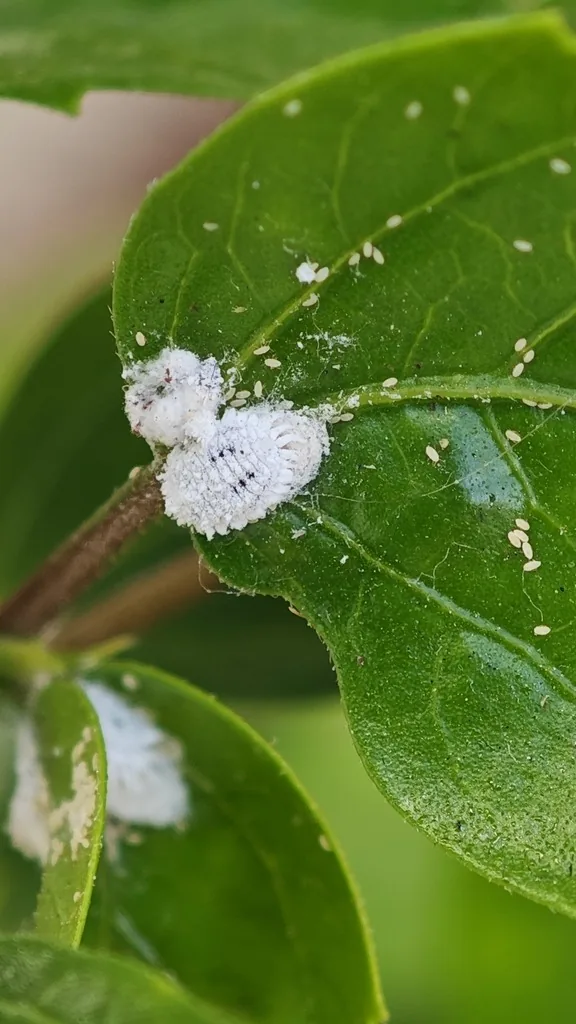
- Adult females are about 2.5 mm (roughly 1/10 inch) long and covered in white mealy wax, usually with patches of dark gray skin showing through where the wax is missing: three pairs along the abdomen and one pair on the thorax. A fringe of 18 pairs of short waxy filaments runs around the edge.[1][4]
- Appearance varies a lot. Some populations, including ones in California, lack the dark spots, which makes accurate identification a challenge.[1]
- Females lay their eggs into a cottony, sticky egg sac attached to the end of the body; males are tiny winged insects that live only a day or two.[4]
Where it lives
ScaleNet lists it from 20 U.S. states and the District of Columbia, from Florida and Texas to California, Washington, Michigan and New York; GBIF holds only 32 U.S. records since 1990, from Texas, Hawaii, California, Florida and Louisiana. EFSA calls it native to North America and says it has spread to every continent except Antarctica, with recent reports from Cyprus, Greece and Italy. A 2021 review counts more than 43 countries and dates the first records in Pakistan and India to 2005, and it was first reported in China in 2008.[1][5][6][2][7]
Biology and life cycle
It usually lives above ground on stems and leaves but also turns up on roots and in fire ant nests. Fire ants and other ants tend it for honeydew and in return guard it from parasites and predators.[1][4]
On hibiscus, a Chinese study found it failed to complete development at 15 or 35 °C (59 or 95 °F) and did best at 27.5 °C (81.5 °F) and 45 percent humidity. A 2021 review notes that warm temperatures mean more generations a year, and Pacific Pests says a female can lay up to 500 eggs over a life of about 3 months.[7][2][4]
Crawlers spread on wind and rain, on clothing and machinery, and even on birds and other insects, while long-distance spread comes with nursery stock.[4]
Damage and signs
- Since at least 2005 it has seriously damaged cotton across Sindh and Punjab in Pakistan and in northwestern India, and a 2021 review says it causes considerable cotton losses in China, India and Pakistan.[1][2]
- In Israel, outbreaks have badly damaged ornamental plants, mainly hibiscus hedges in residential neighborhoods, and it has become a serious pest in some cotton fields and in pepper and tomato greenhouses.[1]
- On garden and crop plants, heavy infestations stunt growth and distort leaves, which yellow and fall, flowers and fruit drop, and the honeydew turns leaves and stems black with sooty mold. Pacific Pests says cotton losses in Pakistan and India were put at 14 percent in 2005.[4]
Health risk
ScaleNet, Pacific Pests and UC IPM describe it only as a plant pest and don't mention bites or any risk to people or pets.[1][4][3]
Control
Prevention
Most mealybug problems arrive on new plants. Inspect hibiscus, tomatoes, peppers and other new plants before you bring them home and discard infested ones. EFSA names plants for planting as the main way it reaches new areas, and Pacific Pests says long-distance spread comes with nursery stock.[3][6][4]
Sanitation
Prune out infested leaves and stems and burn or bury them when you first see mealybugs, remove weeds that can harbor them (parthenium is a key weed host in India), and clear crop remains after harvest.[4][1]
Traps and physical control
Knock back exposed colonies with a strong stream of water, repeated every few days as needed.[3]
Biological control
Parasitic wasps, especially Aenasius bambawalei in India, attack it, and the mealybug destroyer lady beetle (Cryptolaemus montrouzieri) and lacewing larvae eat eggs and crawlers. Ants tending the mealybugs cut parasitism, so control ants on the plants.[1][4][3]
Pesticides
Insecticidal soap, horticultural oil or neem oil sprayed directly on young mealybugs can reduce numbers; the waxy coat and hiding habit make contact sprays less effective on adults. Avoid broad-spectrum insecticides that kill the natural enemies. On farms, a 2021 review says insecticides are the main control, resistance to common insecticides is increasing, and biological control has strong potential against the young stages.[3][4][2]
Where the sources disagree
How many host plants: ScaleNet lists hosts in 246 genera and 69 families; Pacific Pests says over 200 hosts in more than 50 families; EFSA says about 300 plant species; a 2017 distribution study says plants of about 60 families.[1][4][6][8]
How far it has spread: EFSA says every continent except Antarctica; a 2021 review counts more than 43 countries; GBIF's U.S. records since 1990 come from only five states, while ScaleNet lists 20 states and DC.[6][2][5][1]
Common questions
- How can I recognize cotton mealybug?
- Look for white, mealy mealybugs with paired dark gray patches where the wax is missing, three pairs on the abdomen and one on the thorax. Some populations lack the spots, so identification can be difficult.[1]
- Is cotton mealybug a problem in the United States?
- It has been recorded in 20 states, but the severe outbreaks described in the sources are in Pakistan, India and China and in Israel.[1][2]
- How do I get rid of cotton mealybugs on my hibiscus?
- Prune out the worst shoots, hose off exposed colonies with a strong stream of water every few days, keep ants off the plant, and spray insecticidal soap, horticultural oil or neem on the young mealybugs. Avoid broad-spectrum insecticides that kill lady beetles and parasitic wasps.[3][4]
Sources
- ScaleNet (scale insect database begun at the USDA ARS Systematic Entomology Laboratory), “ScaleNet catalogue: Phenacoccus solenopsis Tinsley.” scalenet.info/catalogue/Phenacoccus%20solenopsis/ (accessed 2026-11-13)
- Pest Manag Sci 2021;77(12):5321-5333, via PubMed, “Biology, ecology, and management of cotton mealybug Phenacoccus solenopsis Tinsley (Hemiptera: Pseudococcidae).” pubmed.ncbi.nlm.nih.gov/34312983/ (accessed 2026-11-13)
- University of California Statewide IPM Program, “Mealybugs (Pest Notes, Home and Landscape).” ipm.ucanr.edu/home-and-landscape/mealybugs/ (accessed 2026-11-13)
- Pacific Pests, Pathogens & Weeds (University of Queensland and the Pacific Community), “Cotton mealybug, Fact Sheet 373 (Pacific Pests, Pathogens & Weeds).” apps.lucidcentral.org/ppp/text/web_full/entities/cotton_mealybug_373.htm (accessed 2026-11-13)
- Global Biodiversity Information Facility (GBIF), “Phenacoccus solenopsis: U.S. occurrence records since 1990 by state (GBIF occurrence search).” api.gbif.org/v1/occurrence/search?taxonKey=2096154&country=US&hasGeospatialIssue=false&occurrenceStatus=PRESENT&year=1990%2C2026&facet=stateProvince&facetLimit=400&limit=0 (accessed 2026-11-13)
- EFSA J 2021;19(8):e06801, via PubMed, “Pest categorisation of Phenacoccus solenopsis (EFSA Panel on Plant Health).” pubmed.ncbi.nlm.nih.gov/34429782/ (accessed 2026-11-13)
- Environ Entomol 2015;44(4):1230-1239, via PubMed, “Temperature- and Relative Humidity-Dependent Life History Traits of Phenacoccus solenopsis (Hemiptera: Pseudococcidae) on Hibiscus rosa-sinensis (Malvales: Malvaceae).” pubmed.ncbi.nlm.nih.gov/26314069/ (accessed 2026-11-13)
- PLoS One 2017;12(7):e0180913, via PubMed, “Niche shifts and the potential distribution of Phenacoccus solenopsis (Hemiptera: Pseudococcidae) under climate change.” pubmed.ncbi.nlm.nih.gov/28700721/ (accessed 2026-11-13)
- Global Biodiversity Information Facility (GBIF), “Phenacoccus solenopsis Tinsley, 1898 (GBIF Backbone Taxonomy).” api.gbif.org/v1/species/2096154 (accessed 2026-11-13)
- iNaturalist, “Phenacoccus solenopsis taxon page (order and family).” www.inaturalist.org/taxa/330250 (accessed 2026-11-09)