On this page
How to identify it
- Caterpillars range from light green, or green with white and black side lines, to brown or velvety black with fine pale markings; NC State describes five color forms. Grown caterpillars are about 1 1/4 inches long according to NC State and 1 1/2 inches according to Mississippi State.[1][2]
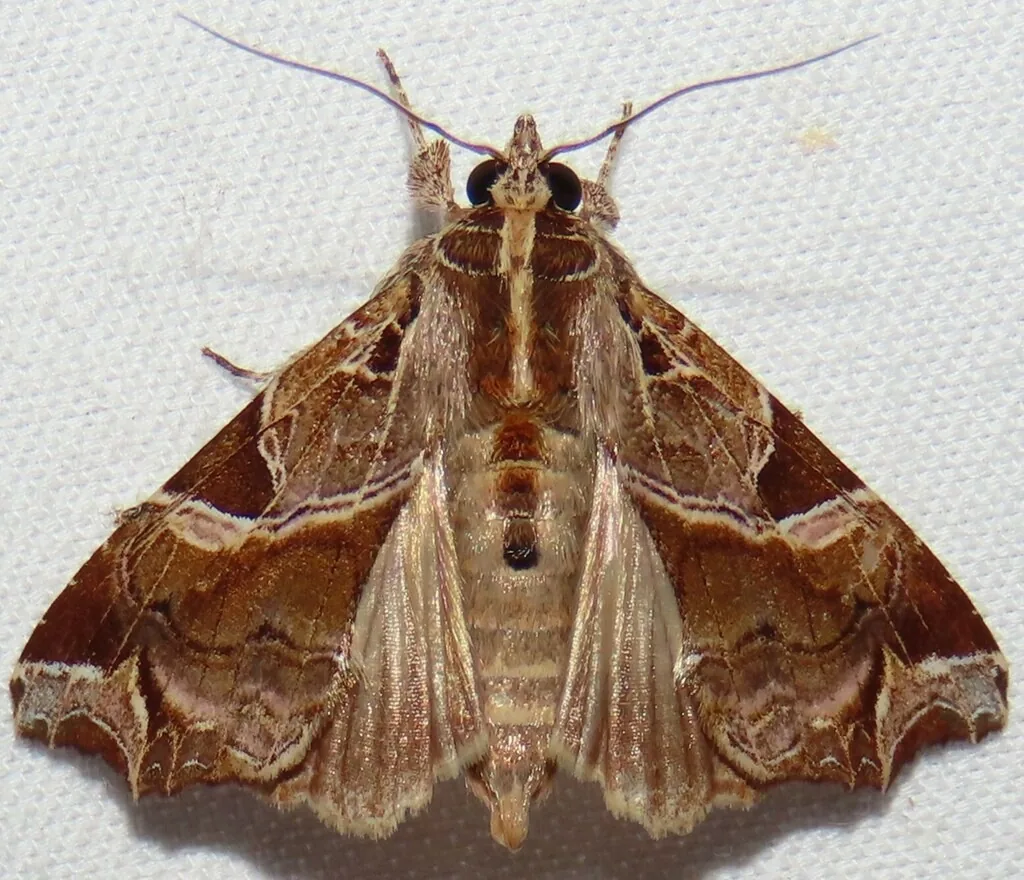
- The moth is brownish with variegated, slightly ragged forewings with a dark reddish-brown triangle, and a wingspan just over 1 inch.[1]
- Pupae are reddish brown and about 3/4 inch long, inside a cocoon usually covered with soil and bits of leaf.[1]
Where it lives
Mississippi State says it's native to Florida and other tropical areas but can turn up in greenhouses farther north, and that infestations in homes usually arrive on ferns that were already infested when bought.[2]
Biology and life cycle
Eggs are laid singly under fern leaflets near the tips. NC State cites one study in which females averaged about 465 eggs each, and says eggs hatch in 5 to 7 days.[1]
Young caterpillars feed at night on tender leaflets; older ones hide on stems at the base of the plant or in the soil by day. They mature in about 36 days and pupate on the soil surface, and moths emerge 12 to 16 days later, or almost 4 weeks in cool weather.[1]
Damage and signs
- NC State says it feeds mainly on ferns, at least 14 species, including maidenhair, Boston and other sword ferns, holly fern, table and silver ferns and rabbit's foot fern, plus asparagus fern. Mississippi State says it's especially common on Boston and Kimberly Queen ferns.[1][2]
- Infested ferns look tattered, with droppings collecting underneath. Several caterpillars can severely damage a plant, and Mississippi State says infestations heavy enough to need treatment are not uncommon in commercial greenhouses.[1][2]
Health risk
No cited source describes a health risk specific to this caterpillar. MedlinePlus says most caterpillars are harmless, but some cause allergic reactions through contact with their hairs, and brightly colored caterpillars with spines, bristles or a fuzzy look might be venomous and shouldn't be touched. For an exposure, the Poison Help line is 1-800-222-1222.[3]
Control
Traps and physical control
Pick off or shake out caterpillars. NC State says shaking a fern dislodges many of them; Mississippi State says the larger dark ones are easy to spot but newly hatched ones are easy to miss, so hand-picking won't get them all.[1][2]
Biological control
Mississippi State says Bt products are slower acting and usually somewhat less effective than spinosad but can still work; choose a Bt labeled for caterpillars, since mosquito strains don't work on them.[2]
Pesticides
Sources differ on how to treat. Mississippi State recommends spinosad sprays, sold for home use by brands such as Fertilome, GreenLight, Bonide and Monterey, repeated at weekly intervals with good coverage of the lower interior fronds. NC State says ferns are sensitive to many pesticides, especially liquids, and prefers an insecticide dust once droppings appear under a fern. Follow the label.[2][1]
Common questions
- What is eating my hanging Boston fern at night?
- Often Florida fern caterpillars, which feed at night and hide at the base of the plant by day; look for droppings under the fern.[1][2]
- Are Florida fern caterpillars dangerous to touch?
- No cited source describes a health risk from this species specifically. MedlinePlus says most caterpillars are harmless but some cause allergic reactions through their hairs, and advises not touching brightly colored caterpillars with spines, bristles or a fuzzy look.[3]
Sources
- NC State Extension, “Florida Fern Caterpillar (PDIC Factsheet).” content.ces.ncsu.edu/florida-fern-caterpillar-1 (accessed 2026-11-13)
- Mississippi State University Extension (Bug's Eye View), “Florida Fern Caterpillar (Bug's Eye View, Vol. 3, No. 24, 2017).” extension.msstate.edu/newsletters/bugs-eye-view/2017/florida-fern-caterpillar-vol-3-no-24 (accessed 2026-11-13)
- U.S. National Library of Medicine (MedlinePlus), “Caterpillars (MedlinePlus Medical Encyclopedia).” medlineplus.gov/ency/article/002860.htm (accessed 2026-11-13)
- Global Biodiversity Information Facility (GBIF), “Callopistria floridensis Guenée, 1852 (GBIF Backbone Taxonomy).” api.gbif.org/v1/species/5108665 (accessed 2026-11-13)