On this page
How to identify it
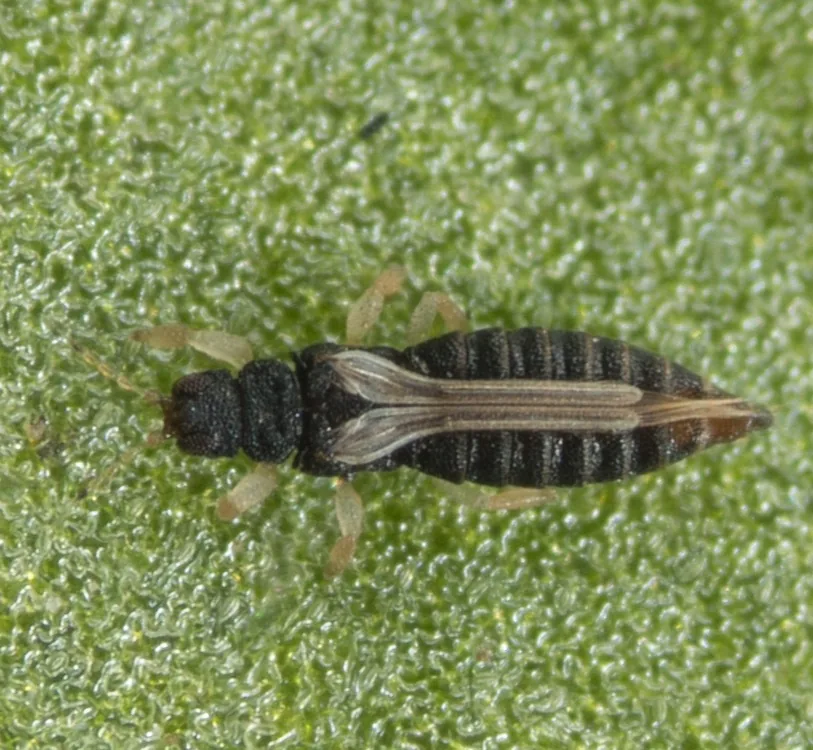
- Adults are about 1/16 inch long and dark brown to black, with a lighter tail end, pale narrow wings and pale legs.[1][4]
- Larvae are white to yellowish with red eyes and often carry a dark droplet of liquid excrement at the tip of the abdomen; dropped droplets leave the black specks that give infestations away.[1][3][4]
- All stages are sluggish and adults seldom fly. Colonies feed in groups, usually on leaf undersides and where leaves and fruit touch, and spread slowly.[1][2][3]
Look-alikes
| Look-alike | How to tell them apart |
|---|---|
| Western flower thrips | Another common landscape thrips. Greenhouse thrips feed almost entirely on foliage and fruit, and their pupae stay out in the open on the leaves instead of dropping to the soil.[1][2] |
| Black hunter thrips | A predatory thrips, dark brown or black with a long abdomen and white wings. It is much more active than the similar-looking greenhouse thrips, and it eats other thrips.[2][4] |
Where it lives
Spread worldwide; in North America it is the only Heliothrips species present. Outdoors in the U.S. it is a pest of coastal Southern California avocado and citrus and of Florida citrus, and it breeds year-round in greenhouses. NC State also covers it as a greenhouse pest in North Carolina.[5][3][4][6][1]
Biology and life cycle
Females reproduce without mating; males are rarely found, and none are known in California. Eggs are inserted singly into leaves or fruit, and each egg raises a small blister you can see with a hand lens.[1][3][4]
There are two larval stages and two non-feeding stages (prepupa and pupa) that stay among the feeding colony on the leaves.[1][4]
Along the Southern California coast there are about five to six generations a year, and all stages can be found year-round; in greenhouses they breed all year.[3][4][1]
They favor moderate, humid coastal conditions. Freezing weather, temperatures above 100 degrees F and hot, dry winds cause heavy losses, especially when they last several days.[4]
Damage and signs
- Over 100 hosts include croton, azalea, begonia, cyclamen, ferns, fuchsia, orchids, palms, rose, viburnum and grape, along with avocado and citrus.[1][3]
- Leaves turn silvery or bleached, then yellow and drop if damage is severe; both leaves and fruit get dark spots of excrement.[1][3]
- On avocado and citrus, feeding where fruits touch each other or a leaf leaves pale, then brownish, hardened or spotted patches that get fruit downgraded. Leaf damage on avocado is unsightly but doesn't affect tree health.[3][4]
- In Florida citrus it is one of four thrips considered economic pests.[6]
Health risk
None of the sources here reports any risk to people or pets; it is a plant pest.[1][2]
Control
Traps and physical control
Check leaf undersides regularly. Infestations start in one part of the plant and spread slowly, so pruning off early colonies can work.[2]
Biological control
Natural enemies include the egg parasite Megaphragma mymaripenne, which kills about 25 to 50 percent of eggs in coastal avocado, and the larval parasite Thripobius semiluteus, which turns parasitized larvae black and swollen around the head.[3][2][4]
NC State notes the predators Orius insidiosus and Neoseiulus cucumeris are sold for thrips control; choose sprays that spare natural enemies.[1][2]
Pesticides
Thoroughly spray the undersides of infested leaves with horticultural oil, insecticidal soap or pyrethrins; repeat applications may be needed, because eggs inside the leaf survive and can hatch up to two weeks later. Spinosad may work better.[2][1]
NC State lists imidacloprid as a systemic option that lasts long enough to kill larvae hatching after the first spray.[1]
Where sources disagree
Eggs: NC State says each female inserts 25 to 50 eggs and eggs take 17 to 20 days under optimum conditions; UC IPM says a female can lay up to 60 eggs, hatching in about 4 to 5 weeks in summer and longer in winter.[1][3]
Color: NC State describes adults as dark brown with yellow legs; UC IPM as black with white legs and wings.[1][3]
Predatory mites: NC State lists Neoseiulus cucumeris among predators sold for thrips control, but in a 2026 lab study on avocado it ate almost no greenhouse thrips larvae, while Amblydromalus limonicus ate first-instar larvae readily.[1][7]
Thripobius: UC IPM's citrus guide calls it the only effective natural enemy known, and its avocado guide says releases have controlled greenhouse thrips, but natural control by it is inconsistent and the parasite is no longer, or may not currently be, sold by commercial insectaries.[4][3]
Common questions
- What are the tiny black dots on my croton leaves?
- Often excrement from greenhouse thrips feeding on the leaves; the larvae carry it as a dark droplet and drop it as they feed.[1][3]
- Why did thrips come back after I sprayed?
- Eggs inserted in the leaves are not killed by contact sprays and can hatch up to two weeks later, so oils, soaps and pyrethrins may need repeating.[1][2]
- Are greenhouse thrips in the U.S. all the same species?
- In North America, a 2024 revision found only Heliothrips haemorrhoidalis. Records under that name from the Neotropics, India and Thailand turned out to be a related species, H. angustior.[5]
Sources
- NC State Extension, “Greenhouse Thrips (PDIC Factsheet).” content.ces.ncsu.edu/greenhouse-thrips (accessed 2026-11-11)
- University of California Statewide IPM Program, “Pest Notes: Thrips.” ipm.ucanr.edu/PMG/PESTNOTES/pn7429.html (accessed 2026-11-11)
- University of California Statewide IPM Program, “Avocado Pest Management Guidelines: Greenhouse Thrips.” ipm.ucanr.edu/agriculture/avocado/greenhouse-thrips/ (accessed 2026-11-11)
- University of California Statewide IPM Program, “Citrus Pest Management Guidelines: Greenhouse Thrips.” ipm.ucanr.edu/agriculture/citrus/greenhouse-thrips/ (accessed 2026-11-11)
- Zootaxa, via PubMed, “Species identity crisis among New World members of the genus Heliothrips (Silva, O'Donnell & Lima 2024).” pubmed.ncbi.nlm.nih.gov/39646805/ (accessed 2026-11-11)
- Journal of Insect Science, via PubMed, “Thysanoptera (thrips) within citrus orchards in Florida: species distribution, relative and seasonal abundance (Childers & Nakahara 2006).” pubmed.ncbi.nlm.nih.gov/20233100/ (accessed 2026-11-11)
- Experimental and Applied Acarology, via PubMed, “Stage-specific predation and functional response of predatory mites to greenhouse thrips on avocado (Cao & Zhang 2026).” pubmed.ncbi.nlm.nih.gov/42098530/ (accessed 2026-11-11)
- iNaturalist, “Heliothrips haemorrhoidalis taxon page (order and family).” www.inaturalist.org/taxa/330694 (accessed 2026-11-11)