On this page
How to identify it
- Adults are dark brown to black, about 1/16 inch long according to NC State Extension, a little over 1 mm according to Pacific Pests and about 1.2 mm according to EPPO, with antennae of alternating pale and dark segments.[1][2][3]
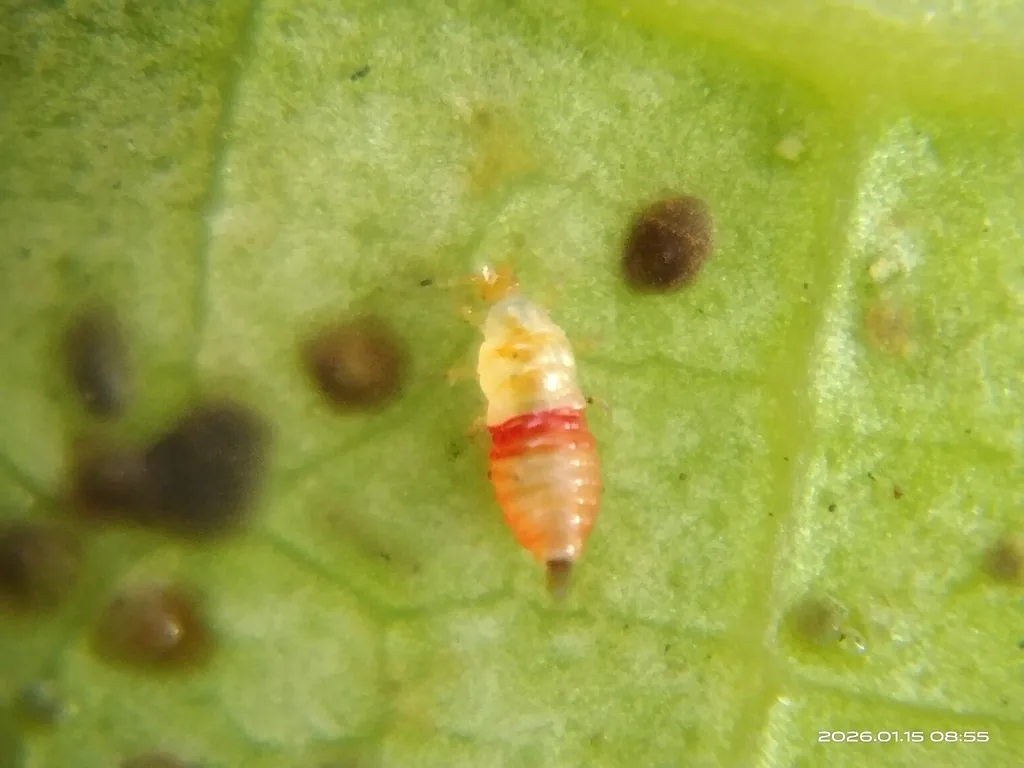
- Nymphs are pale or creamy yellow with a bright red band across the middle and a red tail tip, which gives the species its name (Pacific Pests describes two red bands). Adults have the band too, but their dark color usually hides it.[1][2]
- Females cover each egg with a drop of liquid that dries into a small dark blister on the leaf.[1][2]
- It is the only species in its genus, Selenothrips.[3]
Where it lives
Widespread in tropical and subtropical countries in Asia, Africa, the Americas, the Caribbean and many Pacific islands. EPPO says it was recently recorded as established for the first time in the EPPO region, in Italy, and also lists Portugal (Madeira). Its native range is given as northern South America by Pacific Pests, while EPPO says it is uncertain, either northern South America or Africa. NC State Extension says it reached Florida from the West Indies, and EPPO lists it in the USA in Florida and Hawaii.[2][3][1]
Biology and life cycle
Egg counts differ by source: NC State Extension gives 25 to 50 eggs per female; Pacific Pests says females lay upwards of 50 over about a month. Males are rarely seen, and females produce eggs without mating.[1][2]
Pacific Pests gives about 4 days for eggs to hatch, 9 to 10 days for the two nymphal stages and 3 to 4 days for the resting pupal stages. NC State describes development as relatively slow, up to six weeks from egg to adult.[2][1]
All stages are usually present at the same time, mostly on leaf undersides along the midveins of new growth and on the inner parts of the plant. It spreads on the wind.[1][2]
In a Costa Rican laboratory life table, mortality was highest in the egg stage (72.5%), followed by the second larval stage (18.4%).[4]
EPPO reports several generations a year: 3 in Florida and 8 in southern China. Adults have wings and can be carried by wind, and all stages travel long distances on infested plants, cut flowers, foliage and fruit.[3]
Damage and signs
- Feeding leaves small pale spots that turn to russeting; heavily infested plants look silvery or bleached, and leaves become papery and may drop. Leaves and fruit get spotted with tiny dark drops of excrement, which can grow sooty mold.[1][2]
- In Florida it infests avocado, guava, mango and sweetgum as well as many other trees, shrubs and flowers. Elsewhere it attacks cashew, rambutan, mangosteen, cocoa and cotton.[1][2][4]
- EPPO adds grapevine and cocoa to its pest hosts and says severe infestations give leaves a brown, sun-scorched look and scar fruit skin silvery or brown, making it unmarketable. It is not recorded as a virus vector.[3]
- In Gabon it was among the insects attacking the leaves of African plum (safou) trees.[5]
Health risk
It feeds on leaves and fruit. NC State Extension, Pacific Pests and EPPO don't mention any risk to people or pets.[1][2][3]
Control
Prevention
Pacific Pests says to monitor by hanging blue sticky traps in trees (yellow traps are also effective) or by tapping foliage over a white plastic tray or white cloth and counting the thrips.[2]
Keep trees healthy with good spacing, irrigation and pruning, and avoid excess nitrogen.[2]
Pacific Pests says to plant windbreaks around fruit orchards to prevent infestation and that particular attention should be given to the movement of nursery stock, which may carry eggs, nymphs and adults. EPPO says all stages travel long distances on infested plants, cut flowers, foliage and fruit.[2][3]
Biological control
NC State says predators such as spiders, mites, lacewings, bugs and predatory thrips are effective most of the time. Pacific Pests advises an insecticide only if monitoring finds that natural enemies are low and the thrips is damaging.[1][2]
Pesticides
NC State says redbanded thrips are not particularly resistant to pesticides: neem seed extracts, pyrethrums, pyrethroids and Orthene should all give adequate control, and most insecticides in plant centers labeled for residential use in the landscape should also control it. NC State says to avoid using pyrethroids around pools, ponds and streams because they are toxic to fish. EPA's product search lists Orthene products with active registrations. Pacific Pests names petroleum oils, which must coat the thrips, and, if natural enemies are low and the thrips is damaging, abamectin, pyrethrum or synthetic pyrethroids. Follow the label.[1][6][2]
Where the sources disagree
Adult size: NC State gives 1/16 inch, Pacific Pests a little over 1 mm and EPPO about 1.2 mm.[1][2][3]
Red bands on the nymphs: NC State describes a bright red band across the middle; Pacific Pests and EPPO describe two red bands.[1][2][3]
Eggs: NC State says females lay 25 to 50 eggs; Pacific Pests says upwards of 50 over about a month.[1][2]
Development: NC State says up to six weeks from egg to adult; Pacific Pests gives about 4 days for the eggs, 9 to 10 days for the nymphs and 3 to 4 days for the resting stages.[1][2]
Native range: Pacific Pests says northern South America; EPPO says it is uncertain, either northern South America or Africa.[2][3]
Common questions
- What are the tiny thrips with a red band on my mango leaves?
- Redbanded thrips nymphs, named for that red band. Look for the black droppings and silvery patches nearby.[1][2]
- Why are my mango leaves and fruit silvery with black dots?
- That pattern of silvering plus tiny black spots of dried excrement is typical of redbanded thrips feeding.[2][1]
- Do redbanded thrips bite people?
- NC State Extension, Pacific Pests and EPPO describe it as a feeder on leaves and fruit and don't mention any risk to people or pets.[1][2][3]
- Where does the redbanded thrips live?
- EPPO lists it in the USA in Florida and Hawaii, and NC State describes it as a Florida pest of avocado, guava, mango and sweetgum. Worldwide it lives across the tropics and subtropics, and EPPO says it was recently recorded as established in Italy.[3][1]
Sources
- NC State Extension, “Redbanded Thrips on Ornamental Plants (PDIC Factsheet).” content.ces.ncsu.edu/redbanded-thrips-on-ornamental-plants (accessed 2026-11-13)
- Pacific Pests, Pathogens & Weeds (ACIAR and the Pacific Community), “Red-banded thrips, Fact Sheet 519 (Pacific Pests, Pathogens, Weeds & Pesticides).” apps.lucidcentral.org/pppw_v11/text/web_full/entities/redbanded_thrips_519.htm (accessed 2026-11-13)
- European and Mediterranean Plant Protection Organization (EPPO), “EPPO Alert List: Selenothrips rubrocinctus (Thysanoptera: Thripidae).” eppo.int/ACTIVITIES/plant_quarantine/alert_list_insects/selenothrips_rubrocinctus (accessed 2026-11-13)
- Revista de Biologia Tropical, via PubMed, “Life table for Selenothrips rubrocinctus (Thripidae: Panchaetothripinae) under laboratory conditions (Soto-Rodriguez and Retana-Salazar 2005; in Spanish, English abstract).” pubmed.ncbi.nlm.nih.gov/17354431/ (accessed 2026-11-13)
- Neotropical Entomology 43, 2014 (Poligui et al.), via PubMed, “Insect Pests Occurring on Dacryodes edulis (Burseraceae) in Rural Areas in Gabon.” pubmed.ncbi.nlm.nih.gov/27193810/ (accessed 2026-11-13)
- U.S. EPA Pesticide Product Label System, “Pesticide Product Label System: product-name search 'Orthene'.” ordspub.epa.gov/ords/pesticides/cswu/ProductSearch/partialprodsearch/v2/riname/Orthene (accessed 2026-11-13). 410 product-name rows, 53 with product status Active (for example 5481-8978 ORTHENE TURF, TREE & ORNAMENTAL 97 SPRAY and 239-2461 ORTHENE SYSTEMIC INSECT CONTROL); saved 2026-11-13.
- Global Biodiversity Information Facility (GBIF), “Selenothrips rubrocinctus (Giard, 1901) (GBIF Backbone Taxonomy).” api.gbif.org/v1/species/1420801 (accessed 2026-11-13)
- iNaturalist, “Selenothrips rubrocinctus taxon page (order and family).” www.inaturalist.org/taxa/271215 (accessed 2026-10-06)