On this page
How to identify it
- Adults are large for thrips, up to 1/8 inch long, slender and dark brown to black.[1]
- Larvae are translucent white with red eyes; older larvae have a dark tail tube that they hold pointing up.[1]
- Eggs are cylindrical with rounded ends, smooth and translucent white.[1]
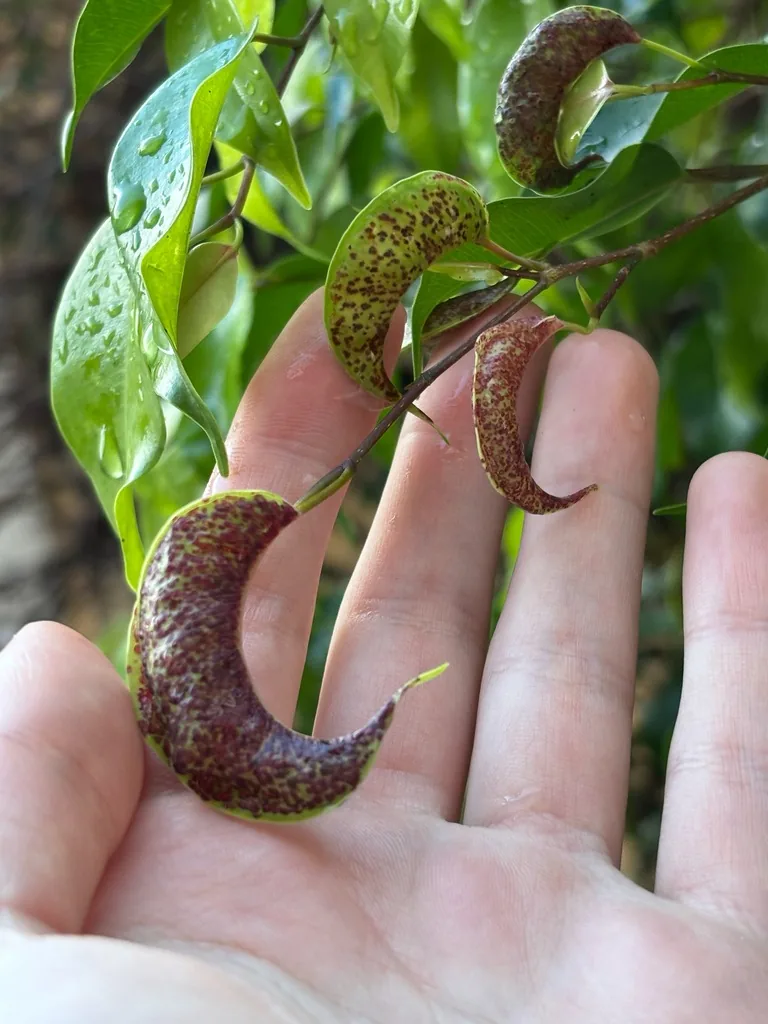
- Each feeding spot leaves a tiny purplish pit on the upper leaf surface. With enough feeding the top of the leaf stops growing while the bottom keeps growing, so the leaf curls upward into a roll or pocket.[1]
Look-alikes
| Look-alike | How to tell them apart |
|---|---|
| Weeping fig thrips (Gynaikothrips uzeli) | A very close relative that galls weeping fig; it was first found in North America in 2003. Thrips specialists consider the split between the two species questionable, and a mitochondrial DNA study places them as sister species.[3][4][5] |
Where it lives
It is a serious pest of Indian laurel fig (Ficus microcarpa) in California street trees and nurseries. GBIF has only about 30 U.S. records since 1990, mostly from California, Hawaii and Florida; worldwide, most records come from New Zealand, Spain, Australia and the U.S. The close relative G. uzeli has been reported from ten continental states plus Hawaii.[2][6][7][3]
Biology and life cycle
Females feed and lay eggs on young Ficus leaves, and all stages can be found together inside the galls.[2][1]
Development from egg to egg-laying female takes about 30 days. Adults are active fliers and spread readily in hot weather.[1]
In a Mississippi study of the weeping fig thrips, adults flew mostly from mid-morning to evening, with yellow sticky traps catching the most and captures peaking around 3 to 4 p.m.[3]
Damage and signs
Health risk
Like some other thrips, it sometimes bites people, causing temporary discomfort. In one Italian report, all four adults in a household developed an itchy rash after the thrips infested their home.[1][8]
Control
Traps and physical control
Clip off and destroy all galled leaves and tender new growth. The thrips can only infest new growth, so any left behind die before the plant puts out more.[1]
Biological control
The predatory bug Montandoniola confusa was released in southern California in 1995. By 2013 to 2014 it was present at all three release areas and galls were significantly fewer, and the researchers credit it with successful control. In laboratory tests, green lacewing larvae also attacked the thrips' nymphs.[2][9]
Pesticides
NC State says two or three thorough applications of a product labeled for thrips on ornamentals, about 5 to 7 days apart, should give control, or prune off the galls and follow with one thorough spray.[1]
Results on weeping fig thrips were less encouraging: in Mississippi trials, systemic insecticides applied to the potting mix did not control adults feeding on the foliage, and foliar sprays of the same products lasted 7 days or less. The authors concluded that products that work on other thrips are of limited use against this group.[3]
Common questions
- Why are my ficus leaves curled and full of tiny black bugs?
- That's typical of Cuban laurel thrips, which fold new leaves into pocket galls and breed inside.[1][2]
- Do Cuban laurel thrips bite?
- Sometimes. Like some other thrips they can bite, causing brief discomfort, and an infestation in one home was linked to an itchy rash.[1][8]
- Will the thrips kill my fig?
- Probably not, but repeated galling makes it look much worse.[1]
Sources
- NC State Extension, “Cuban Laurel Thrips (PDIC Factsheet).” content.ces.ncsu.edu/cuban-laurel-thrips (accessed 2026-11-11)
- Journal of Economic Entomology, via PubMed, “Economic benefit for Cuban laurel thrips biological control (Shogren and Paine 2016).” pubmed.ncbi.nlm.nih.gov/26503345/ (accessed 2026-11-11)
- Pest Management Science, via PubMed, “Evaluation of sticky traps and insecticides to prevent gall induction by Gynaikothrips uzeli on Ficus benjamina (Held and Boyd 2008, Mississippi State University).” pubmed.ncbi.nlm.nih.gov/18069654/ (accessed 2026-11-11)
- Zootaxa, via PubMed, “Taxonomic problems with Gynaikothrips and related genera: the ficorum/uzeli complex (Mound and Tree 2021).” pubmed.ncbi.nlm.nih.gov/34810949/ (accessed 2026-11-11)
- Mitochondrial DNA Part B, via PubMed, “Complete mitochondrial genome of Gynaikothrips ficorum (Dang et al. 2021).” pubmed.ncbi.nlm.nih.gov/34212088/ (accessed 2026-11-11)
- Global Biodiversity Information Facility (GBIF), “Gynaikothrips ficorum: U.S. occurrence records since 1990 by state (GBIF occurrence search).” api.gbif.org/v1/occurrence/search?taxonKey=1420185&country=US&hasGeospatialIssue=false&occurrenceStatus=PRESENT&year=1990%2C2026&facet=stateProvince&facetLimit=400&limit=0 (accessed 2026-11-11). Exact count at access: 31 U.S. records since 1990 (California 15; Hawaii 7; Florida 6; New York 1; South Carolina 1).
- Global Biodiversity Information Facility (GBIF), “Gynaikothrips ficorum: occurrence records since 1990 by country (GBIF occurrence search).” api.gbif.org/v1/occurrence/search?taxonKey=1420185&hasGeospatialIssue=false&occurrenceStatus=PRESENT&year=1990%2C2026&facet=country&limit=0 (accessed 2026-11-11). Exact counts at access: 231 records since 1990; New Zealand 45, Spain 38, Australia 31, United States 31, Macao 13.
- Allergy, via PubMed, “Itchy dermatitis from Gynaikothrips ficorum in a family group (Piu et al. 1992).” pubmed.ncbi.nlm.nih.gov/1456418/ (accessed 2026-11-11)
- Brazilian Journal of Biology, via PubMed, “Functional response estimations of Chrysoperla carnea to different densities of Aphis craccivora and Gynaikothrips ficorum nymphs (Abdel-Hameid 2022).” pubmed.ncbi.nlm.nih.gov/36541961/ (accessed 2026-11-11)
- iNaturalist, “Gynaikothrips ficorum taxon page (order and family).” www.inaturalist.org/taxa/270786 (accessed 2026-10-06)