On this page
How to identify it
- Affected leaves look grayish or dusty from many tiny pale spots; the insects themselves need magnification to see.[1]
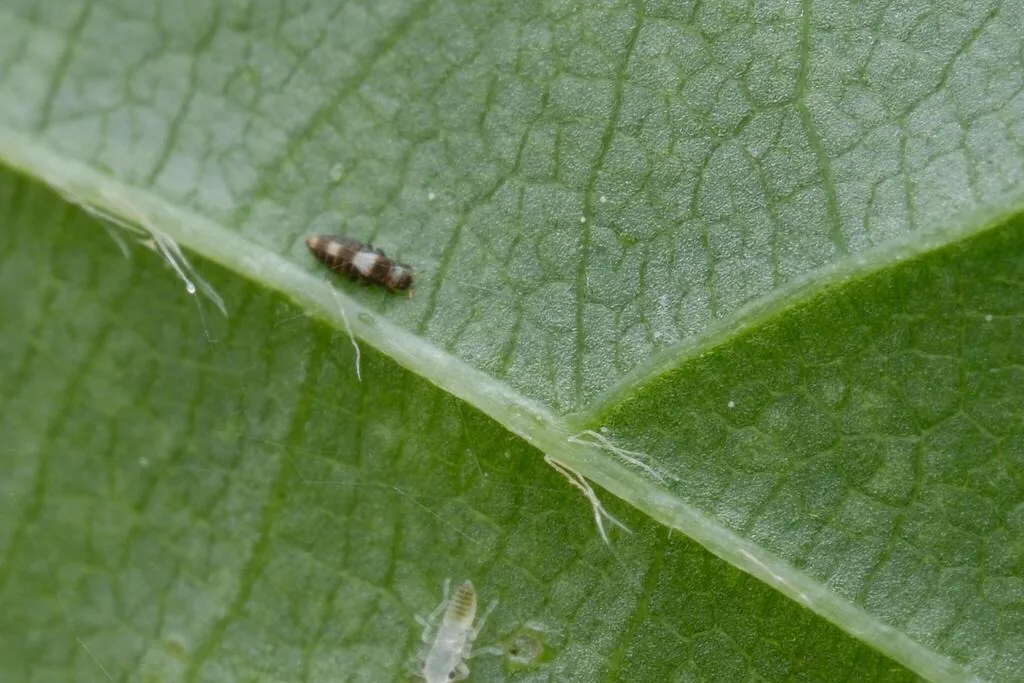
- Adults are about 1 mm long and fully winged, with a brown body, yellow markings behind the head and front wings banded with two dark and three white bands.[1][2]
- Immature thrips are slender and wingless and are found mainly on the leaf undersides; when numbers are high, 20 to 30 may be found on a single leaf.[1]
Where it lives
Sources differ on its origin: UMass says it is native to parts of Europe, Asia and Russia, while the Thrips of California key says probably southern Europe, where it is widespread. Both say it was introduced to North America; the California key notes only a few records from that state.[1][2]
Biology and life cycle
Its life history isn't completely understood; females lay eggs on the leaves in late spring, and several generations are possible through the summer.[1]
Larvae and adults feed on older leaves rather than on young buds, and the pupae can also be found on the leaves; adults are active fliers.[2][1]
Damage and signs
Health risk
It feeds on plant leaves, and no cited source describes any risk to people or pets.[1][2]
Control
Prevention
Check gray or yellowing leaves with a hand lens, especially the undersides; tapping foliage over white paper or hanging blue or yellow sticky cards nearby helps find the thrips.[1]
Sanitation
Removing weeds, old plants and debris can reduce thrips, especially in nurseries.[1]
Biological control
Predators, nematodes and insect-killing fungi are used against some thrips in greenhouses, but how well they work on privet thrips isn't yet known.[1]
Pesticides
UMass lists a range of active ingredients for privet thrips, says to spray after bloom and when pollinators are less active, and notes that imidacloprid, though often labeled for thrips, often doesn't give satisfactory thrips control. Follow the label.[1]
Common questions
- Why do my privet leaves look gray and dusty?
- Grayish leaves covered in tiny pale spots can be privet thrips feeding; look under the leaves with a hand lens for slender insects about 1 mm long.[1]
- Where did privet thrips come from?
- It was introduced to North America. UMass says it is native to parts of Europe, Asia and Russia; the Thrips of California key says it probably originated in southern Europe.[1][2]
Sources
- UMass Extension Landscape, Nursery and Urban Forestry Program (Landscape Insect & Mite Guide), “Dendrothrips ornatus (Privet Thrips).” www.umass.edu/agriculture-food-environment/landscape/publications-resources/insect-mite-guide/dendrothrips-ornatus (accessed 2026-11-13)
- Thrips of California 2012 (Lucid identification key), “Dendrothrips ornatus (Thrips of California 2012, Lucid identification key).” keyserver.lucidcentral.org/key-server/data/07060c0e-0504-490a-8003-050004060f01/media/Html/browse_species/Dendrothrips_ornatus.htm (accessed 2026-11-13)
- Global Biodiversity Information Facility (GBIF), “Dendrothrips ornatus (Jablonowski, 1894) (GBIF Backbone Taxonomy).” api.gbif.org/v1/species/1420825 (accessed 2026-11-13)