On this page
How to identify it
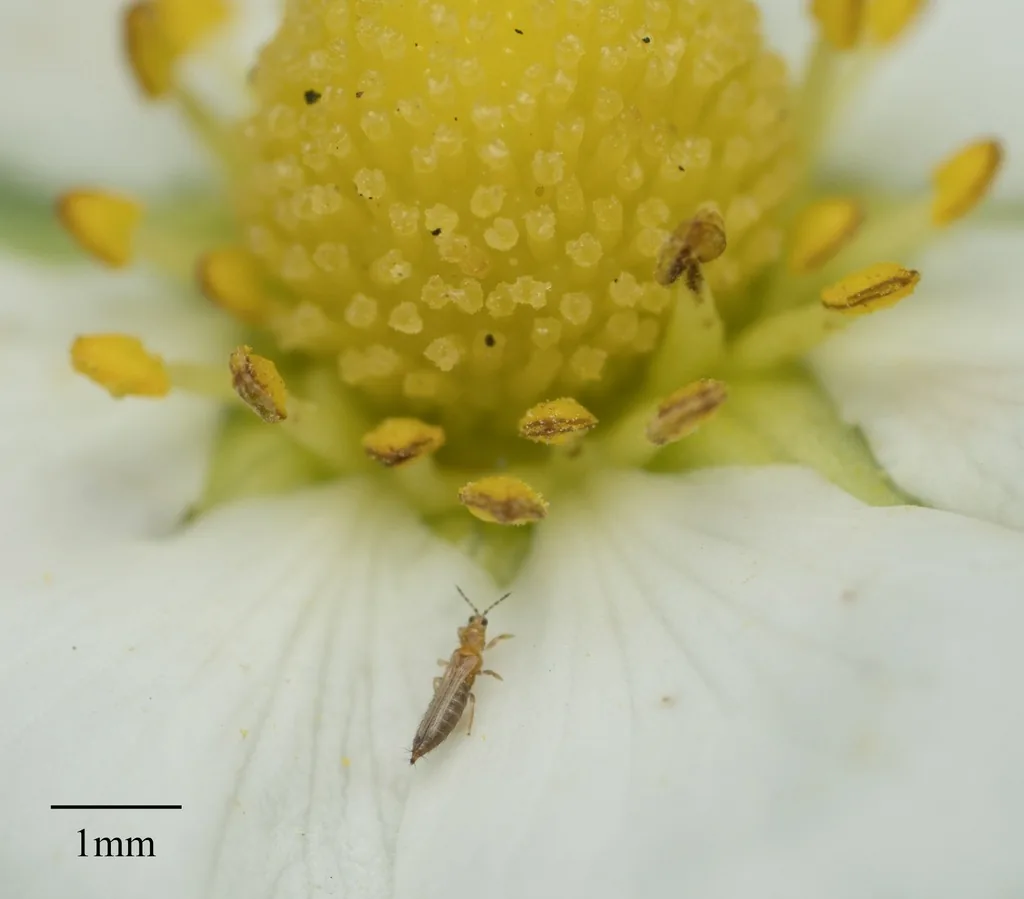
- Size figures differ: Penn State gives about 1/16 inch for adult females, UC IPM's tomato guidelines 0.06 inch (1.5 mm), and its strawberry guidelines about 0.03 inch (0.8 mm). Males are about two-thirds the size of females and usually paler.[1][4][5]
- Adult color varies a great deal, from entirely black, orange, yellow or whitish to a pale head and thorax with a dark abdomen. Both pairs of wings are fringed with long hairs. UF/IFAS recognizes three color forms: dark brown, light, and an intermediate form that is yellow with a dark band down the back of the thorax and abdomen. The intermediate form is the most common in Florida.[3][4][6]
- Larvae look like small, wingless adults. First instars are white, and older larvae are commonly orange to yellow.[1][3]
- It is hard to tell from other, less damaging flower thrips; UC IPM says thrips can be identified to species only by an expert. UF/IFAS says specimens are usually identified at 40X magnification, using features such as the setae (bristles) near the simple eyes and on the front edge of the thorax and a complete comb of fine hairs on the eighth abdominal segment.[1][2][6]
Look-alikes
| Look-alike | How to tell them apart |
|---|---|
| Other thrips | Most thrips are under 1/20 inch and need an expert to name, but western flower thrips and onion thrips adults are noticeably larger than citrus and avocado thrips when they turn up on the same plant.[2] |
| Onion thrips | Slightly smaller: UC's tomato guidelines give 0.05 inch (1.3 mm) for onion thrips against 0.06 inch for western flower thrips. Strawberry fields often hold a mix of the two.[4][5] |
| Chilli thrips | About the same size but pale cream rather than amber, with dark gray eyes. It is especially drawn to roses and peppers, where its feeding distorts and scars leaves and flowers and can make leaves drop early.[7] |
| Other Frankliniella flower thrips | UF/IFAS lists the native Frankliniella tritici and F. bispinosa and the introduced F. schultzei among the thrips found in Florida. Telling them from western flower thrips takes magnification and a key.[6] |
Where it lives
Once limited to western North America, it has become nearly worldwide since the 1970s, carried with crops and plants. Penn State reports it feeding on nectarine and peach in southern Pennsylvania and adjoining Mid-Atlantic states, and UC IPM covers it in California. UF/IFAS says it stayed west of 100°W longitude until the 1960s before spreading with the horticultural trade. In cooler areas it may not survive the winter or may be limited to greenhouses; in Florida it occurs statewide but is more common in the north.[1][2][8][9][6]
Biology and life cycle
Females insert their eggs into plant tissue. Larvae and adults feed in buds, flowers and growing tips, and the non-feeding prepupa and pupa stages are spent in the soil or growing medium below the plant.[3][2]
Unmated females lay eggs that become males; mated females lay eggs that become females.[3]
Development depends on temperature. UC IPM's floriculture guidelines give about 11 days from egg to adult at 77 to 87°F and 44 days at 50 to 60°F, Penn State about two weeks per generation in summer, and UC's tomato guidelines 30 to 45 days in general and as little as 14. UF/IFAS cites a study on cabbage leaves at 27°C in which egg to adult took 10.2 days and females laid an average of 76.6 eggs.[3][1][4][6]
In Pennsylvania, dark brown adult females overwinter in leaf litter and other organic matter, come out in late April and May, and build up on crops and weeds to a summer peak.[1]
Only adults fly, and they are weak fliers, but wind currents, clothing and infested plants carry them long distances. UF/IFAS adds that males form mating swarms.[4][2][6]
Besides plant tissue, it feeds on pollen and even on spider mites. UF/IFAS says it punches a hole with its mandible and sucks out cell contents rather than feeding from the plant's vascular tissue, and in cotton it has been found preying on spider mite eggs.[3][6]
Damage and signs
- Feeding empties plant cells. On ripe peaches and nectarines it leaves silver stippling or patches; on flowers it streaks or discolors petals, and buds fed on before they open grow distorted.[1][3][2]
- It is mainly a pest of herbaceous plants, but heavy populations damage flowers on woody plants such as roses; UC IPM says fragrant, light-colored or white roses are hit more often.[2]
- It transmits impatiens necrotic spot virus and tomato spotted wilt virus. Only larvae pick up tomato spotted wilt virus; the adults then spread it for the rest of their lives, which UC puts at 30 to 45 days, and they don't pass it to their offspring through the egg. UF/IFAS adds tomato chlorotic spot virus and groundnut ringspot virus to the list.[2][4][8][6]
- Reviews rank it among the most economically important crop pests worldwide. A 2015 review calls it one of two insect supervectors that have carried plant viruses to new hosts and regions.[8][9]
- On Pennsylvania peaches and nectarines, hot, dry weather can bring damaging numbers, and fruit injury peaks at harvest when adults move in from weeds and other crops.[1]
- Its presence doesn't always mean loss: in strawberries it seldom causes economic damage at normal field numbers, and the cat-faced berries often blamed on it come from lygus bug feeding.[5]
- UF/IFAS, citing CABI, says it has host plants in 65 families, among them alfalfa, artichoke, carnation, chrysanthemum, corn, cotton, cucumber, eggplant, gerbera, gladiolus, grapes, impatiens, melons, peaches, peanut, pepper, strawberry, tomato and watermelon, though not every recorded host supports its reproduction.[6]
- Direct injury from feeding and egg-laying includes scarring of pepper fruit and egg-laying wounds in tomatoes.[6]
Health risk
Western flower thrips feeds on plants. Thrips in general occasionally bite people; a 2016 report described 15 Marines with clusters of small raised skin bumps traced to thrips bites.[10]
Control
Prevention
Check for thrips by tapping or shaking blooms over a flat surface and counting them; Penn State uses a light yellow surface and UC's strawberry guidelines a dark one. Sticky cards also work, and UC IPM notes blue cards attract western flower thrips most, though yellow is generally used because it catches more pest species and is easier to read. UF/IFAS cautions that sticky-trap counts have rarely been shown to reflect population size or predict damage accurately, though yellow cards also monitor leafminers, aphids and whiteflies.[1][5][3][6]
Avoid overwatering and excess nitrogen fertilizer, which can raise thrips numbers, and control nearby weeds that host them. Thrips move into gardens when weedy areas and grasslands dry out, so avoid planting susceptible plants right next to them.[2]
Silver or gray reflective mulch laid before plants emerge can delay or reduce thrips and the viruses they carry on young plants. It stops working once the plant canopy covers about half the soil. UF/IFAS says UV-reflective mulch, used in northern Florida tomatoes, interferes with the thrips' host finding, and that cutting back nitrogen fertilizer may lower numbers.[2][3][6]
Keep them out
Inspect new plants before bringing them in. Screens over greenhouse vents need very fine mesh, about 145 microns (roughly 1/200 inch), to keep thrips out.[3]
Biological control
Minute pirate bugs, predatory mites, green lacewings and predatory thrips all eat plant-feeding thrips, so avoid persistent broad-spectrum sprays. Orius pirate bugs and Neoseiulus cucumeris mites are also sold for release. UF/IFAS names minute pirate bugs among the most important natural enemies: in pepper, about one Orius insidiosus per 180 thrips suppresses them and one per 50 controls them. The predatory mites Amblyseius swirskii and Neoseiulus cucumeris also eat them.[2][3][5][6]
Pesticides
Thrips are hard to reach with sprays because they hide in buds and their eggs and pupae are protected. UC IPM rates spinosad as generally more effective than contact sprays such as insecticidal soap, oils, neem or pyrethrins, but it is toxic to bees and some predators for about a day, so don't spray it on flowering plants. Imidacloprid commonly fails against thrips.[2]
Insecticide resistance is a major problem with western flower thrips: rotate between modes of action and don't rely on sprays alone. Penn State adds that carbaryl doesn't control it and can increase injury by killing natural enemies. UF/IFAS says resistance to many insecticide groups has been documented and that the thrips' hidden habits limit their exposure to sprays.[3][8][9][1][6]
Common questions
- What makes silver streaks on my flowers and fruit?
- Often thrips. Their feeding leaves stippling, silvering or pale flecks, usually with tiny black, varnish-like specks of excrement, which helps tell it from spider mite damage.[2][3]
- How do I check for thrips?
- Tap or shake blooms over a flat card and count what falls, or hang sticky cards near the plants. Blue cards attract western flower thrips most.[1][5][3]
- Do thrips spread plant disease?
- Yes. Western flower thrips spread tomato spotted wilt and impatiens necrotic spot viruses, among others, and an adult that picked up tomato spotted wilt as a larva can spread it for the rest of its life.[2][4][8]
- Can thrips bite people?
- Occasionally. Thrips are plant feeders, but bites on people do happen; a 2016 case series described an outbreak of small raised skin bumps among 15 Marines caused by thrips bites.[10]
- Is western flower thrips found in Florida?
- Yes. UF/IFAS says it occurs throughout Florida but is more common in the north, where UV-reflective mulch is used against it in tomatoes, and the yellow form with a dark band down the back is the most common color form there.[6]
Sources
- Penn State Extension, “Tree Fruit Insect Pest - Western Flower Thrips.” extension.psu.edu/tree-fruit-insect-pest-western-flower-thrips/ (accessed 2026-11-12)
- University of California Statewide IPM Program, “Pest Notes: Thrips (Publication 7429).” ipm.ucanr.edu/home-and-landscape/thrips/ (accessed 2026-11-12)
- University of California Statewide IPM Program, “Floriculture and Ornamental Nurseries Pest Management Guidelines: Thrips.” ipm.ucanr.edu/agriculture/floriculture-and-ornamental-nurseries/thrips/ (accessed 2026-11-11)
- University of California Statewide IPM Program, “Tomato Pest Management Guidelines: Thrips.” ipm.ucanr.edu/agriculture/tomato/thrips/ (accessed 2026-11-11)
- University of California Statewide IPM Program, “Strawberry Pest Management Guidelines: Western Flower Thrips.” ipm.ucanr.edu/agriculture/strawberry/western-flower-thrips/ (accessed 2026-11-11)
- University of Florida IFAS Extension (EDIS), “Western Flower Thrips (Frankliniella occidentalis [Pergande]), ENY-883/IN1089 (J. D. Cluever, H. A. Smith, J. E. Funderburk and G. Frantz).” ask.ifas.ufl.edu/publication/IN1089 (accessed 2026-11-14)
- NC State Extension, “Chilli Thrips.” content.ces.ncsu.edu/chilli-thrips (accessed 2026-11-11)
- Insect Science, via PubMed, “He Z, Guo JF, Reitz SR, Lei ZR, Wu SY (2020), A global invasion by the thrip, Frankliniella occidentalis: current virus vector status and its management, Insect Science 27(4):626-645.” pubmed.ncbi.nlm.nih.gov/31453663/ (accessed 2026-11-11). Cited from the PubMed abstract.
- Annual Review of Virology, via PubMed, “Gilbertson RL, Batuman O, Webster CG, Adkins S (2015), Role of the insect supervectors Bemisia tabaci and Frankliniella occidentalis in the emergence and global spread of plant viruses, Annual Review of Virology 2(1):67-93.” pubmed.ncbi.nlm.nih.gov/26958907/ (accessed 2026-11-11). Cited from the PubMed abstract.
- Cutis, via PubMed, “Carness JM, Winchester JC, Oras MJ, Arora NS (2016), Night of the living thrips: an unusual outbreak of Thysanoptera dermatitis, Cutis 97(3):E13-16.” pubmed.ncbi.nlm.nih.gov/27023090/ (accessed 2026-11-11). Cited from the PubMed abstract.
- iNaturalist, “Frankliniella occidentalis taxon page (order and family).” www.inaturalist.org/taxa/243760 (accessed 2026-11-11)