On this page
How to identify it
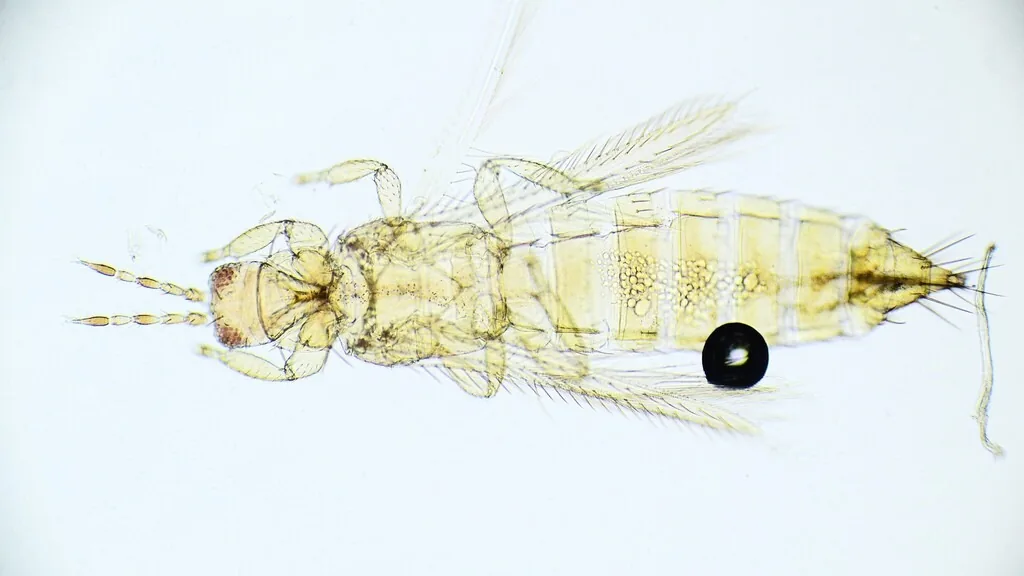
- Adults are slender and approximately 1 mm long. Thrips of California notes that adults from the southern part of the range, such as Florida and Georgia, are usually yellow, while those farther north and west are often dark brown. UF/IFAS describes adults as elongate and yellow, about 1 mm (0.039 in) long, with fringed wings.[1][2][9]
- Larvae are wingless and yellow, elongated and oval, approximately 0.5 mm long, and resemble the adults. The pupa is 0.5 to 1 mm long, with its antennae bent backward over the head. UF/IFAS adds that larvae and pupae of different Frankliniella species look so alike that they are not usually identified to species.[1][9]
- Telling adults from other Frankliniella species takes high magnification: the stalk (pedicel) of the third antenna segment is swollen, and the comb of fine teeth on the rear edge of the eighth abdominal segment is interrupted in the middle. UF/IFAS lists more microscope features: simple setae on the second antenna segment, three pairs of ocellar setae on the front edge of the ocellar triangle, and five pairs of major setae on the pronotum.[1][2][9]
Look-alikes
| Look-alike | How to tell them apart |
|---|---|
| Western flower thrips | A close relative of similar size, development and reproduction that takes magnification to tell apart. Unlike tobacco thrips and other vectors, eastern flower thrips is treated as a non-vector of tomato spotted wilt virus. UF/IFAS says western flower thrips can transmit tomato spotted wilt virus and is highly damaging: in Florida tomatoes the action threshold is one western flower thrips adult per flower, while ten or more eastern flower thrips per flower are tolerated. UF/IFAS also reports that eastern flower thrips can outcompete it.[1][3][9] |
| Florida flower thrips (Frankliniella bispinosa) | The other main flower thrips of southeastern blueberries, with the same kind of flower injury. In Florida it made up 83.6% of the thrips on sticky traps in blueberry fields, while in Georgia eastern flower thrips made up 94.0%. UF/IFAS warns that it is easily confused with eastern flower thrips in Florida but, unlike it, can transmit tomato spotted wilt virus.[1][9] |
Where it lives
It originates in eastern North America and is widespread on the continent. A 2025 review says it is found in Asia, the Caribbean and Europe, while Thrips of California says records from other countries need confirmation. It is also caught in suction traps across the Midwest. UF/IFAS places the native range in eastern North America, mainly east of the Rocky Mountains.[1][2][4][9]
Biology and life cycle
Females insert kidney-shaped eggs, about 0.4 mm long, into plant tissue. Unfertilized eggs produce males and fertilized eggs produce females. UF/IFAS adds that a female can lay up to 17 eggs a day.[1][9]
The life cycle runs egg, two feeding larval stages, then a prepupa and pupa that do not feed. A 1936 study summarized in a 2025 review found the life cycle takes 15.01 days on average, females lay 41.25 eggs in their lifetime, and adults live 21.42 days. UF/IFAS gives egg to adult as about two to three weeks, with a minimum development temperature of 10°C (50°F), says the pupal stages rest in the soil, and gives adults about 38 days.[1][9]
Thrips move readily between plants as flowers open and close, building up on wild and weedy hosts and then migrating into crops. In one study it was seen on vetch during winter, though vetch did not appear to be a preferred overwintering host; in Midwest suction traps, its activity began earlier when conditions were warmer. UF/IFAS says larvae and adults are highly mobile and live in the flower or on the fruit, and that the species has multiple generations a year, building up faster as temperatures rise.[1][4][9]
It breeds in flowers and possibly on leaves of a wide range of flowering plants. Sources record it on blueberry flowers, soybean, seedling cotton, vetch and clover. UF/IFAS lists crop hosts including asparagus, blackberry, cotton, eggplant, peach, pepper, rye, soybean, strawberry and tomato, ornamentals such as chrysanthemum and rose, and flowering weeds such as morning glory, dandelion, wood sorrel and clover; in a year-long north Florida study it was collected from 48 plant species, 18 of them breeding hosts.[2][1][5][6][9]
Damage and signs
- Thrips of California says its crop damage involves roses in particular.[2]
- In southern highbush and rabbiteye blueberries it feeds inside the flowers on petals, styles, ovaries and young fruit tissue, and may eat pollen, which can reduce fruit set and yield. In Georgia it made up 94.0% of the thrips captured, thrips have reached 40-50 per flower cluster, and thrips damage has been blamed for up to a 60% reduction in fruit set in southern highbush blueberries.[1]
- It is one of the thrips found on seedling cotton in the Southeast: in a 2016 survey of five states, tobacco thrips dominated everywhere, and eastern flower thrips was the second species in South Carolina, at 10.8% of adults. UF/IFAS calls it, with other Frankliniella species, an early-season pest of seedling cotton in the Southeast: adults feed on new growth at the tip and under the leaves, silvering the tissue, and damaged plants may be stunted with distorted leaves.[5][9]
- It is a secondary vector of soybean vein necrosis virus, first detected in Arkansas in 2008; soybean thrips is the primary vector.[6][4]
- In north Florida it is the most common thrips in eggplant, pepper and tomato flowers, but UF/IFAS says it is not damaging there even at 20 to 25 adults per flower.[9]
Health risk
The sources treat it only as a flower-feeding plant pest and mention no harm to people.[1][2]
Control
Prevention
Healthy woody plants usually tolerate thrips. Prune off injured or infested plant parts, and where plant foliage covers less than half of the soil surface, reflective mulch can repel flying thrips; pruning and reflective mulch are also part of blueberry thrips management.[7][1]
Traps and physical control
To check for thrips, gently shake or tap flowers or foliage over a light-colored sheet of paper, beating tray or small cloth and count them. Blueberry growers use action thresholds such as 2-6 eastern flower thrips per flower cluster, though economic thresholds based on yield loss remain undeveloped. In vegetables, UF/IFAS describes tapping blooms against a white board and counting the thrips; in cotton, the plants are beaten over a white board. Thrips can be kept in 70% ethyl alcohol so the species can be confirmed under magnification.[7][1][9]
Biological control
Green lacewings, minute pirate bugs, predatory mites and certain parasitic wasps help control plant-feeding thrips, and Orius insidiosus and predatory mites are part of blueberry thrips management. UC IPM says to encourage them by avoiding dust, rinsing dust off small plants and avoiding persistent pesticides. UF/IFAS calls the minute pirate bug Orius insidiosus the most effective predator of Frankliniella flower thrips; wild populations move into Florida eggplant and pepper fields in late spring and control thrips there, and the bugs prefer the larvae because adult eastern flower thrips are active enough to escape.[1][7][9]
Pesticides
Horticultural oils, insecticidal soaps and pyrethrins give temporary control. Spinosad (sold as Captain Jack's Deadbug Brew and Monterey Garden Insect Spray) is generally more effective, but it is toxic to bees when sprayed and for about 1 day afterward, so UC IPM says not to apply it to plants that are flowering. Imidacloprid commonly fails against thrips and is generally not recommended. In farm crops, UF/IFAS says insecticides are not recommended until economic thresholds are reached, favors reduced-risk products over broad-spectrum ones to protect minute pirate bugs, and notes that cotton relies mainly on insecticide-treated seed.[7][9]
In blueberries, reduced-risk insecticides such as spinetoram and spinosad are used to suppress flower thrips while limiting harm to pollinators.[1]
Where the sources disagree
Life cycle: a 1936 study summarized in a 2025 review gives a 15.01-day life cycle, 41.25 eggs per female and a 21.42-day adult life, while UF/IFAS gives about two to three weeks from egg to adult, up to 17 eggs a day and an adult life of about 38 days.[1][9]
Range outside North America: UF/IFAS and a 2025 review report it from Asia, the Caribbean and Europe, while Thrips of California says such records need confirmation.[9][1][2]
Common questions
- Are the tiny yellow insects in my flowers harmful?
- They may well be eastern flower thrips, which are drawn to the flowers of many plants. Healthy woody plants usually tolerate thrips; the damage that matters is reduced fruit set in crops such as blueberries. UF/IFAS adds that in north Florida tomato, pepper and eggplant flowers it does no damage even at 20 to 25 adults per flower.[7][1][9]
- Does the eastern flower thrips spread tomato spotted wilt virus?
- No. Studies treat it as a non-vector of tomato spotted wilt virus, and Thrips of California lists no tospoviruses vectored. Only nine of the more than 7,000 thrips species are known to transmit it. UF/IFAS agrees it is not a vector, but notes that two look-alikes in Florida, the Florida flower thrips and the western flower thrips, are.[3][2][9]
- When is the eastern flower thrips a real pest?
- Mainly in blueberry flowers, where heavy feeding can cut fruit set and yield. In soybeans it can also carry soybean vein necrosis virus. UF/IFAS also lists it as an early-season pest of seedling cotton in the Southeast.[1][6][9]
- Is it called flower thrips or eastern flower thrips?
- Both. UF/IFAS says the Entomological Society of America's official common name is flower thrips, but because that name is used loosely for many Frankliniella species that live in flowers, it is often called the eastern flower thrips after its range.[9]
Sources
- Insects (MDPI), “Biology, Ecology, and Management of Prevalent Thrips Species (Thysanoptera: Thripidae) Impacting Blueberry Production in the Southeastern United States (Adhikari et al. 2025, Insects 16:653).” pmc.ncbi.nlm.nih.gov/articles/PMC12296047/ (accessed 2026-11-12)
- Thrips of California (Hoddle, Mound and Paris), Lucidcentral, “Frankliniella tritici (Thrips of California, browse species).” keys.lucidcentral.org/keys/v3/thrips_of_california/identify-thrips/key/california-thysanoptera-2012/Media/Html/browse_species/Frankliniella_tritici.htm (accessed 2026-11-12)
- PLoS One 2019, via PubMed, “Comparison of transcriptomes of an orthotospovirus vector and non-vector thrips species.” pubmed.ncbi.nlm.nih.gov/31600262/ (accessed 2026-11-12)
- Environmental Entomology (Entomological Society of America), “Monitoring Eastern flower thrips and soybean thrips (Thysanoptera: Thripidae) and the generalist predator, insidious flower bug (Hemiptera: Anthocoridae) in the American Midwest Suction Trap Network (Lagos-Kutz et al. 2025, Environmental Entomology 54:1432-1444), abstract.” pubmed.ncbi.nlm.nih.gov/41126555/ (accessed 2026-11-12)
- Journal of Economic Entomology 2018, via PubMed, “Molecular identification of thrips species infesting cotton in the southeastern United States.” pubmed.ncbi.nlm.nih.gov/29506223/ (accessed 2026-11-12)
- Frontiers in Microbiology 2019, via PubMed, “Vector competence of thrips species to transmit soybean vein necrosis virus.” pubmed.ncbi.nlm.nih.gov/30941106/ (accessed 2026-11-12)
- University of California Statewide IPM Program, “Thrips: Pest Notes for Home and Landscape.” ipm.ucanr.edu/home-and-landscape/thrips/ (accessed 2026-11-12)
- iNaturalist, “Frankliniella tritici taxon page (order and family).” www.inaturalist.org/taxa/270745 (accessed 2026-11-09)
- University of Florida IFAS Extension, EDIS (Featured Creatures), “Flower Thrips, Frankliniella tritici (Fitch), EENY-720/IN1236 (D. Williams, J. Funderburk and A. Lucky; Featured Creatures).” ask.ifas.ufl.edu/publication/IN1236 (accessed 2026-11-14)