On this page
How to identify it
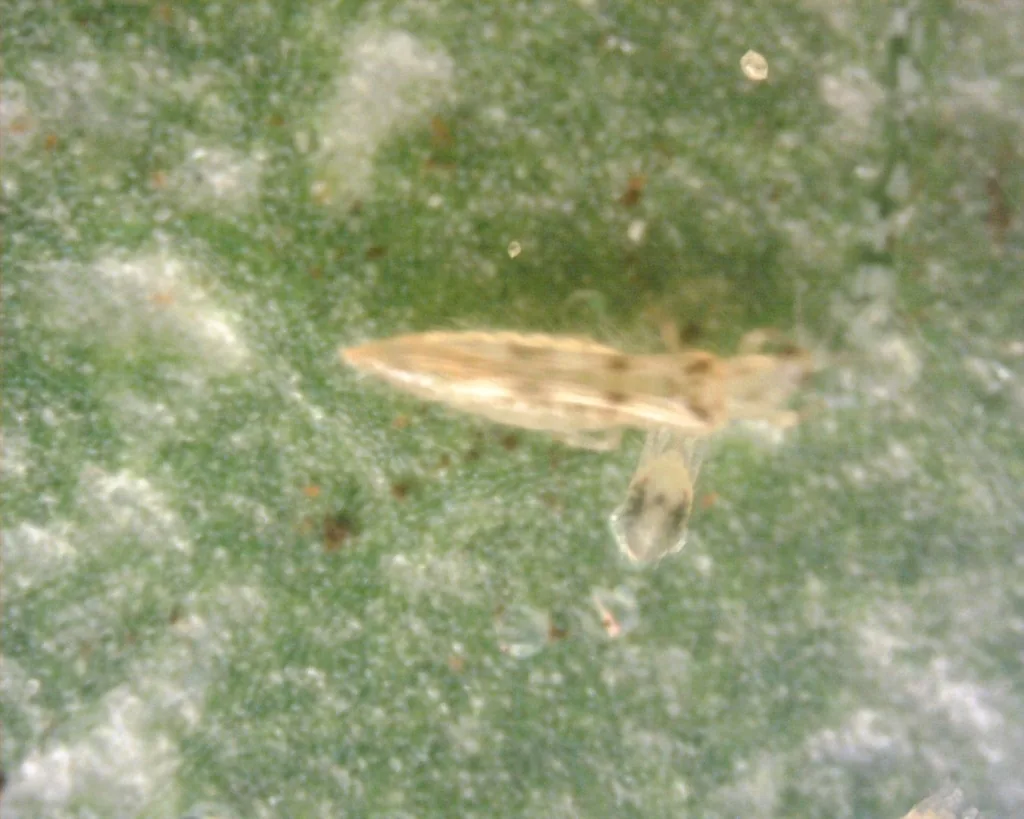
- Adults and older larvae are about 1/8 inch long and pale yellow to whitish.[1]
- Each whitish forewing shows three dark spots at rest, six in all, and the wings have long hairlike fringes.[1]
- Larvae are translucent white to yellowish.[1]
- The prepupa has wing buds and straight, forward-pointing antennae; the pupa has wing buds with the antennae folded back over the head.[1]
Look-alikes
| Look-alike | How to tell them apart |
|---|---|
| Pest thrips | Six dark wing spots on a pale thrips separate this species from common pest thrips, and it's usually found among spider mites, often feeding on them.[1][3] |
Where it lives
It occurs on most plants infested with spider mites. At least three Scolothrips species live in California, and two can be told apart only by an expert.[1]
Biology and life cycle
Eggs are laid inside plant tissue and hatch almost immediately; the thrips passes through two larval stages, a prepupa and a pupa.[1]
Egg to adult takes about 10 days in the growing season, with many generations where it's warm and mites are plentiful.[1]
In California almond orchards, numbers rose from about 2 to an average of 1,272 per sticky trap per week over 5 weeks during a mite outbreak, a population doubling time of 4.0 days.[2]
Researchers note it has a high reproductive rate, its larvae search well inside mite webbing, and it can turn cannibalistic when prey run short, which helps it survive when mites are scarce.[4]
Damage and signs
Health risk
UC IPM and NC State describe it only as a mite predator and give no sign of any concern for people.[1][3]
Control
Prevention
Before treating thrips, check what they're doing: pale thrips with spotted wings feeding among spider mites are allies.[1][3]
Biological control
It finds prey well even when mites are scarce and needs relatively few to survive.[1][4]
In California almonds it became the main mite predator after growers shifted to more sustainable chemical control programs.[2][4]
More from the research literature
A 2021 Journal of Economic Entomology study in southern San Joaquin Valley almond orchards found this thrips had become the main predator of Pacific spider mite, with two activity peaks (spring and summer) that followed rises in mite numbers; more than 90% of the thrips caught on yellow sticky traps were females, which laid eggs from May to October.[2]
Of nine sticky traps tested in California almonds, a yellow strip trap worked best; at peak numbers single cards caught more than 1,000 sixspotted thrips a week.[4]
A companion study set mite treatment thresholds that count these thrips: Pacific spider mite numbers held steady when traps caught 0.42 thrips per week for every mite per leaf, which helps growers avoid unnecessary miticide sprays.[5]
It isn't only a California insect: a 2025 report found it feeding on twospotted spider mites in hop plantings in Brazil, and NC State's diagnostic clinic identified it in a sample from a soybean field.[6][3]
Where sources disagree
Which mite stages it takes: UC IPM and NC State say it eats all stages but prefers immatures; the almond researchers cite laboratory work finding it doesn't discriminate among prey life stages.[1][3][4]
How common it is: UC IPM calls it common wherever mites are abundant; the almond researchers note a 1939 study rarely found it in large numbers, while today it is a dominant mite predator in California almonds.[1][4]
Common questions
Sources
- University of California Statewide IPM Program, “Sixspotted Thrips (Natural Enemies Gallery).” ipm.ucanr.edu/natural-enemies/sixspotted-thrips/ (accessed 2026-11-11)
- Peer-reviewed literature (PubMed), “Field Biology of Scolothrips sexmaculatus (Thysanoptera: Thripidae) as a Predator of Tetranychus pacificus (Acari: Tetranychidae) in California Almonds (Haviland DR et al., Journal of economic entomology, 2021).” pubmed.ncbi.nlm.nih.gov/33728447/ (accessed 2026-11-11)
- NC State Extension, “Sixspotted thrips (Root Cause Reports, Plant Disease and Insect Clinic).” rootcausereports.ces.ncsu.edu/library/398a060c-addc-48dc-b61e-28b8e25a6750/ (accessed 2026-11-11)
- Journal of Economic Entomology (full text via UC Cooperative Extension), “Evaluation of sticky traps for monitoring Scolothrips sexmaculatus and Stethorus punctum as predators of spider mites in California almonds (Haviland, Rill and Gordon 2021; PubMed 33346359).” ccfruitandnuts.ucanr.edu/sites/default/files/2021-01/343351.pdf (accessed 2026-11-11)
- Journal of Economic Entomology, via PubMed, “Treatment thresholds for Tetranychus pacificus in California almonds based on monitoring for Scolothrips sexmaculatus (2021).” pubmed.ncbi.nlm.nih.gov/34132813/ (accessed 2026-11-11)
- Zootaxa, via PubMed, “Predatory thrips in action: Scolothrips sexmaculatus and S. tenuipennis feeding on Tetranychus urticae in Brazil (2025).” pubmed.ncbi.nlm.nih.gov/40174105/ (accessed 2026-11-11)
- iNaturalist, “Scolothrips sexmaculatus taxon page (order and family).” www.inaturalist.org/taxa/308423 (accessed 2026-11-11)