On this page
How to identify it
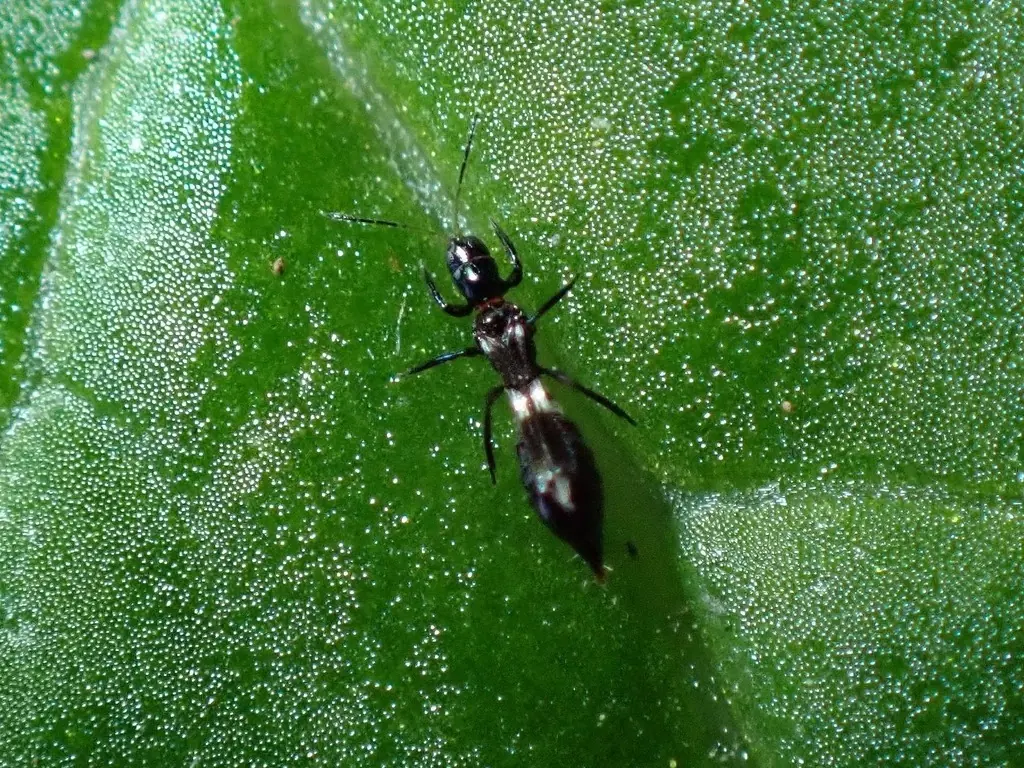
- Adult females look like small ants: 2.5 to 3.0 mm long, brown to black, with long legs and a strongly pinched waist set off by white bands on the second and third abdominal segments. UF/IFAS describes the wings as banded black and white; the published review describes brown forewings with three paler areas.[3][1][2]
- The antennae have nine segments, the first three yellow. Males are very rare; they are smaller and less ant-like, with longer, darker antennae and usually paler wings.[3][1]
- Newly hatched larvae are pale yellow and quickly develop red bands, which become very pronounced in the second larval stage; older larvae have a red head, red-banded legs and a humped back.[3][1]
- Mature larvae spin white, oval silk cocoons about 2.7 mm long on the undersides of leaves or at ground level and pass through a prepupa and a pupa inside.[3][1]
- Eggs are kidney-shaped, translucent white and about 0.38 mm long, hidden inside leaf tissue.[3]
Look-alikes
| Look-alike | How to tell them apart |
|---|---|
| Ants | Adults are easily taken for ants: they have an ant-like waist, run quickly and tap the ground with their antennae. Look for the wings, which ants of that size lack, and the white band at the narrow waist.[1][3] |
| Franklinothrips orizabensis | A predatory thrips that closely resembles the vespiform thrips and is the most important natural enemy of avocado thrips in California. UF/IFAS says its forewings are broader at the tip and lack a pale area near the tip; UC IPM describes the adult as mostly black with pale bands near its thin waist.[3][1][4] |
Where it lives
Presumed native to Central America, it has been recorded in North and South America, the Caribbean, Southeast Asia, Africa, Oceania and Europe. UF/IFAS lists U.S. records from Arizona, California, Colorado, Texas and Florida, and more recent finds in Australia and Japan. In California, UC IPM lists it among the predators of avocado thrips.[1][3][4]
Biology and life cycle
Females insert single, kidney-shaped eggs into stems, leaf veins or other soft plant tissue and cover them with a yellowish secretion. A female can lay 150 to 200 eggs in her life, and adults live up to about 60 days.[1][3]
It is active above about 18°C and develops from egg to adult in roughly three weeks at 27°C. No diapause has been reported.[1]
Larvae and adults move quickly, seize prey with their front legs and hold it while feeding, and they may turn cannibalistic when crowded in the laboratory. It usually reproduces without males; males have been seen in South America but not where it was introduced in Asia.[1][3]
It is usually found on low plants, shrubs and bushes, in habitats from roadsides and rainforests to orchards and field crops, including beans, melon, gourd, cucumber, avocado, eggplant, citrus and ornamental sunflowers. In central Florida it has been collected in small numbers from roadside plumbago and grassy weeds. Adults can also live for long periods on pollen and plant sap.[1][3]
Damage and signs
- It is a predator, not a plant pest. Recorded prey include western flower thrips, melon thrips, onion thrips, chilli thrips, greenhouse thrips and redbanded thrips, and in laboratory tests it also took spider mites, young whiteflies, leafminer larvae and psyllid eggs.[1][3]
- On California avocados it is one of several predatory thrips that feed on avocado thrips, other pest thrips and mites.[4]
- In laboratory tests against larvae of the invasive thrips Thrips parvispinus, it ate far more prey, and handled each one faster, than the two predatory mites tested alongside it.[5]
Health risk
UF/IFAS and the published review describe it only as a predator of thrips and other small arthropods; they mention no bites or other harm to people.[1][3]
Control
Prevention
No control is needed: it is a beneficial predator of pest thrips and mites, so leave it alone. Because some Franklinothrips also feed on pollen or plant sap, UF/IFAS notes they may be poisoned accidentally by systemic insecticides.[1][4][3]
Biological control
It has been sold for years in Europe, and in Israel, for thrips and mite control in greenhouses, nurseries, botanical gardens, zoos and interiorscapes, and outdoors in subtropical regions. Its slow rate of increase, cannibalism and poor tolerance of cold storage make mass rearing costly, and limited research has held back wider use.[1][3]
Common questions
- What is the tiny ant-like insect with banded wings on my plants?
- It may be a vespiform thrips, a predatory thrips that mimics ants. Look for the narrow, ant-like waist with white bands and the banded wings; its larvae are bright red-banded.[1][3]
- Are vespiform thrips harmful to plants?
- No. They are predators that eat pest thrips, mites and other small insects. Their red-banded larvae are hunters too.[1][2]
- Can I buy vespiform thrips for biological control?
- It is sold for thrips control in Europe and Israel, mostly for greenhouses and interior plantings. Researchers consider it a promising thrips predator, but say more is needed to know how much it can contribute in control programs.[1][2][3]
Sources
- Insects 2022;13(2):108, via PubMed Central, “A Review of Franklinothrips vespiformis (Thysanoptera: Aeolothripidae): Life History, Distribution, and Prospects as a Biological Control Agent (2022).” pmc.ncbi.nlm.nih.gov/articles/PMC8879288/ (accessed 2026-11-14). PMID 35206682
- Insects (MDPI), “A Review of Franklinothrips vespiformis (Thysanoptera: Aeolothripidae): Life History, Distribution, and Prospects as a Biological Control Agent (Hussain et al. 2022, Insects 13:108), abstract.” pubmed.ncbi.nlm.nih.gov/35206682/ (accessed 2026-11-14)
- University of Florida/IFAS Extension (Featured Creatures), “Vespiform Thrips, Franklinothrips vespiformis Crawford, EENY621/IN1083.” ask.ifas.ufl.edu/publication/IN1083 (accessed 2026-11-14)
- University of California Statewide IPM Program, “Avocado Thrips, UC IPM Pest Management Guidelines: Avocado.” ipm.ucanr.edu/agriculture/avocado/avocado-thrips (accessed 2026-11-14)
- Journal of Economic Entomology (Entomological Society of America), “Functional responses of 3 generalist predators to Thrips parvispinus: Amblydromalus limonicus, Amblyseius swirskii and Franklinothrips vespiformis (Park, McKenzie and Osborne 2026, Journal of Economic Entomology 119:3235-3248), abstract.” pubmed.ncbi.nlm.nih.gov/42340863/ (accessed 2026-11-14)
- iNaturalist, “Franklinothrips vespiformis taxon page (order and family).” www.inaturalist.org/taxa/270746 (accessed 2026-11-14)