On this page
How to identify it
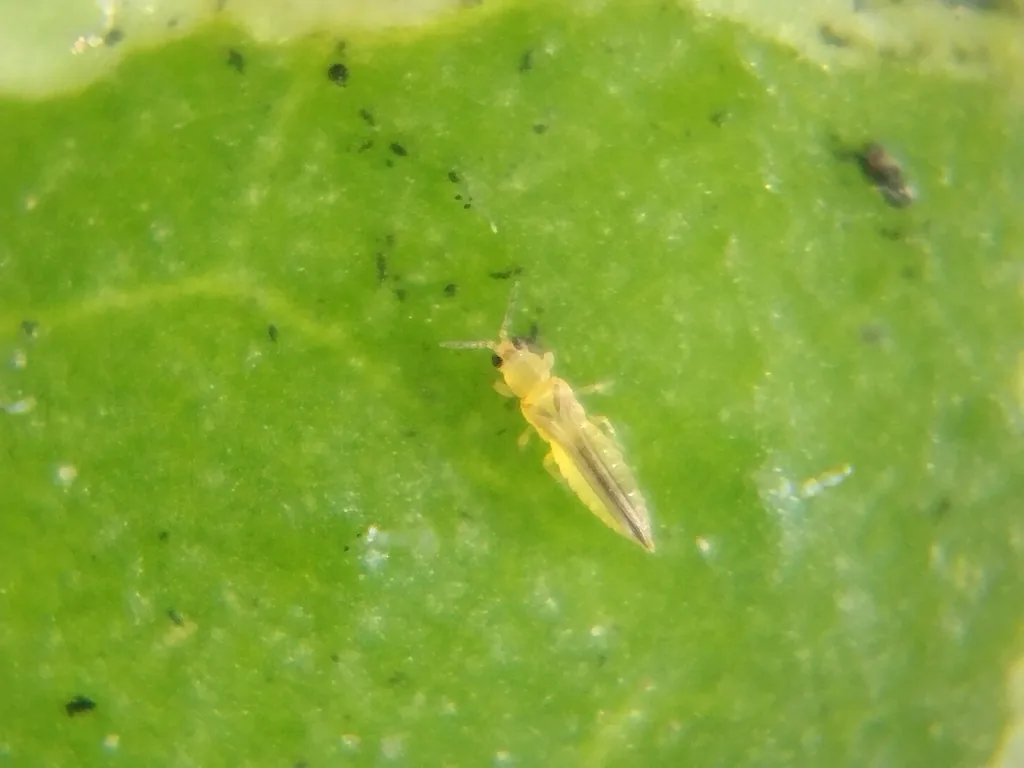
- Adults are pale cream to mostly yellow, about 1/20 to 1/16 inch long, with dark gray eyes and grayish antennae beyond the base. Under a microscope the wings are fringed like feathers. UF/IFAS gives adults about 1.2 mm long, with dark spots forming incomplete stripes on top of the abdomen; of the eight antenna segments, the first two are pale and the rest dark.[2][1][8]
- UMass and Texas A&M describe the wings as dark, and UC as pale brown; UMass notes dark brown ridges on the abdominal segments.[3][4][2]
- Larvae are pale yellow to whitish and look like small wingless adults. Unlike most look-alike thrips, mature larvae usually don't drop to the soil: prepupae and pupae are found on leaves, in leaf axils, in curled leaves or under the calyx of fruit. UF/IFAS gives lengths of 0.37 to 0.39 mm for first instars, 0.68 to 0.71 mm for second instars and 0.78 to 0.80 mm for pupae.[2][1][8]
- Damaged tissue turns silvery, then brown or black; leaves curl upward and may drop early, and buds turn brittle. UF/IFAS adds brown frass marks on leaves and fruit, a ring of gray to black scarring around the fruit tip, corky tissue on infested fruit, and, in heavily infested peppers, the curled look called 'chilli leaf curl'.[3][4][2][8]
Look-alikes
| Look-alike | How to tell them apart |
|---|---|
| Other thrips | In the field it can't be told from avocado, citrus, onion or western flower thrips by eye; species ID takes a microscope and an expert. It is about half the size of those thrips and paler than native flower thrips, which are amber.[2][1] |
| Broad mite injury | UF/IFAS says plants infested with chilli thrips can superficially look like plants infested with broad mites.[8] |
Where it lives
Believed native to Southeast Asia or the Indian subcontinent, it has spread across much of Asia and to Australia, Pacific islands, the Caribbean and northern South America. In the U.S. it is established in Hawaii and across the South from Florida to Texas, has reached Southern California, and has been found as far north as Massachusetts. UF/IFAS calls it an important pest in southern and eastern Asia, Africa and Oceania: abundant on sacred lotus in Thailand, a pest of chilli peppers and peanuts in India, and of tea and citrus in Japan.[5][2][3][4][8]
Biology and life cycle
Females insert eggs completely into plant tissue, often in buds and the undersides of leaves, and lay about 60 to 200 eggs in a lifetime. UF/IFAS says the eggs are microscopic (0.075 mm long), kidney-shaped and creamy white.[2][4][1][8]
Eggs hatch in 6 to 8 days; two feeding larval stages follow, then a non-feeding prepupa of about a day and a pupa of 2 to 3 days. UF/IFAS says the two larval stages take eight to ten days and the pupa 2.6 to 3.3 days, and that larvae and adults gather near the midrib or edges of the leaf.[2][4][8]
A generation takes 12 to 22 days, or 2 to 3 weeks in warm weather. UMass cites 8 generations a year in temperate climates and 18 in the tropics. Host plant matters: at 28°C, UF/IFAS reports 11.0 days from first instar to adult on pepper but 13.3 days on squash, and adult life spans of 15.8 days on eggplant but 13.6 days on tomato.[4][5][2][3][8]
On its own it moves only 12 to 20 m, but it travels long distances on plants, fruit and cut flowers, and NC State says it can ride weather fronts for hundreds of miles.[5][1]
What was called one species is now known to be a group of at least 9 cryptic species; two of them are in the U.S., and hosts can differ by strain.[3][2]
Damage and signs
- It feeds mostly on buds and young leaves, and is attracted to roses and peppers. Rose damage includes brown angular spots on new growth, distorted and elongated leaves, early leaf drop and scarred flower buds. UF/IFAS says it feeds on growing tips and other tender parts and hasn't been reported feeding on mature tissue; severe infestations make tender leaves and buds brittle and can cause complete defoliation.[2][1][8]
- Landscape hosts include Indian hawthorn, pittosporum, schefflera, camellia, crape myrtle, viburnum, ligustrum (privet), azalea and rhododendron, begonia, coleus, marigold and zinnia; food hosts include pepper, eggplant, tomato, strawberry, blueberry and grape. In Florida, UF/IFAS lists reproduction on plants such as snapdragon, poinsettia, plumbago, gerbera daisy, highbush blueberry, sweet viburnum and zinnia, and says its main wild hosts are legumes such as Acacia and Mimosa.[2][4][3][8]
- UC calls it mainly a garden and landscape pest and says it generally hasn't been a serious crop pest elsewhere in the U.S.; a 2025 review counts it among the thrips that are now significant pests of Georgia and Florida blueberries, where it attacks young foliage.[2][6]
- It can carry tomato spotted wilt virus, and CDFA lists seven plant pathogens it has been reported to spread; UMass notes no virus spread by chilli thrips has been confirmed in the U.S. UF/IFAS credits it with transmitting seven recorded plant viruses, among them chilli leaf curl and tobacco streak virus, and three tospoviruses confirmed in field crops in Thailand.[2][5][3][8]
Health risk
A plant feeder; none of the sources describes any risk to people or pets.[2][1][3]
Control
Prevention
Because damage looks like herbicide injury, broad mites or aphids, have samples identified: seal infested plant parts in a zip-top bag for your county extension office (in California, the agricultural commissioner too). UC asks people not to move live suspected chilli thrips across county lines; freeze the sample overnight first.[2][3]
Yellow, blue, white or green sticky cards catch adults; UMass suggests replacing them every 7 to 10 days.[3]
Buy plants from a quality supplier and check new plants; in greenhouses, screen openings with mesh finer than 1/32 inch (0.8 mm).[2]
Sanitation
Remove weeds, plant debris and old flowers and bag them; don't compost infested plant material, because the thrips can survive and move back to plants. UMass also suggests clearing fallen hydrangea leaves in fall. UF/IFAS also lists crop rotation and removing weeds that can host it.[2][3][8]
Biological control
Predatory mites (Amblyseius, Neoseiulus), minute pirate bugs (Orius) and the fungus Beauveria bassiana are sold for thrips, but must be released early; they won't rescue a heavy infestation and work best in greenhouses and nurseries. UF/IFAS adds that Orius insidiosus eats all thrips stages and keeps its numbers up on aphids, mites, moth eggs and pollen when thrips are scarce; Thripinema nematodes leave female thrips unable to lay eggs; Amblyseius swirskii looked promising on pepper; and Beauveria bassiana alone was not effective against chilli thrips.[2][3][8]
Pesticides
No insecticide gives complete control. Systemic or translaminar products such as acephate, imidacloprid and spinosad are the options UC and Texas A&M list for ornamentals; keep imidacloprid off fruits, vegetables and herbs unless labeled, and don't spray imidacloprid or spinosad on plants in bloom, because both harm bees. UF/IFAS advises rotating insecticide classes to slow resistance and reports the best results from spinetoram as a foliar spray and imidacloprid as a soil drench, both of which allowed natural enemies to keep developing.[2][4][1][3][8]
Damage shows up after the thrips have fed and gone, so UC suggests waiting and treating the new growth of last year's damaged plants the following season.[2]
Where it has spread
It was detected in Hawaii in 1987, Florida in 2005, Puerto Rico in 2006, Georgia and Texas in 2007 and Louisiana in 2009; in Texas it was found on landscape roses in Houston in November 2007.[5][4]
It reached Los Angeles and Orange counties in California in 2015, where CDFA gives it a B pest rating and UC expects it to spread through most of the state.[2][5]
UMass confirmed it on landscape hydrangeas in Barnstable County, Massachusetts, from two residential sites, and cites detections in Alabama and New York as well.[3]
UF/IFAS says USDA-APHIS inspectors intercepted it 89 times from 1984 on, on imported plant material from 48 taxa, most often cut flowers, fruits and vegetables.[8]
UF/IFAS lists Caribbean records from Jamaica (1995), St. Vincent (all 8 districts as of 2003), St. Lucia, Suriname and Trinidad (2004) and Barbados (2005).[8]
Where sources disagree
Pyrethroids: NC State, UC and Texas A&M say pyrethroids (bifenthrin, cyfluthrin, permethrin) don't control chilli thrips and aren't recommended; UMass cites sources that found carbaryl and permethrin effective, while warning they kill natural enemies. UF/IFAS says pyrethroids have never been reported to give effective control.[1][2][4][3][8]
Winters: NC State thinks it probably can't survive North Carolina winters, but UMass believes it is overwintering on hydrangeas in Massachusetts, where plants had shown symptoms for several years.[1][3]
How many hosts: Texas A&M says more than 150 plant species in 40 families, NC State hundreds in at least 40 families, and UC and CDFA more than 200 species in 70 families; UMass cites over 100 confirmed hosts and possibly over 225 taxa in 72 families. UF/IFAS says more than 100 plant taxa in 40 families were known hosts before it reached the Western Hemisphere.[4][1][2][5][3][8]
Egg hatch: UC and Texas A&M say 6 to 8 days; UMass says 5 to 8 days. UF/IFAS says two to seven days, depending on temperature.[2][4][3][8]
First records on the U.S. mainland: CDFA dates Florida to 2005 and Texas to 2007, while UF/IFAS reports Florida infestations in Okeechobee County on October 2, 1991, and Highlands County on October 10, 1994, and a Texas find on landscape and retail roses in 2005.[5][8]
Common questions
- Why are my pepper leaves bronzed and curled?
- Chilli thrips are one possibility: they bronze and curl young pepper leaves. Broad mites and herbicide drift look similar, so have a sample identified.[2][1]
- Can I see chilli thrips?
- Barely. Adults are under 2 mm and pale; you need a hand lens to see them, and a microscope to confirm the species.[3][4][2]
- Why didn't my bifenthrin or permethrin spray work?
- Chilli thrips are generally resistant to pyrethroids, and resistance to other insecticide groups has also been documented, so rotate modes of action.[2][1][3]
- Where did chilli thrips come from?
- Probably Southeast Asia or the Indian subcontinent, according to UF/IFAS. It is now an important pest across southern and eastern Asia, Africa and Oceania and has spread into the Caribbean and the southern United States.[8]
Sources
- NC State Extension, “Chilli Thrips.” content.ces.ncsu.edu/chilli-thrips (accessed 2026-11-11)
- University of California Statewide IPM Program, “Chilli Thrips (Home and Landscape).” ipm.ucanr.edu/PMG/GARDEN/PLANTS/INVERT/chillithrips.html (accessed 2026-11-11)
- UMass Amherst Extension, “Chilli Thrips (Landscape fact sheet).” www.umass.edu/agriculture-food-environment/landscape/fact-sheets/chilli-thrips (accessed 2026-11-11)
- Texas A&M AgriLife Extension, “Chilli Thrips: A New Pest in the Home Landscape (EEE-00041).” extensionentomology.tamu.edu/wp-content/uploads/2016/04/EEE-00041.pdf (accessed 2026-11-11)
- California Department of Food and Agriculture, “Scirtothrips dorsalis Hood: (Chilli Thrips), pest rating.” blogs.cdfa.ca.gov/Section3162/?p=1352 (accessed 2026-11-11)
- Insects, via PubMed, “Biology, Ecology, and Management of Prevalent Thrips Species Impacting Blueberry Production in the Southeastern United States (Adhikari et al. 2025).” pubmed.ncbi.nlm.nih.gov/40725285/ (accessed 2026-11-11)
- iNaturalist, “Scirtothrips dorsalis taxon page (order and family).” www.inaturalist.org/taxa/688846 (accessed 2026-11-11)
- University of Florida IFAS Extension, EDIS, “Chilli Thrips, Scirtothrips dorsalis Hood, EENY463/IN833 (Featured Creatures).” ask.ifas.ufl.edu/publication/IN833 (accessed 2026-11-14)