On this page
How to identify it
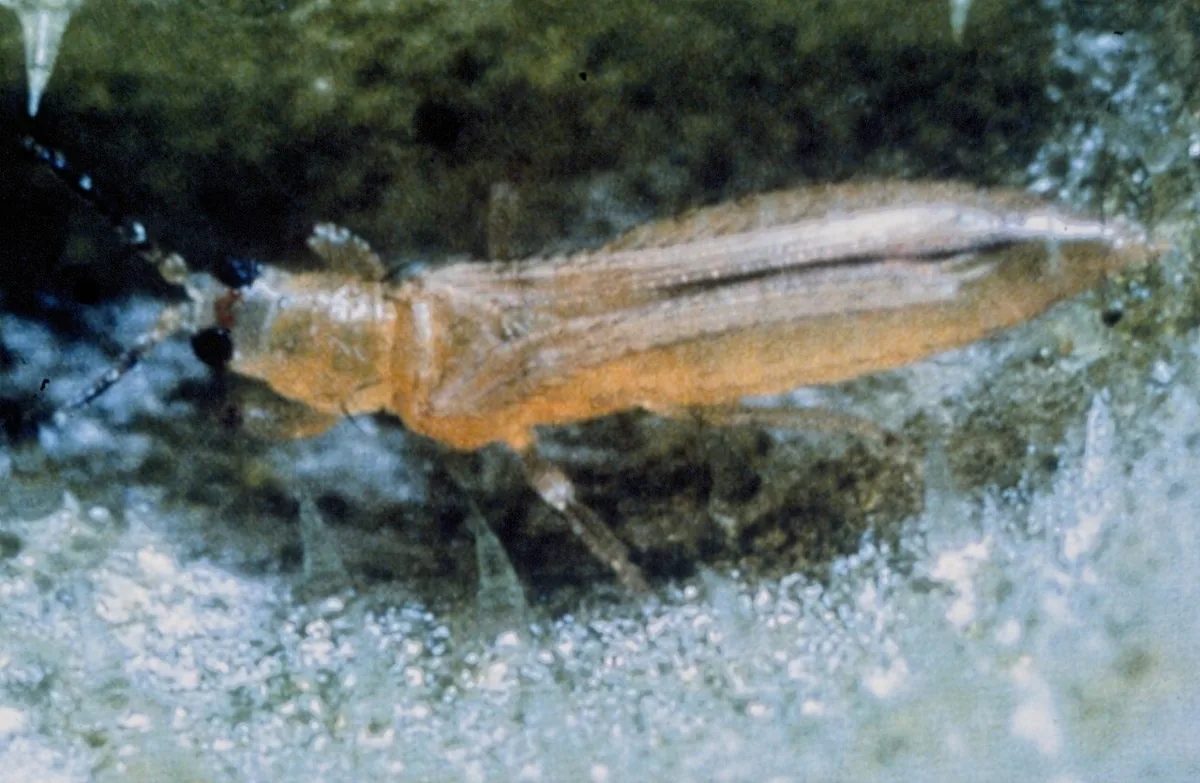
- A very small insect: EPPO puts the female at about 1.3 mm long, with a clear yellow body and blackish bristles. You need a lens or microscope to tell it from other thrips.[1]
- Under a microscope, the pair of bristles between the simple eyes sits outside the triangle the simple eyes form, which helps separate it from the look-alike Thrips flavus.[1]
- Larvae and adults feed in groups along the midribs and veins of leaves, at or near growing tips, among petals and on the fruit surface; on cucumbers and melons they are often in the buds, and on eggplant they hide under the calyx of the fruit.[1]
- Look for silvery feeding scars along the leaf midrib and veins and corky marks on fruit; blue or white sticky traps catch the adults.[1]
- UF/IFAS describes adults as pale yellow or whitish, 0.8 to 1.0 mm long, with many dark bristles; where the folded wings meet, a black line runs down the middle of the back. The slender, fringed wings are pale.[4]
- Under magnification the simple eyes on top of the head carry red pigment (grayish in onion thrips), and the pair of bristles near them does not arise inside the triangle the simple eyes form. Thrips species have seven antenna segments; Frankliniella species have eight.[4]
- Larvae look like small, wingless adults and feed in groups along the midrib and veins, usually on older leaves; adults gather on young growth.[4]
Look-alikes
| Look-alike | How to tell them apart |
|---|---|
| Onion thrips | A common, economically less important thrips that EPPO says is easily mistaken for melon thrips; only microscopic examination separates them reliably. UF/IFAS adds that onion thrips is yellowish gray to brown with grayish simple eyes, while melon thrips is yellow with red-pigmented ones.[1][4] |
| Western flower thrips | EPPO lists western flower thrips (Frankliniella occidentalis) among the species that can be confused with melon thrips. A Frankliniella species, it has eight antenna segments instead of seven, and UF/IFAS says it is reported to damage cucumber fruit more than melon thrips does.[1][4] |
| Asian bean thrips | Shares south Florida snap bean fields with melon thrips; it arrived in Miami-Dade County in 2019-2020, and both species concentrate in bean flowers.[2] |
Where it lives
Described from Sumatra in 1925 and widespread in Asia, it has spread to Africa, Australia and the Pacific, Central and South America and the Caribbean. EPPO lists it in the United States from Florida and Hawaii, and also from Puerto Rico and the U.S. Virgin Islands; GBIF holds 12 U.S. records since 1990, from Florida, Hawaii and North Carolina. It is a pest of warm regions outdoors and of greenhouses elsewhere. UF/IFAS gives U.S. first records in Hawaii in 1982, Puerto Rico in 1986 and Florida in 1990, and says that in Florida it is a field pest only south of Orlando; outdoors it is likely to stay limited to tropical areas, but it could infest greenhouse crops widely.[1][5][4]
Biology and life cycle
Females insert their eggs into plant tissue, where they are impossible to see. The second-stage larva drops into the soil, where it develops and pupates, and new adults climb back to the leaves or flowers.[1]
It breeds fast in warmth. At 25 °C (77 °F) one egg-to-egg cycle takes 17.5 days and a female averages 59.6 eggs; on bean leaves at 26 °C the life cycle took 11.5 days, and in central Taiwan the species was estimated to fit in 25-26 generations a year.[1]
In south Florida, researchers report that numbers are higher in fall and spring than in summer, when heat and frequent rain make conditions worse for reproduction.[2]
In south Florida snap bean fields, melon thrips were most numerous in flowers, then leaves, then pods, and they mostly occurred in clumps rather than spread evenly.[2]
In a Florida field trial the most melon thrips, adults and larvae, were found on eggplant, followed by cucumber, snap bean, squash and jalapeño pepper; tomato had the fewest.[3]
Females cut a slit in leaf tissue and lay a colorless to pale white, bean-shaped egg in it. A female lays up to about 200 eggs, about 50 on average, and both mated and unmated females lay eggs.[4]
Heat speeds everything up: UF/IFAS says a generation takes about 20 days at 30 °C (86 °F) but 80 days at 15 °C (59 °F), and the egg stage lasts about 16 days at 15 °C, 7.5 days at 26 °C and 4.3 days at 32 °C.[4]
After two larval stages the insect usually drops to the soil or leaf litter and builds a small earthen chamber, where it passes through two non-feeding stages before emerging. Adult females live 10 to 30 days and males 7 to 20.[4]
Damage and signs
- Leaves turn silvery or bronzed with tiny feeding spots, and fruits get corky marks; heavy infestations scar and deform plants and can kill them.[1]
- It feeds mostly on the squash and nightshade families: EPPO lists eggplant, peppers, cucumber, melon, watermelon, squash, beans, peas, cowpea, potato, soybean, sunflower, sesame, cotton and tobacco, plus flowers of citrus in Florida and orchids in Hawaii. In Japan it does not attack tomato, but it has been recorded on outdoor tomato crops in the Caribbean.[1]
- It spreads plant viruses, including groundnut bud necrosis virus in India, watermelon silver mottle virus in Japan and Taiwan, and melon yellow spot, capsicum chlorosis and watermelon bud necrosis viruses. EPPO notes these are related to tomato spotted wilt virus, but melon thrips has not yet been shown to carry tomato spotted wilt itself.[1]
- In Guadeloupe it had disastrous effects on melons, cucumbers, eggplant and peppers, and eggplant exports fell from 5000 tonnes in 1985 to 1600 tonnes in 1986.[1]
- UF/IFAS describes leaves turning yellow, white or brown, then crinkling and dying; heavily infested fields can take on a bronze color, and new growth may be discolored, stunted and deformed. Fruit can be scarred or deformed and young fruit may abort.[4]
- On pepper, a less favored host, it feeds in the flowers rather than on the leaves, and pepper and eggplant fruit are damaged when it feeds in the blossoms. UF/IFAS says tomato is reported as a host in the Caribbean but not in the United States or Japan.[4]
- Beyond vegetables, UF/IFAS lists avocado, carnation, chrysanthemum, citrus, cotton, hibiscus, mango, peach, plum, soybean and tobacco among crops it infests, and weeds in the nightshade, legume and aster families can serve as hosts.[4]
Health risk
EPPO and Florida researchers describe melon thrips only as a pest of crops and a carrier of plant viruses; they mention no harm to people or pets. The UF/IFAS profile likewise treats it only as a crop pest and plant-virus carrier.[1][2][4]
Control
Prevention
Grow vegetables on metalized, UV-reflective plastic mulch: in Florida field trials it cut melon thrips numbers on eggplant, cucumber, squash, snap bean, jalapeño and tomato compared with other mulches or bare ground, and the authors recommend it as part of an IPM program.[3]
In one study, sweet and jalapeño peppers were sensitive to leaf injury while cubanelle and cayenne types still produced good fruit. UF/IFAS notes this is the reverse of how they respond to western flower thrips, so variety choice alone won't solve mixed infestations.[4]
Keep them out
Check transplants and produce: melon thrips travels long distances on plants, fruit (for example under the calyx of eggplant) and packing material, and most interceptions have been on ornamentals such as orchid cut flowers, eggplant and bitter melon.[1]
Fine mesh and row covers keep thrips out of greenhouses and slow their settling on field crops. Organic mulch is thought to interfere with winged thrips colonizing a crop, and plastic mulch is also reported to limit populations. Heavy rainfall is thought to cut numbers.[4]
Traps and physical control
Monitor with blue or white sticky traps or water-tray traps, and sample flowers as well as leaves, since that is where most melon thrips are found in beans.[1][2]
Biological control
Many predators attack it, notably minute pirate bugs (Orius) and predatory mites, along with a few parasitoids and insect-killing fungi. Releasing them is not yet efficient in open fields, but EPPO says melon thrips has become rare in open crops in the Lesser Antilles mainly through natural biological control and by avoiding pesticides that harm beneficials.[1]
UF/IFAS says predators matter a great deal: in Hawaii the most important were the predatory thrips Franklinothrips vespiformis and especially the minute pirate bug Orius insidiosus, and the parasitic wasp Ceranisus menes has been introduced to Florida. Fungi including Beauveria bassiana also attack it.[4]
Pesticides
Sprays often disappoint: melon thrips resists some insecticides, and much of the population is hidden as eggs inside leaves and pupae in the soil. EPPO notes that imidacloprid and pyrethroids have been used but can seriously harm natural enemies, and in glasshouse trials in Japan no repeated insecticide program gave more than 80 percent kill without added cultural and mechanical methods. Researchers in Florida aim to target sprays using sampling so fewer are needed. UF/IFAS adds that there are strong signs some insecticides increase melon thrips numbers and damage, that spraying is usually inadvisable when predators are present, and that pyrethroids in particular should be avoided.[1][2][4]
Where the sources disagree
Adult size: EPPO puts the female at about 1.3 mm long; UF/IFAS gives 0.8 to 1.0 mm for adults.[1][4]
Egg numbers: UF/IFAS says a female lays up to about 200 eggs, about 50 on average; EPPO gives an average of 59.6 eggs at 25 °C.[4][1]
Tomato spotted wilt virus: the UF/IFAS profile says melon thrips can transmit some strains of tomato spotted wilt virus and bud necrosis virus; EPPO says the viruses it carries are related to tomato spotted wilt virus but that melon thrips has not yet been shown to carry that virus itself.[4][1]
Common questions
- Is melon thrips found in my state?
- EPPO lists it in the United States from Florida and Hawaii, plus Puerto Rico and the U.S. Virgin Islands. GBIF holds only 12 U.S. records since 1990. It is mainly a pest of warm regions; in Japan it can overwinter outdoors only in a small part of the south, though it has caused large greenhouse outbreaks there. UF/IFAS adds that in Florida it has been a field pest only south of Orlando.[1][5][4]
- Why don't insecticides control melon thrips well?
- Its eggs are inside the leaves and its pupae are in the soil, where sprays don't reach, and some populations resist certain insecticides. Broad sprays such as pyrethroids also kill the predators that help keep it down.[1]
- How can I tell melon thrips from onion thrips?
- Not by eye. EPPO says melon thrips is easily mistaken for onion thrips (Thrips tabaci) and Thrips flavus and that microscopic examination is needed; send a sample to your extension office or plant diagnostic lab. With a strong lens an expert looks at the simple eyes: red-pigmented in melon thrips, grayish in onion thrips.[1][4]
- Will reflective mulch help in my vegetable garden?
- In Florida field trials, metalized UV-reflective mulch significantly reduced melon thrips on all six vegetables tested compared with other mulches and bare soil.[3]
- Is it a problem on peppers?
- It can be, but UF/IFAS calls pepper a less favored host. On pepper it feeds mainly in the flowers, and cubanelle and cayenne types tolerated it better than sweet and jalapeño types in one study.[4]
Sources
- European and Mediterranean Plant Protection Organization (EPPO) Global Database, “Thrips palmi (THRIPL) datasheet.” gd.eppo.int/taxon/THRIPL/datasheet (accessed 2026-11-14)
- Insects (MDPI), “Within-Plant and Within-Field Distribution Patterns of Asian Bean Thrips and Melon Thrips in Snap Bean (Adhikari et al. 2023, Insects 14:175).” pmc.ncbi.nlm.nih.gov/articles/PMC9960844/ (accessed 2026-11-14)
- Environ Entomol 2019;48(2):434-443, via PubMed, “Host Preference and Plastic Mulches for Managing Melon Thrips (Thysanoptera: Thripidae) on Field-Grown Vegetable Crops.” pubmed.ncbi.nlm.nih.gov/30850845/ (accessed 2026-11-14)
- University of Florida/IFAS Extension (EDIS, Featured Creatures), “Melon Thrips, Thrips palmi Karny (Insecta: Thysanoptera: Thripidae), EENY135/IN292 (J. L. Capinera).” ask.ifas.ufl.edu/publication/IN292 (accessed 2026-11-14)
- Global Biodiversity Information Facility (GBIF), “Thrips palmi: U.S. occurrence records since 1990 by state (GBIF occurrence search).” api.gbif.org/v1/occurrence/search?taxonKey=1420906&country=US&hasGeospatialIssue=false&occurrenceStatus=PRESENT&year=1990%2C2026&facet=stateProvince&facetLimit=400&limit=0 (accessed 2026-11-14)
- iNaturalist, “Thrips palmi taxon page (order and family).” www.inaturalist.org/taxa/330696 (accessed 2026-11-14)