On this page
How to identify it
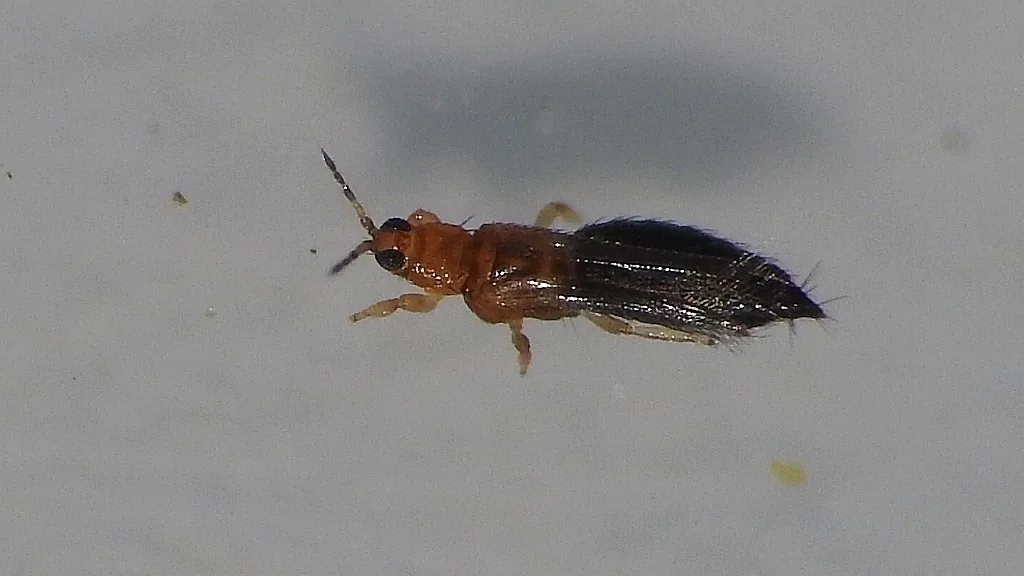
- Adult females are about 1 mm long and, according to the Queensland Government, bright orange and black.[3]
- Males are smaller, about 0.75 mm, and pale straw-colored.[3]
- The clear wings have a fringe of hairs around the edge. A 10x hand lens makes the adults easy to see.[3]
- Larvae are wingless, smaller than adults, and pale to almost transparent.[3]
- It is a flower thrips. On bananas, females hide under the bracts or inside flowers, while males sit on the outside of the bracts.[1][3]
Where it lives
Native to Asia and the Pacific, and now found in Asia, Australia, the Americas, Africa and Europe. In the United States it has been collected, in low numbers, in Florida citrus orchards.[1][2]
Biology and life cycle
Females lay eggs just under the surface of young banana fruit and the bunch stalk. Two active larval stages are followed by two or three pupal stages.[3]
On a banana bunch the whole life cycle takes about three weeks.[3]
It has a wide host range that includes ornamental plants, fruits and vegetables, but it does better on some hosts than others. In a Chinese study, females were drawn to the scent of southern magnolia (Magnolia grandiflora) flowers, one of its preferred hosts.[1]
In banana-growing areas of northern Queensland it is active all year, and fruit harvested in winter or spring is usually the most damaged, which points to peak activity after the wet season.[3]
Damage and signs
- On bananas, feeding causes corky scab: slightly raised grey-brown to silvery patches that turn into brown, corky scabs. Damage is mostly on the outer curve of the fruit near where it joins the stalk, and the bottom hands, closest to the male flower, are most at risk.[3]
- Egg-laying leaves tiny raised spots with a dark center on young banana fruit. They become almost unnoticeable as the fruit grows and matter little.[3]
- Feeding and egg-laying also leave dark brown to black bumps on banana flower buds, which are also used for food and medicine.[4]
- In Florida citrus orchards it was found in low numbers, and researchers consider it a potential pest of citrus and possibly other crops there.[2]
Health risk
The sources describe it only as a plant pest of flowers and fruit; they mention no harm to people.[3][1]
Control
Prevention
On bananas, observations and growers' reports suggest overhead irrigation prevents corky scab in most situations. Removing the male bell, where adults gather once all the hands are exposed, may also help, though it has not been tested.[3]
Traps and physical control
Colored sticky traps and scent lures are more useful for telling when the thrips are present than for reducing their numbers.[4]
Biological control
Predatory bugs, lady beetles and lacewings help reduce thrips numbers on bananas.[3]
Pesticides
Insecticides are the main field control for banana flower thrips, but they bring residue, resistance and pest-resurgence problems. In Queensland, cover sprays are not recommended because they disrupt beneficial insects; injecting insecticide into the developing bunch has prevented corky scab in the north of the state. Numbers of thrips do not track damage closely, so check local extension advice before spraying.[4][3]
Common questions
- What causes brown corky scabs on homegrown bananas?
- Banana flower thrips (Thrips hawaiiensis) cause corky scab. Their feeding first leaves raised grey-brown to silvery patches that turn brown and corky, mostly on the outer curve of the fruit and on the bottom hands of the bunch.[3]
- Is the Hawaiian flower thrips found on the US mainland?
- Yes. It has been collected in Florida citrus orchards, in low numbers, and researchers consider it a potential pest of citrus and possibly other crops there.[2]
- What does the Hawaiian flower thrips look like?
- Females are about 1 mm long and orange and black; males are smaller and pale straw-colored. Adults have clear wings fringed with hairs.[3]
Sources
- Insects (MDPI), “Electrophysiological and Behavioral Responses of Thrips hawaiiensis to the Floral Volatiles of Magnolia grandiflora (Insects 2025, 16:633).” pmc.ncbi.nlm.nih.gov/articles/PMC12193323/ (accessed 2026-11-09)
- Journal of Insect Science, via PubMed, “Thysanoptera (thrips) within citrus orchards in Florida: species distribution, relative and seasonal abundance (Childers & Nakahara 2006).” pubmed.ncbi.nlm.nih.gov/20233100/ (accessed 2026-11-11)
- Business Queensland, Queensland Government, “Banana flower thrips (Thrips hawaiiensis).” business.qld.gov.au/industries/farms-fishing-forestry/agriculture/biosecurity/plants/insects/horticultural/banana-flower-thrips (accessed 2026-11-09)
- PLoS ONE, “Effects of flower thrips (Thysanoptera: Thripidae) on nutritional quality of banana (Zingiberales: Musaceae) buds (PLoS ONE 2018, 13:e0202199).” pmc.ncbi.nlm.nih.gov/articles/PMC6086469/ (accessed 2026-11-09)
- iNaturalist, “Thrips hawaiiensis taxon page (order and family).” www.inaturalist.org/taxa/417798 (accessed 2026-11-09)