On this page
How to identify it
- They are smaller than 0.2 mm (about 1/100 inch), yellowish, and adult females have a white stripe on the back. UF/IFAS gives females as about 0.2 mm (0.008 inch), oval, swollen in profile and light yellow to amber or green, with a faint light stripe that forks near the rear and hind legs reduced to whip-like threads. Males lack the stripe and are smaller (0.11 mm) and faster.[1][2][4]
- UC IPM says you need a hand lens to see them; Penn State says 30 to 60x magnification is needed and suggests asking your local Extension office for help.[2][1]
- The eggs are the giveaway: translucent and dimpled, dotted with white speckles, often laid in small depressions on fruit. UF/IFAS gives the eggs as colorless, elliptical and about 0.08 mm long, with 29 to 37 white tufts on the upper surface.[2][1][4]
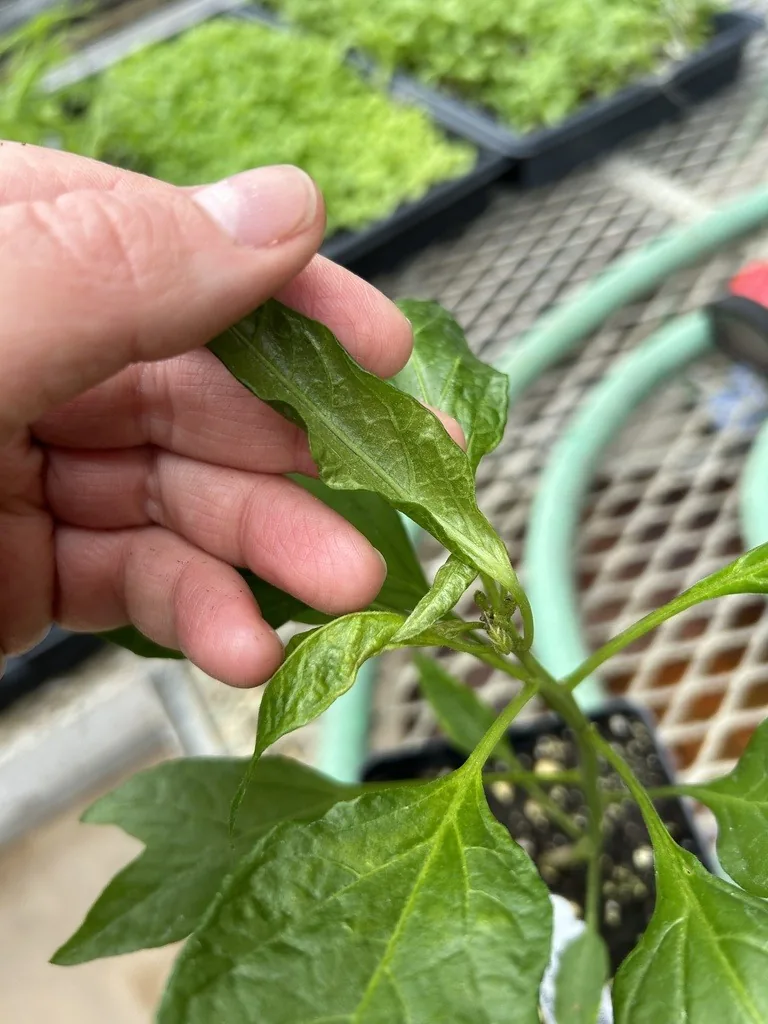
- Usually the plant symptoms are noticed first, and they mimic other problems: fire blight on blackberries (Penn State), and glyphosate injury, boron deficiency or physiological disorders on citrus (UC IPM). UF/IFAS adds that in late winter some leaf curling on New Guinea impatiens is a physiological disorder, not broad mite injury.[1][2][4]
- UF/IFAS says larvae have only three pairs of legs, move slowly and look whitish, and the resting nymph stage is clear and pointed at both ends.[4]
Look-alikes
| Look-alike | How to tell them apart |
|---|---|
| Cyclamen mite | Both are tiny, web-free mites found by their symptoms. Colorado State notes cyclamen mite stunts and twists new growth, especially on African violet, while broad mite bronzes the leaf underside on plants such as citrus and begonias.[5] |
Where it lives
It is a pest of crops and ornamentals worldwide and is commonly a problem in greenhouses. It was first found on blackberries in Pennsylvania in 2013 and has since turned up in plantings across the eastern U.S. States named in the cited sources are Pennsylvania and Arkansas (blackberries), California (coastal lemons) and Colorado (houseplants). UF/IFAS notes its other names, including yellow tea mite in India and Sri Lanka, yellow jute mite in Bangladesh, and tropical mite or broad rust mite in parts of South America, and says USDA-ARS found it on watermelons in the U.S. for the first time in 2006.[6][1][7][2][5][4]
Biology and life cycle
Development is fast in warmth. On azalea leaves, egg to adult took 13.3 days at 15 degrees C (59 F) but only 4.2 days at 25 degrees C (77 F).[8]
Adult females handled 6 weeks at 7 degrees C (45 F) without significant losses, but freezing temperatures sharply cut survival.[9]
It spreads on infested plants, on workers' tools and by hitching rides on whiteflies, aphids and possibly thrips. Penn State thinks early blackberry infestations started on greenhouse-propagated plants.[1]
Populations are worst in warm, humid conditions such as greenhouses. On California coastal lemons they are occasional pests from late July through early October, often alongside citrus rust mite.[2]
UC IPM says Argentine ants enhance infestations on coastal lemons.[2]
UF/IFAS says females lay 30 to 76 eggs, about five a day, on leaf undersides and in depressions of small fruit over 8 to 13 days and then die; males live 5 to 9 days. Eggs hatch in two or three days, larvae rest after two or three more, and the nymph stage lasts about a day.[4]
UF/IFAS says unmated females lay only male eggs, while mated females usually lay four female eggs for every male. Males pick up resting female larvae and carry them to new leaves, which accounts for much of a colony's spread.[4]
UF/IFAS lists crop hosts including apple, avocado, citrus, chili, eggplant, grapes, guava, mango, papaya, potato, beans, tea and tomato, and ornamentals including African violet, azalea, begonia, chrysanthemum, cyclamen, gerbera, impatiens and marigold. It calls broad mite a serious pest of Pittosporum in Florida.[4]
Damage and signs
- New leaves curl or cup upward or downward, terminal growth is stunted or dies back, and flower clusters look compressed or dry up. Populations can reach hundreds per leaflet on young terminal leaves.[1]
- On primocane-fruiting blackberries Penn State has seen nearly total crop loss; floricane-fruiting varieties have been less affected.[1]
- On citrus they feed mostly on young fruit up to about 1 inch across, leaving scars that crack as the fruit grows.[2]
- Peppers are highly susceptible: six bell pepper varieties tested in Brazil all showed low tolerance and injury.[3]
- UF/IFAS says the mite's toxic saliva makes new growth twisted, hardened and distorted: leaves turn down and become coppery or purplish, internodes shorten, side buds break more than normal, and with large populations blooms abort and growth stalls.[4]
- On fruit trees UF/IFAS says the damage is usually on the shaded side of the fruit, so it is easy to miss; fruit is discolored, may drop early in severe cases, and badly damaged fruit can't be sold fresh.[4]
Health risk
It feeds only on plants, and no cited source describes any risk to people or pets.[1][2][5]
Control
Prevention
Start with clean plants: mites move on plant material and on workers' tools from patch to patch, and early blackberry infestations may have come from greenhouse-propagated plants.[1]
Sanitation
If only a plant or two shows symptoms, remove them along with a couple of plants on each side.[1]
Traps and physical control
UF/IFAS says plants can be dipped in water held at 43 to 49°C (109.4 to 120.2°F) for 15 minutes to kill the mites without injuring the plants.[4]
Biological control
Conserve natural enemies, release predatory mites early enough for them to establish, and avoid broad-spectrum insecticides. In greenhouse peppers, the predatory mite Neoseiulus californicus combined with resistant varieties improved broad mite management. UF/IFAS says several predatory mite species are available for large areas and greenhouses.[1][10][4]
Pesticides
Spray only when scouting shows enough mites. A blackberry study notes a threshold of 5 mites or one egg per leaflet, and Penn State cites a University of Arkansas threshold of 1 to 5 mites per leaflet. Choose a miticide least toxic to predatory mites. Penn State recommends only one miticide application a year because resistance develops easily, then scouting again before spraying a second time.[7][1][2]
UF/IFAS says insecticidal oils or soaps are usually just as effective as miticides and less toxic to the environment.[4]
Where the sources disagree
Magnification: UC IPM says a hand lens is enough, while Penn State says 30 to 60x magnification is needed. UF/IFAS says a 10X or stronger hand lens is needed.[2][1][4]
When to spray: UC IPM says no treatment thresholds have been developed for broad mite in citrus, Penn State cites a University of Arkansas threshold of 1 to 5 mites per leaflet on blackberries, and a 2025 blackberry study uses 5 mites or one egg per leaflet.[2][1][7]
Symptoms: Colorado State describes bronzing of the leaf underside on plants such as citrus and begonias, Penn State curled or cupped leaves, stunted tips and compressed flower clusters on blackberries, and UC IPM scarred fruit and leaf curl on lemons.[5][1][2]
One species or several: the extension sources treat it as a single species, while Mexican researchers found large genetic differences between populations and say their results strengthen the idea that it is a complex of species.[1][2][6]
Common questions
- Why are the new leaves on my pepper plant twisted and cupped?
- Broad mites are one cause, but herbicide injury and boron deficiency can look similar, so check the leaves under magnification for mites and their speckled eggs.[2][1]
- Can I see broad mites?
- Not with the naked eye. They are under 0.2 mm; Penn State says 30 to 60x magnification is needed, so ask your Extension office for help.[1]
- Can I scout for broad mites without a microscope?
- On blackberries, yes, roughly: a University of Arkansas study found visual injury ratings track mite numbers, and a rating of 2 on a 1-to-5 scale meant 72% of samples were above the treatment threshold.[7]
- Do soap or oil sprays work on broad mites?
- UF/IFAS says insecticidal oils or soaps are usually just as effective as miticides and less toxic to the environment.[4]
Sources
- Penn State Extension, “Small Fruit Mite: Broad Mites on Blackberries.” extension.psu.edu/small-fruit-mite-broad-mites-on-blackberries (accessed 2026-11-14)
- University of California Statewide IPM Program, “Broad Mite (Citrus: Pest Management Guidelines).” ipm.ucanr.edu/agriculture/citrus/broad-mite/ (accessed 2026-11-14)
- Bulletin of Entomological Research, via PubMed, “Breda MO, de Oliveira JV, Esteves Filho AB, Barbosa DR, de Santana MF (2016), Host preference, population growth and injuries assessment of Polyphagotarsonemus latus on Capsicum annuum genotypes, Bulletin of Entomological Research 106(5):672-678.” pubmed.ncbi.nlm.nih.gov/27296280/ (accessed 2026-11-13). Cited from the PubMed abstract.
- University of Florida IFAS Extension (EDIS), “Broad Mite, Polyphagotarsonemus latus (Banks), EENY-183/IN340 (Featured Creatures).” ask.ifas.ufl.edu/publication/IN340 (accessed 2026-11-14)
- Colorado State University Extension, “Managing Houseplant Pests.” extension.colostate.edu/resource/managing-houseplant-pests/ (accessed 2026-11-13)
- PLoS One, via PubMed, “Ovando-Garay V, Gonzalez-Gomez R, Zarza E, Castillo-Vera A, de Coss-Flores ME (2022), Morphological and genetic characterization of the broad mite Polyphagotarsonemus latus from two Mexican populations, PLoS One 17(4):e0266335.” pubmed.ncbi.nlm.nih.gov/35446869/ (accessed 2026-11-13). Cited from the PubMed abstract.
- Journal of Economic Entomology, via PubMed, “Linn JB, Cato AJ, McWhirt AL, Keiffer RF, Joshi NK (2025), Evaluating broad mite sampling techniques in blackberry, Journal of Economic Entomology 118(3):1354-1362 (University of Arkansas).” pubmed.ncbi.nlm.nih.gov/40260949/ (accessed 2026-11-13). Cited from the PubMed abstract.
- Experimental and Applied Acarology, via PubMed, “Luypaert G, Witters J, Van Huylenbroeck J, Maes M, De Riek J, De Clercq P (2014), Temperature-dependent development of the broad mite Polyphagotarsonemus latus on Rhododendron simsii, Experimental and Applied Acarology 63(3):389-400.” pubmed.ncbi.nlm.nih.gov/24509789/ (accessed 2026-11-13). Cited from the PubMed abstract.
- Experimental and Applied Acarology, via PubMed, “Luypaert G, Witters J, Berkvens N, Van Huylenbroeck J, De Riek J, De Clercq P (2015), Cold hardiness of the broad mite Polyphagotarsonemus latus, Experimental and Applied Acarology 66(1):29-39.” pubmed.ncbi.nlm.nih.gov/25758635/ (accessed 2026-11-13). Cited from the PubMed abstract.
- Pest Management Science, via PubMed, “Fadaei E, Mehrabadi M, Bagheri A, Rashed A, Fathipour Y (2025), An ecofriendly approach to broad mite management: integrating pepper resistance and predatory mite (Neoseiulus californicus) in a tritrophic system, Pest Management Science 81(12):8487-8499.” pubmed.ncbi.nlm.nih.gov/40858521/ (accessed 2026-11-13). Cited from the PubMed abstract.
- Global Biodiversity Information Facility (GBIF), “Polyphagotarsonemus latus (Banks, 1904) (GBIF Backbone Taxonomy).” api.gbif.org/v1/species/2131854 (accessed 2026-11-13)