On this page
How to identify it
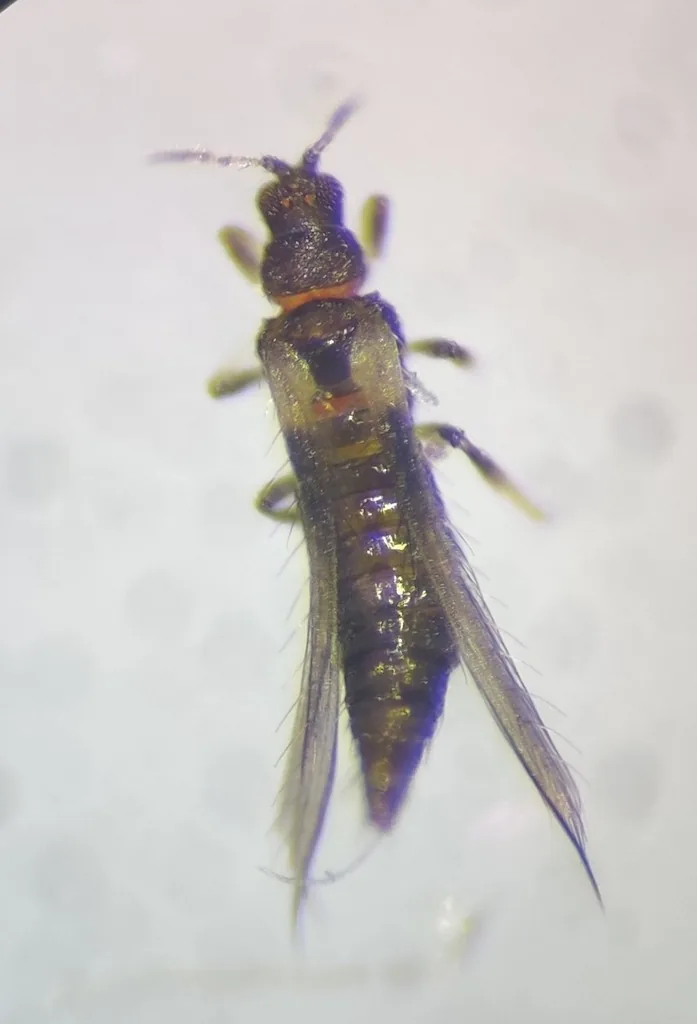
- Adults are relatively dark: females about 1.6 mm (about 1/16 inch) long and males somewhat smaller, about 1.3 mm. The body is dark brown with red between the abdominal segments.[5][4][6]
- The slender wings have pale and dark bands; the legs are dark near the body and pale toward the tips.[4][6][5]
- Larvae are clear just after hatching, then white and pale yellow after feeding, with bright red eyes.[5][4][6]
- It is sluggish, tends to stay on the lower part of plants, and adults and larvae may stay in the same spot on a leaf for days if undisturbed. Turn infested leaves over to see the thrips and their black excrement.[4][5]
Look-alikes
| Look-alike | How to tell them apart |
|---|---|
| Banded greenhouse thrips | In Ontario's greenhouse key, the banded greenhouse thrips (Hercinothrips femoralis) has yellow front legs, brown femurs on the back legs, a head and pronotum often paler than the abdomen, and light bands at the top and tips of the wings. It is also proving hard to control with biocontrol.[1] |
| Greenhouse thrips | Plant Health Australia says the greenhouse thrips (Heliothrips haemorrhoidalis) has no red internal pigment or yellow legs, and its forewings are paler than the poinsettia thrips'.[6] |
Where it lives
Native to the eastern United States, where it is a pest mostly in the southern part of its range. First reported from Florida in 1913, it spread through the eastern U.S. and into southern Canada, reached Europe in 1989 and Asia (Thailand) in 2000, with later records from Japan, Indonesia, China and Puerto Rico.[8][4][7][6]
Biology and life cycle
Females insert eggs one at a time into slits in the leaf tissue. Larvae go through two stages, then a prepupa and pupa that rest on the leaf and move only when disturbed.[5][4]
Development depends on temperature: at 15°C (59°F) the egg stage averaged 15.5 days and egg to adult took 33.9 days, while at 30°C (86°F) egg to adult took 11.4 days. NC State gives 12 to 33 days from egg to new adult. All stages occur year-round in greenhouses.[5][4]
It reproduces both sexually and by unmated females, which produce only sons. In lab work, mated females lived longer, laid eggs for longer, and had higher fecundity and survival than unmated ones. It carries Wolbachia bacteria.[9][2]
Fun fact: although a male poinsettia thrips has all his sperm ready when he becomes an adult, he can still inseminate 10 females with an equal amount of sperm.[8]
It has a wide host range, about 106 plant species in 48 families. In a Georgia experiment it fed and reproduced on 40 of 51 cultivated and 59 of 75 native plants tested. Poinsettia, Irish shamrock and impatiens are the most common greenhouse hosts there, and it also infests chrysanthemum, witch hazel and woody ornamentals.[7][5][4]
Damage and signs
- Larvae and adults make many shallow punctures and remove the cell contents, including chlorophyll, leaving light spots and shrunken-looking tissue much like mite damage, plus numerous black specks of excrement. Damage can resemble sun scald until the leaves are turned over. They also feed on flowers.[5][4][6]
- The damage mainly lowers the value of ornamental plants and greenhouse vegetables. Plant Health Australia notes it has the potential to vector viruses.[7][6]
- In Ontario greenhouse flower crops it was among the less common pest thrips (with others, under 8 percent of specimens), but it is proving difficult or expensive to control with biological control, so chemical sprays are needed during outbreaks.[1]
Health risk
The sources describe it only as a plant-feeding pest; none mentions any risk to people or pets.[4][5][6]
Control
Traps and physical control
Inspect plants by turning leaves over and looking for the thrips, pale spotting and black specks. Larvae cannot fly but walk between plants, and most long-distance spread is on infested nursery stock and other plant material, so check plants often for new pests.[4][6]
Biological control
The predatory bug Macrolophus pygmaeus cut poinsettia thrips on gerbera plants to very low levels in a greenhouse test. Phytoseiid predatory mites ate every stage except adults, and cattail pollen boosted mite numbers without feeding the thrips. Still, researchers note current biological controls lack efficiency, so chemicals remain the main greenhouse strategy.[12][10][11]
Pesticides
NC State says horticultural oil and insecticidal soaps give adequate control, and most insecticides labeled for residential landscape use should also suppress it; it does not appear resistant to pesticides. Do not spray flowers, keep watching treated plants afterward, and follow the label.[4]
Where sources disagree
Spread: NC State calls it sluggish and says it does not spread rapidly unless blown in on breezes; Plant Health Australia says adults can fly and spread through crops rapidly.[4][6]
Egg to adult: NC State gives 12 to 33 days; the Minnesota sheet gives 11.4 days at 30°C and 33.9 days at 15°C.[4][5]
Common questions
- How do I tell if my poinsettia or impatiens has poinsettia thrips?
- Turn the leaves over. Look for slender dark adults, pale larvae with bright red eyes, light spotting and black specks of excrement on the lower surfaces.[4][6]
- Does the poinsettia thrips only attack poinsettias?
- No. It feeds on about 106 plant species in 48 families, especially poinsettia, Irish shamrock and impatiens, and also chrysanthemum, witch hazel and woody ornamentals.[7][5][4]
- Is the poinsettia thrips native?
- Yes. It is native to the eastern United States; it was first reported in 1913 on a plant in Florida and had spread over most of the eastern U.S. by 1968.[8][7]
- What kills poinsettia thrips on houseplants?
- NC State says horticultural oil and insecticidal soaps give adequate control. Don't spray the flowers, and keep checking the plants afterward.[4]
Sources
- Insects (MDPI), “Thrips Species Composition in Ontario Greenhouse Floriculture: Innovative Identification Tools and Implications for Pest Management (Insects 2024, 15:94).” pmc.ncbi.nlm.nih.gov/articles/PMC10971553/ (accessed 2026-11-12)
- Environmental Entomology (Entomological Society of America), “First detection of Wolbachia in arrhenotokous populations of thrips species (Thysanoptera: Thripidae and Phlaeothripidae) and its role in reproduction (Kumm and Moritz 2008, Environmental Entomology 37:1422-1428), abstract.” pubmed.ncbi.nlm.nih.gov/19161685/ (accessed 2026-11-12)
- iNaturalist, “Echinothrips americanus taxon page (order and family).” www.inaturalist.org/taxa/506713 (accessed 2026-11-12)
- NC State Extension, “Poinsettia Thrips (PDIC Factsheet).” content.ces.ncsu.edu/poinsettia-thripps (accessed 2026-11-12)
- University of Minnesota Department of Entomology, “Greenhouse & Nursery Insect Pest ID: Echinothrips americanus (from NC State AG-136).” ncipmhort.cfans.umn.edu/sites/ncipmhort.cfans.umn.edu/files/2022-03/Echinothrips_americanus.pdf (accessed 2026-11-12)
- Plant Health Australia, “Fact sheet: Poinsettia thrips.” www.planthealthaustralia.com.au/wp-content/uploads/2024/01/Poinsettia-thrips-FS.pdf (accessed 2026-11-12)
- Ecology and Evolution (2026), via PubMed Central, “Current and Future Potential Distribution of the Invasive Thrips Echinothrips americanus (Terebrantia: Thripidae).” pmc.ncbi.nlm.nih.gov/articles/PMC13148137/ (accessed 2026-11-12)
- Journal of Insect Science (2017), via PubMed Central, “Reproductive Behavior of Echinothrips americanus (Thysanoptera: Thripidae).” pmc.ncbi.nlm.nih.gov/articles/PMC5469385/ (accessed 2026-11-12)
- Environmental Entomology (2012), via PubMed, “Comparisons of developmental and reproductive biology between parthenogenetic and sexual Echinothrips americanus.” pubmed.ncbi.nlm.nih.gov/22732630/ (accessed 2026-11-12). Cited from the PubMed abstract.
- Experimental and Applied Acarology (2017), via PubMed, “Biological control of Echinothrips americanus by phytoseiid predatory mites and the effect of pollen as supplemental food.” pubmed.ncbi.nlm.nih.gov/29128983/ (accessed 2026-11-12). Cited from the PubMed abstract.
- Experimental and Applied Acarology (2023), via PubMed, “Why are phytoseiid predatory mites not effectively controlling Echinothrips americanus?.” pubmed.ncbi.nlm.nih.gov/37285108/ (accessed 2026-11-12). Cited from the PubMed abstract.
- Insect Science (2020), via PubMed, “The omnivorous predator Macrolophus pygmaeus, a good candidate for the control of both greenhouse whitefly and poinsettia thrips on gerbera plants.” pubmed.ncbi.nlm.nih.gov/30549212/ (accessed 2026-11-12). Cited from the PubMed abstract.