On this page
How to identify it
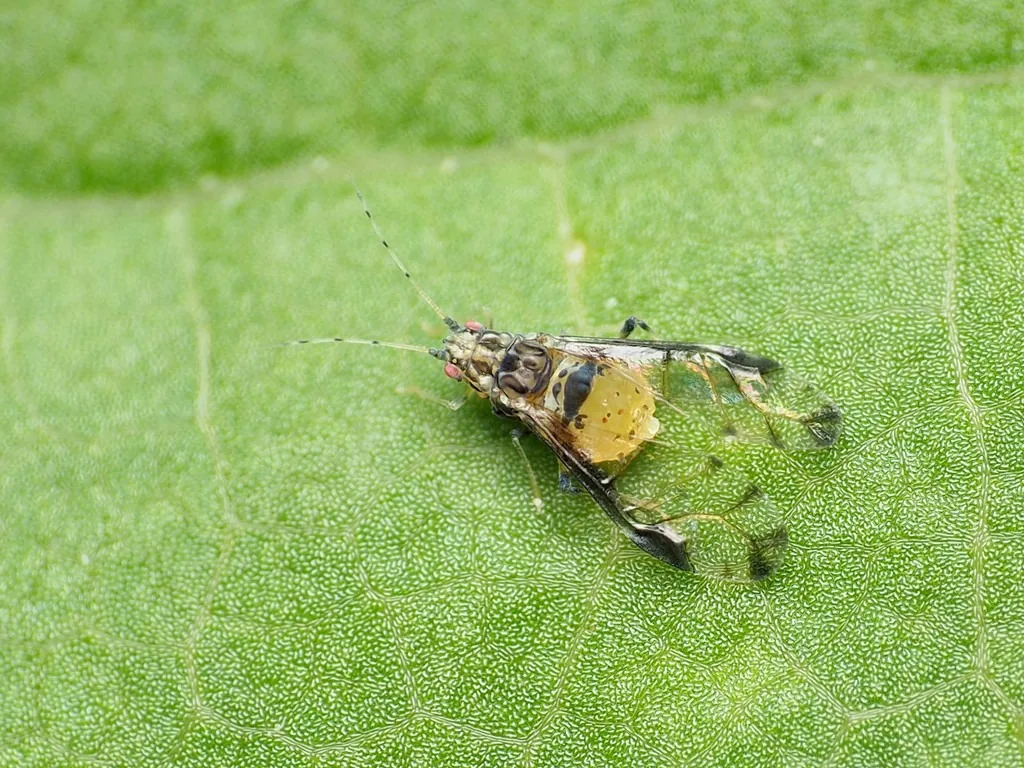
- The aphids are pale yellowish green with black spots on the abdomen and range from 1/16 to 1/8 inch long. UF/IFAS describes nymphs as pale to bright yellow with black spiky hairs on the abdomen, and adults as yellow with black spots and two large black bumps on top of the abdomen.[1][6]
- Look on the leaves, especially the undersides, and on the twigs of crape myrtle.[1]
- The overwintering eggs are shiny black and are laid in small folds and crevices on the branches.[4]
- Unlike other aphids, which produce winged forms only in response to environmental or reproductive cues, every adult crapemyrtle aphid has wings, held rooflike over the body and mottled with black.[6]
Look-alikes
| Look-alike | How to tell them apart |
|---|---|
| Other aphids | This species feeds only on crape myrtle; UC IPM lists crape myrtle as its host. Aphids on any other plant belong to a different species.[1][2] |
| Crapemyrtle bark scale | Also a crape myrtle pest, but a scale insect that builds up heavily on stems and trunks rather than on the leaves.[1] |
Where it lives
A common pest of crape myrtle throughout the southeastern United States and the most common insect on crape myrtle in South Carolina. It also occurs outside North America: a 2006 study reported its winter eggs on crape myrtle in Brazil. UF/IFAS adds that it is native to southeast Asia, was described from specimens collected in Hawaii, and occurs throughout the tropics, India, China, Korea, Japan, the southeastern U.S., Hawaii and anywhere crapemyrtle is grown.[3][1][4][6]
Biology and life cycle
Winter is passed as eggs, which hatch in spring. Through the growing season females give birth to live young, and each aphid takes about 10 days to mature, so several generations follow one another each season. Late in the season females lay the eggs that overwinter.[1]
In a Brazilian survey of crape myrtle branches, winter eggs sat mostly 30 to 60 cm (about 1 to 2 feet) back from the branch tips, and trees 20 to 30 years old carried more eggs than trees 5 to 10 years old.[4]
Cultivar matters: in a Florida test of seven crape myrtle cultivars, the total number of young each aphid produced differed by cultivar, parentage, source of Lagerstroemia fauriei germplasm and mature plant height, and aphids given a choice preferred some cultivars over others.[3]
UF/IFAS details the cycle: all aphids hatching from the overwintering eggs in early spring, as leaf buds break, are females that give live birth without mating, and so are their daughters through spring and summer. When days shorten and temperatures fall in autumn, a generation that produces both males and females appears, and the mated females lay four to six eggs each in bark crevices on the stems.[6]
There are four nymphal stages. Under optimal conditions a nymph can reach adulthood in five days and start giving birth at once, six or more young within 24 hours; adults may live 14 days and produce over 150 young, which is why infestations often go unnoticed until they reach damaging levels.[6]
Crapemyrtle aphids can help the wider garden: green lacewings feed on them when pecan aphids are scarce, and paper wasps, sphecid wasps, ants and parasitoids use the honeydew for energy. UF/IFAS notes that sprays and soaps don't discriminate between predator and prey.[6]
Damage and signs
- Aphids push their mouthparts into tender new leaves and suck sap. Their saliva leaves yellow spots, feeding on young leaves often distorts them, and buds, branch tips and flowers can be affected too.[1]
- They excrete large amounts of honeydew, which can completely coat the leaves when numbers are high. Sooty mold fungi grow on it, and it draws ants, wasps and flies.[1]
- UC IPM notes that aphids seldom kill a mature plant; the honeydew and the look of the tree are usually what prompt control.[2]
- UF/IFAS says crapemyrtle aphids are not known to spread any plant disease. One sooty mold fungus in the genus Capnodium is associated only with their honeydew; severe mold can interfere with photosynthesis and cause early leaf drop or complete defoliation, but plants typically rebound and bloom well in following years.[6]
Health risk
It feeds only on crape myrtle sap; none of the sources mentions any risk to people or pets.[1][2]
Control
Prevention
For new plantings, choose aphid-resistant crape myrtles. Clemson lists a number of Lagerstroemia indica x fauriei hybrids with moderate aphid resistance, among them 'Natchez', 'Muskogee', 'Tuscarora' and 'Sioux'.[1]
Traps and physical control
A strong stream of water knocks many aphids off; repeat as needed.[1][2]
Biological control
Lady beetles and their larvae, green lacewings, hover fly maggots, parasitic wasps and insect-killing fungi all attack crapemyrtle aphids; as far as possible, let them bring numbers down. UF/IFAS singles out the multicolored Asian lady beetle, whose larvae and adults eat large numbers and give natural control while aphid numbers are low, but notes populations often escape their natural enemies near the end of July and early August in Florida.[1][6]
Pesticides
Aphids are hard to control with insecticides because they reproduce so fast, and sprays also kill their predators. If you do treat, insecticidal soap and horticultural oil are the options both Clemson and UC IPM name; follow the label. UF/IFAS says to save insecticidal soap for heavy infestations that have escaped natural control, as a last resort.[1][2][6]
Systemic soil drenches: two views
Clemson says a spring soil drench of imidacloprid will control crapemyrtle aphids and keep working in the plant to prevent later infestations.[1]
UC IPM agrees systemics like imidacloprid are very effective but says they can harm predators, parasitoids and pollinators, so they should be avoided where soaps and oils will do, and never applied to plants in bloom or before bloom. UC IPM, which writes for California, adds that as of January 2025 these materials are available only to licensed pest control professionals.[2]
Where the sources disagree
Parasitic wasps: Clemson lists parasitic wasps among its natural enemies; a 2002 Florida Entomologist note reports that searches in Southeast Asia and elsewhere from 1988 to 2000 found no parasites, apart from one earlier greenhouse report, and calls a parasite-free leaf-feeding aphid unusual.[1][7]
Development time: Clemson says each aphid takes about 10 days to mature; UF/IFAS says it can go from first-stage nymph to adult in five days under optimal conditions.[1][6]
Hosts: UF/IFAS says that in the United States it feeds only on crapemyrtle; the 2002 note adds a report from India of it infesting Lawsonia alba, another plant in the crapemyrtle family.[6][7]
Common questions
- Why is my crape myrtle covered in black mold?
- Crapemyrtle aphids excrete honeydew onto the leaves, and sooty mold fungi grow on it.[1]
- Will crapemyrtle aphids kill my tree?
- Unlikely. They distort and spot new leaves and leave honeydew and sooty mold, but UC IPM notes that aphids seldom kill a mature plant.[1][2]
- Which crape myrtles resist aphids?
- Clemson lists several Lagerstroemia indica x fauriei hybrids, such as 'Natchez', 'Muskogee' and 'Tuscarora', as moderately resistant.[1]
- Will crapemyrtle aphids spread to my other plants?
- No. UF/IFAS says that in the U.S. they feed only on crapemyrtle and don't attack or damage other plants.[6]
Sources
- Clemson Cooperative Extension Home & Garden Information Center, “Crape Myrtle Diseases & Insect Pests in South Carolina.” hgic.clemson.edu/factsheet/crape-myrtle-diseases-insect-pests/ (accessed 2026-11-11)
- University of California Statewide IPM Program, “Pest Notes: Aphids.” ipm.ucanr.edu/home-and-landscape/aphids/ (accessed 2026-11-11)
- Environmental Entomology, via PubMed, “Host preference of the crapemyrtle aphid and host suitability of crapemyrtle cultivars (Herbert et al. 2009).” pubmed.ncbi.nlm.nih.gov/19689894/ (accessed 2026-11-11)
- Neotropical Entomology, via PubMed, “Modeling egg distribution of Tinocallis kahawaluokalani on Lagerstroemia indica (Lazzari & Zonta-de-Carvalho 2006).” pubmed.ncbi.nlm.nih.gov/17273706/ (accessed 2026-11-11)
- iNaturalist, “Sarucallis kahawaluokalani taxon page (order and family).” www.inaturalist.org/taxa/506298 (accessed 2026-11-11)
- University of Florida IFAS Extension, EDIS (Featured Creatures), “Crapemyrtle Aphid, Tinocallis kahawaluokalani (Kirkaldy), EENY-365/IN663 (Featured Creatures).” ask.ifas.ufl.edu/publication/IN663 (accessed 2026-11-14)
- Florida Entomologist (Florida Entomological Society), via Florida Online Journals, “Unsuccessful search for parasites of the crapemyrtle aphid, Tinocallis kahawaluokalani (Mizell, Bennett & Reed 2002), Florida Entomologist 85: 521-523.” journals.flvc.org/flaent/article/view/75134 (accessed 2026-11-14)