On this page
How to identify it
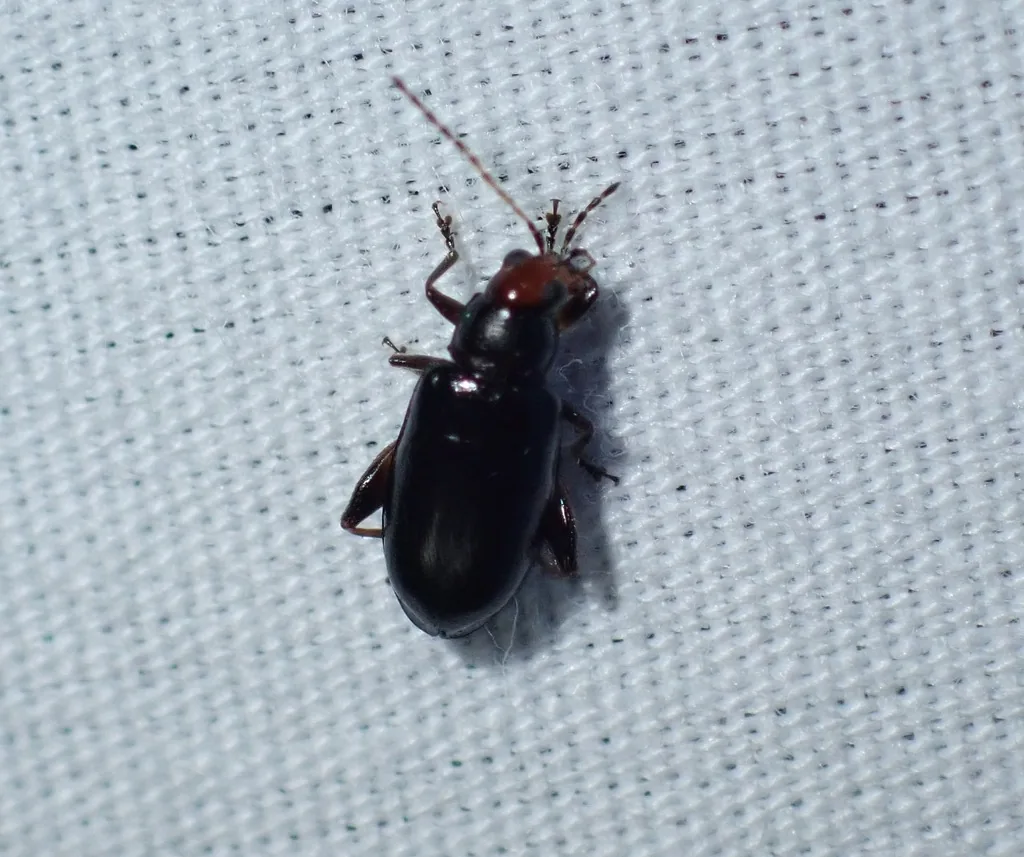
- Adults are small, shiny, oval beetles, about 0.2 inch long according to Georgia (3.5 to 5 mm according to UMass), metallic black with a red head, which sets them apart from similar flea beetles; females are slightly larger than males.[1][3][6]
- An enlarged femur on each hind leg lets them hop like a flea, which is how they got their name; they jump or fly away when disturbed.[5][6][2]
- The damage is many small holes in the leaves, or skeletonized patches where only the surface was eaten, often with tiny black droppings near the feeding sites.[1][6][2]
- The larvae are creamy white with a brown head and a fleshy, hairy tip on the last segment that curves upward; Georgia and Kansas State give their length as 5 to 10 mm (0.5 to 1 centimeter).[1][6][5]
Look-alikes
| Look-alike | How to tell them apart |
|---|---|
| Other flea beetles | Many flea beetles chew similar small holes, but this one's red head on a shiny black body is distinctive; you may need a hand lens and good light to see the red.[1][5] |
Where it lives
Native to the central and eastern United States; Connecticut describes it east of the Rockies from Texas to Florida to Maine to Montana. It damages nursery and landscape plants from Georgia to Virginia and New England, and also turns up in cranberry and blueberry plantings, where it is called the cranberry flea beetle.[1][2][5][3]
Biology and life cycle
It overwinters as eggs in the soil. In Georgia nurseries the first adults usually appear in the last week of May, followed by overlapping generations until late October; in Connecticut adults may emerge in late June or early July, and three generations a year have been reported in New Jersey.[1][5][10]
Females lay pale yellow eggs one at a time in the soil, and the larvae feed on roots through three larval stages, causing less damage than the adults.[1][5][6]
Container potting mix is a key source: in Georgia, North Carolina and Virginia nurseries most of the beetles, and most of the damage on hydrangeas, came from adults emerging from the plants' own containers.[9][8]
Fun fact: its eggs need a winter. In a cranberry study, many more eggs hatched after 15 weeks of steady cold between 0 and 5°C than at warmer temperatures, and eggs and larvae were found more than 30 cm deep in the soil.[10]
In Massachusetts cranberry bogs, adults appear from July into September; Kansas State says adults can be present from June through November depending on temperature and host plants.[3][6]
Damage and signs
- Favorite hosts include panicle hydrangea and roses; damage is also reported on sweetspire (Itea), forsythia, azaleas, crapemyrtle, dogwoods, Japanese holly, weigela, viburnums and wax myrtle, perennials such as asters, coreopsis, salvia, sedum and zinnias, and blueberries and cranberries.[1][2][5]
- In a 2026 study of 12 ornamentals, panicled hydrangea was the most preferred host and produced the most new adults, while azalea, physocarpus, forsythia and weigela could also be damaged severely.[12]
- A single adult ate up to 10% of a young hydrangea leaf, or 5% of a whole mature leaf, in 24 hours.[11]
- Known in the eastern United States since the 1800s, it has become an economic concern in nurseries only in the past decade, and damage can be severe and fast when many adults arrive.[2][1]
Health risk
It feeds only on plants; none of the extension or state sources reports any harm to people or pets.[1][2][5][6]
Control
Prevention
Check favorite hosts weekly for adults from mid-May, preferably in the middle of the day, and keep new plants away from infested ones. The beetles jump or fly at any disturbance, even a passing shadow, so NC State suggests walking on the down-sun side of plants; on hot sunny days they shade themselves below the upper leaves. Yellow sticky cards are not effective for catching them.[1][6][7]
Sanitation
Pull weeds in and around plantings and out of containers, since the adults feed and build up on weeds such as pigweed, lambsquarters, smartweed, velvetleaf and jewelweed.[1][6][5]
Biological control
For larvae in the soil, insect-killing nematodes (Steinernema carpocapsae) and fungi (Beauveria bassiana, Isaria fumosorosea and Metarhizium) are options, as is azadirachtin; NC State says the fungal and azadirachtin drenches need two applications to match one application of the other products.[1][5][7]
Pesticides
Larvae: a soil drench in the container can give acceptable control if the insecticide spreads evenly through the root ball, and Connecticut lists pre-plant mixing of bifenthrin or imidacloprid into the potting mix.[1][5]
Adults usually need contact sprays with thorough, high-volume coverage of leaves and the soil surface, often repeated, because beetles jump off the leaves to dodge the spray; systemic products only work once adults feed. In tests, acetamiprid, dinotefuran and the fungus Isaria fumosorosea protected plants better than no treatment, and acetamiprid and pyrethrins with canola oil killed the most adults in the lab. Follow the label.[6][1][8]
Where sources disagree
Adult size: Georgia says about 0.2 inch, UMass 3.5 to 5 mm and Kansas State 5.0 mm, while Virginia Tech gives around 1/10 to 1/4 inch.[1][3][6][2]
Where the damage comes from: Virginia Tech says the larvae do not cause measurable damage, while a cranberry study suggests the larval stage may be the best target for control, and a nursery study found most damaging adults emerge from the plants' own potting mix.[2][10][9]
Common questions
- What is making tiny holes in my hydrangea leaves?
- Tiny shiny black beetles with red heads that jump when disturbed are redheaded flea beetles, which riddle panicle hydrangea leaves with small holes.[1][2][12]
- Where do redheaded flea beetles come from?
- They overwinter as eggs in the soil, including the potting mix of container plants, and build up on weeds around plantings; the larvae feed on roots and the adults move up to the leaves.[1][9][8]
Sources
- University of Georgia Cooperative Extension, “Red-Headed Flea Beetle: An Ornamental Nursery Pest (Circular 1187, S. V. Joseph and W. Hudson).” fieldreport.caes.uga.edu/publications/C1187/ (accessed 2026-11-12)
- Virginia Cooperative Extension, “Red Headed Flea Beetle in Virginia Nurseries (ENTO-464, E. Lane and A. Del-Pozo).” turf.spes.vt.edu/content/dam/pubs_ext_vt_edu/ENTO/ento-464/ENTO-464.pdf (accessed 2026-11-12)
- UMass Cranberry Station, “Red-Headed Flea Beetle (2011, A. L. Averill and M. M. Sylvia).” ag.umass.edu/sites/ag.umass.edu/files/fact-sheets/pdf/red-headed_flea_beetle-ua.pdf (accessed 2026-11-12)
- iNaturalist, “Systena frontalis taxon page (order and family).” www.inaturalist.org/taxa/232169 (accessed 2026-11-12)
- The Connecticut Agricultural Experiment Station, “Redheaded Flea Beetle (Systena frontalis).” portal.ct.gov/-/media/caes/documents/publications/fact_sheets/entomology/redheadedfleabeetlepdf.pdf (accessed 2026-11-12)
- Kansas State University Agricultural Experiment Station and Cooperative Extension Service, “Redheaded Flea Beetle (MF3225).” bookstore.ksre.ksu.edu/download/redheaded-flea-beetle_MF3225 (accessed 2026-11-12)
- NC State Extension, “Red-Headed Flea Beetle Management in Container Nurseries.” content.ces.ncsu.edu/red-headed-flea-beetle-management-in-container-nurseries (accessed 2026-11-12)
- Journal of Economic Entomology (2020), via PubMed, “Overwintering, Host-Plant Selection, and Insecticide Susceptibility of Systena frontalis (Coleoptera: Chrysomelidae).” pubmed.ncbi.nlm.nih.gov/33080025/ (accessed 2026-11-12). Cited from the PubMed abstract.
- Journal of Economic Entomology (2023), via PubMed, “Growing media is the major source of damaging population of Systena frontalis (Coleoptera: Chrysomelidae) in ornamental nurseries.” pubmed.ncbi.nlm.nih.gov/37595964/ (accessed 2026-11-12). Cited from the PubMed abstract.
- Journal of Insect Science (2021), via PubMed, “Life History and Damage by Systena frontalis F. (Coleoptera: Chrysomelidae) on Vaccinium macrocarpon Ait..” pubmed.ncbi.nlm.nih.gov/33560361/ (accessed 2026-11-12). Cited from the PubMed abstract.
- Journal of Insect Science (2023), via PubMed, “Feeding potential of adult Systena frontalis (Coleoptera: Chrysomelidae) on leaves of Hydrangea paniculata.” pubmed.ncbi.nlm.nih.gov/37632793/ (accessed 2026-11-12). Cited from the PubMed abstract.
- Journal of Economic Entomology (2026), via PubMed, “Host plant preference and suitability of Systena frontalis (Coleoptera: Chrysomelidae) in container ornamental plants.” pubmed.ncbi.nlm.nih.gov/42709502/ (accessed 2026-11-12). Cited from the PubMed abstract.