On this page
How to identify it
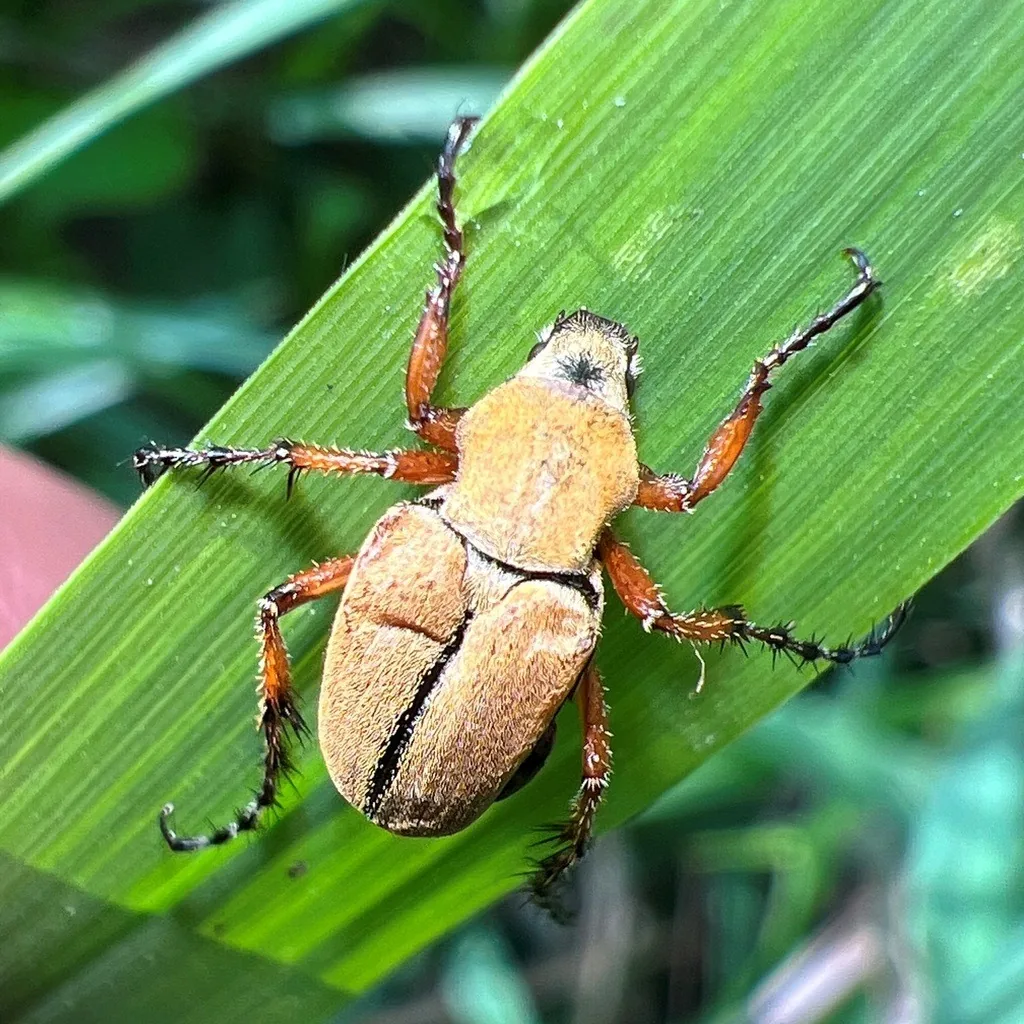
- Adults are slender beetles 5/16 to almost 1/2 inch long, pale green to tan, with long, spiny, reddish-brown to orange legs; UMass adds a reddish head and wings that don't entirely cover the abdomen.[1][3]
- The antennae end in a set of flat, plate-like segments, and in flight the beetle can look like a wasp.[1]
- Larvae are C-shaped grubs with brown heads and conspicuous legs, about 3/4 inch long when grown (UMass says about 0.7 inch), and are rarely seen.[1][3]
Look-alikes
| Look-alike | How to tell them apart |
|---|---|
| Japanese beetle | Japanese beetles feed on trees and shrubs in a similar way, but rose chafers are tan with long, spiny reddish legs and are usually active earlier in the season.[3][1] |
| Other white grubs | Rose chafer grubs look like other C-shaped white grubs, but Minnesota says they don't damage home lawns or landscape plants.[1] |
Where it lives
UMass says the rose chafer occurs in New England, Colorado and parts of eastern Canada; Minnesota says it is found throughout that state, particularly in areas with sandy soil.[3][1]
Biology and life cycle
Adults come out of the ground in late May and early June and feed for three or four weeks, generally until late June; UMass says adults live about 30 days and feed during the day.[1][3]
Females lay oval, shiny eggs, singly or in groups of 6 to 40, as deep as 6 inches in mostly grassy soil, then die soon after.[3][1]
Eggs hatch in two to three weeks; the grubs feed on the roots of grasses and weeds, spend the winter in the soil below the frost line and pupate in spring.[1][3]
Grubs can develop successfully only in light, sandy soil; heavy or clay soils hamper them, which is why damage is worst on sandy sites.[3][4][1]
There is one generation a year, and new beetles can fly in from surrounding areas.[1]
Fun fact: in Ohio State wind-tunnel tests, rose chafers flew upwind to a lure well only when the light was more than half as bright as a clear day and the temperature was 26 to 27°C.[6]
Damage and signs
- Adults chew large, irregular holes in flower blossoms, especially roses and peonies.[1][3][4]
- They skeletonize leaves, eating the tissue between the larger veins, on rose, grape, apple, cherry, birch, raspberry and other trees and shrubs; UMass says grape leaves may be preferred.[1][4][3]
- They also damage fruits, particularly grape, raspberry and strawberry.[1]
- The grubs feed on grass and weed roots but don't damage home lawns or landscape plants.[1]
Health risk
These sources list no risk to people, but adult rose chafers contain a toxin (UMass names it cantharidin) that affects the heart of small animals. They can be deadly to chickens, other birds and small mammals that eat them, and UMass says chickens and ducks should not be allowed to feed on them.[1][3][4]
Control
Prevention
Start checking plants in late May if rose chafers have been a problem before. Where they are a persistent problem, UMass says tilling nearby grassy areas where grubs and pupae develop may help, as the pupae are sensitive to disturbance.[1][3]
Keep them out
Cover plants with cheesecloth or floating row cover when the beetles become active and remove it after they finish feeding, usually after June.[1][3]
Traps and physical control
When numbers are small, handpick the beetles and drop them into a bucket of soapy water; check often because new beetles fly in.[1][3]
Lures: Ohio State researchers found a five-part blend of valeric acid, hexanoic acid, octyl butyrate, trans-2-nonenol and alpha-ionone outperformed other lures. UMass says mass trapping in vineyards may reduce local numbers over time, with traps hung about 1 meter off the ground; light-colored traps (pink, yellow, white) seem to be preferred.[5][3]
Pesticides
If large numbers are present, a garden insecticide labeled for the plant may be needed, sometimes more than once; active ingredients Minnesota lists include bifenthrin, esfenvalerate, cyfluthrin, imidacloprid, permethrin and carbaryl. UMass says contact sprays need to wet the foliage thoroughly and plants should not be treated while in bloom, to protect pollinators.[1][3]
Where sources disagree
How big a pest: Minnesota says protecting plants can be challenging when large numbers are present, while UMass calls it a minor pest of roses that may have been more common in the past.[1][3]
Common questions
- Can I feed rose chafers to my chickens?
- No. Minnesota says rose chafers can be deadly to birds, including chickens, and UMass says chickens and ducks should not be allowed to feed on them.[1][3]
- Will rose chafer grubs ruin my lawn?
- No. The grubs feed on the roots of grasses and weeds but don't damage home lawns or landscape plants.[1]
- Why are my roses and peonies full of tan beetles in June?
- Rose chafers come out in late spring and feed heavily on rose and peony blossoms for a few weeks, especially on sandy sites.[1][4]
Sources
- University of Minnesota Extension, “Rose Chafers (reviewed 2026).” extension.umn.edu/garden-and-home/yard-and-garden/yard-and-garden-insects/rose-chafers (accessed 2026-11-12)
- iNaturalist, “Macrodactylus subspinosus taxon page (order and family).” www.inaturalist.org/taxa/130504 (accessed 2026-11-12)
- UMass Extension Landscape, Nursery and Urban Forestry Program, “Macrodactylus subspinosus (Insect & Mite Guide).” www.umass.edu/agriculture-food-environment/landscape/publications-resources/insect-mite-guide/macrodactylus-subspinosus (accessed 2026-11-12)
- University of Wisconsin-Madison Extension, Wisconsin Horticulture, “Deciduous Tree and Shrub Disorder: Skeletonizing by Rose Chafer.” hort.extension.wisc.edu/articles/deciduous-tree-and-shrub-disorder-skeletonizing-by-rose-chafer (accessed 2026-11-12)
- Journal of Economic Entomology (2000), via PubMed, “Development of an attractant for the scarab pest Macrodactylus subspinosus (Coleoptera: Scarabaeidae).” pubmed.ncbi.nlm.nih.gov/11057721/ (accessed 2026-11-12). Cited from the PubMed abstract.
- Journal of Chemical Ecology (2001), via PubMed, “High light intensity: a critical factor in the wind-tunnel flight of two scarabs, the rose chafer and Japanese beetle.” pubmed.ncbi.nlm.nih.gov/11441436/ (accessed 2026-11-12). Cited from the PubMed abstract.