On this page
How to identify it
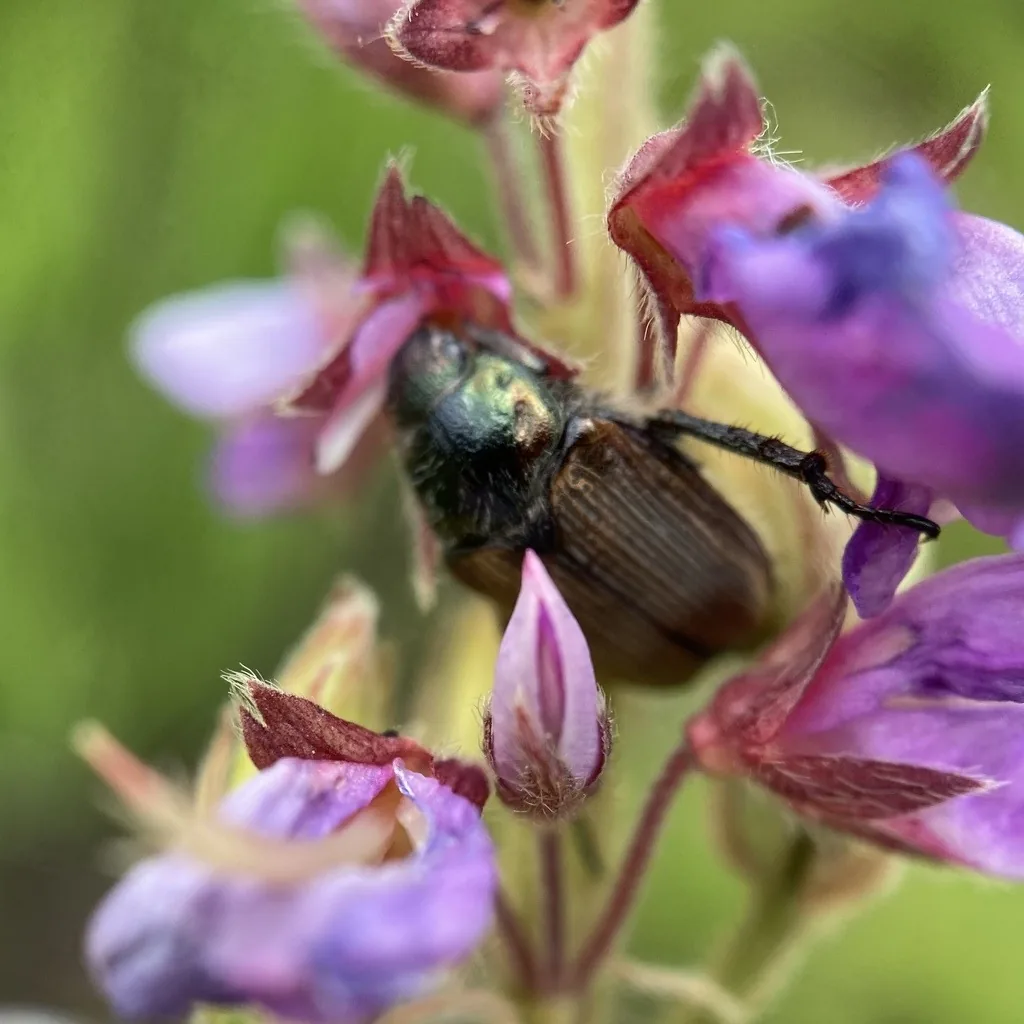
- NC State puts adults at about half an inch long and Iowa State at 7/16 inch, longer than wide. Adults look slightly hairy.[1][3]
- Sources describe the colors differently. NC State calls the beetle greenish-black with a greenish-purple iridescence and brownish-yellow wing covers; Iowa State describes a brown to slightly green thorax, dark tan to brown wing covers and an overall drab look.[1][3]
- Unlike the Japanese beetle, it has no white tufts of hair along the sides of the abdomen. Kansas State and North Dakota State both use those tufts to tell Japanese beetles from false Japanese beetles.[1][3][4][5]
- The larvae are typical white grubs in the soil.[1][3]
Look-alikes
| Look-alike | How to tell them apart |
|---|---|
| Japanese beetle | The Japanese beetle is shiny and colorful, nearly square in outline, metallic green with coppery-brown wing covers and a row of white hair tufts along each side of the abdomen. NC State says spring rose beetles appear at least a month earlier.[3][4][5][1] |
| Rose chafer | Another sandy-soil beetle of rose and peony blossoms, but slender and pale green to tan, with reddish-brown or orange spiny legs.[6] |
Where it lives
NC State gives emergence dates for Virginia and notes that beetles appear later farther north. Iowa State says it occurs statewide in Iowa and is more common in east-central Iowa. The grubs favor grassy, sandy soil.[1][3]
Biology and life cycle
It overwinters as a third-stage grub about 7 inches deep in the soil. In spring each grub hollows out a curved earthen cell about an inch long and spends about 6 days as a prepupa and 13 days as a pupa.[1]
In Virginia, adults usually emerge between May 15 and June 10; farther north they often don't appear before the end of June. NC State gives an average adult life of about 17 days, and Iowa State says adults are usually present for only 2 weeks in late June and early July.[1][3]
Several days after mating, females lay 26 to 28 eggs singly in the soil, and the eggs hatch in about 17 days. There is one generation a year.[1][3]
The beetles prefer pale flowers: NC State says especially pale or white rose varieties, and Iowa State says damage is especially common on white and yellow roses.[1][3]
Damage and signs
- Adults feed on the flowers of rose, iris, lilies, honeysuckle and peony. Iowa State says they chew large, irregular holes in leaves, flowers and buds and are occasionally a significant pest in flower gardens and soybean fields.[1][3]
- Grubs feed on the roots of pasture grasses, peanut, strawberry and sweet potato. Iowa State says they have not been reported as a soil pest in Iowa.[1][3]
Health risk
A flower and root feeder; none of the sources describes any risk to people or pets.[1][3]
Control
Keep them out
Protect prized blooms with light netting, or put fabric screening over individual rose bushes.[1][3]
Traps and physical control
Where only a few beetles are present, pick them off by hand.[3]
Biological control
A parasitic nematode, Steinernema glaseri, has been found infecting the grubs.[1]
Pesticides
Insecticides kill the beetles, but NC State advises against spraying or dusting flowers because it harms pollinators, and Iowa State warns results may be disappointing because residues may not stop new beetles that fly in. Don't treat flowers that bees are visiting.[1][3]
Common questions
- Is this a Japanese beetle on my roses?
- If it has no white hair tufts along its sides and shows up in late spring, at least a month before Japanese beetles, it may be the spring rose beetle.[1][3][4]
- Why only on white roses?
- It prefers pale flowers. NC State points to white and pale roses, and Iowa State to white and yellow roses.[1][3]
- How do I protect my roses?
- Pick off the beetles by hand and cover prized blooms with light netting or fabric rather than spraying flowers.[1][3]
Sources
- NC State Extension, “Spring Rose Beetle (PDIC Factsheet).” content.ces.ncsu.edu/spring-rose-beetle (accessed 2026-11-11)
- iNaturalist, “Strigoderma arbicola taxon page (order and family).” www.inaturalist.org/taxa/359532 (accessed 2026-11-11)
- Iowa State University Extension and Outreach, “False Japanese Beetle (D. Lewis, Yard and Garden, July 2, 1999).” yardandgarden.extension.iastate.edu/article/1999/7-2-1999/fjapbeet.html (accessed 2026-11-11)
- Kansas State University Research and Extension, “Japanese Beetle: Insect Pest of Horticultural Plants and Turfgrass (MF3488).” bookstore.ksre.ksu.edu/pubs/MF3488.pdf (accessed 2026-11-11)
- North Dakota State University Extension, “Integrated Pest Management of Japanese Beetle in North Dakota (E1631, revised March 2025; J. J. Knodel and P. B. Beauzay).” www.ndsu.edu/agriculture/sites/default/files/2025-03/E1631%20IPM%20of%20Japanese%20Beetle%20in%20ND.pdf (accessed 2026-11-11)
- University of Minnesota Extension, “Rose chafers.” extension.umn.edu/garden-and-home/yard-and-garden/yard-and-garden-insects/rose-chafers (accessed 2026-11-11)