On this page
How to identify it
- Five Aphthona species are established on cypress and leafy spurge. A. czwalinai and A. lacertosa are the black species; A. nigriscutis, A. cyparissiae and A. flava are brown. The Forest Service says to look for adults on spurge foliage during the heat of the day, and that they jump away quickly when disturbed.[1]
- Brown-legged flea beetle (A. lacertosa) adults are shiny black and 3 mm long, with legs largely reddish-brown and sometimes dark patches on top of the hind femurs, which are lighter than those of A. czwalinai.[1]
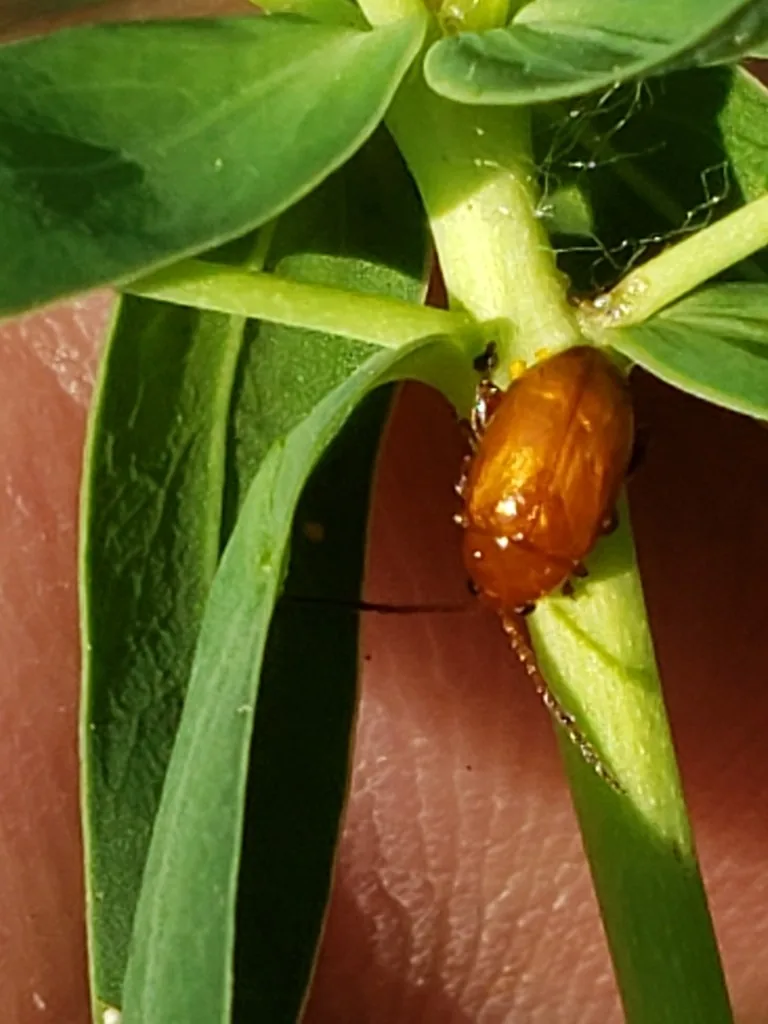
- Black dot flea beetle (A. nigriscutis) adults are usually just over 3 mm, orangish-brown, and typically have a black dot on the back near the leading edge of the wings. The other brown species usually lack the dot and A. flava is more orange, but color differences among the brown species are often unreliable.[1]
- Larvae are slender, whitish and brown-headed, up to 5 mm for A. lacertosa and 1 to 6 mm for A. nigriscutis, found only by digging and cutting open spurge roots.[1]
Where it lives
In Canada the black dot flea beetle was released on leafy spurge from 1983, and in the US it was redistributed from 1989; the brown-legged flea beetle was released in the US from 1993 and in western Canada in 1987, and many US releases were mixtures of Aphthona species. Minnesota runs a statewide program in which almost all counties take part. GBIF holds about 150 records of A. lacertosa, only 5 from the US, and about 170 of A. nigriscutis, 39 from the US; the A. nigriscutis US records since 1990 include New Mexico and Minnesota. In Canada, the Forest Service says A. lacertosa is established only on leafy spurge and appears to be displacing A. czwalinai at many locations.[1][2][3][4][5][6]
Biology and life cycle
Each species has one generation a year. Larvae overwinter in the roots and resume feeding in early spring as the spurge starts to grow, then pupate in the soil.[1]
Adults are active from early to late summer as the spurge bolts, flowers and matures. A. lacertosa females lay 200 to 300 eggs into the soil; A. nigriscutis lays eggs in groups on stems at or just below the soil surface. The larvae burrow into the roots and develop through three instars.[1]
The brown-legged flea beetle does best in moderately dense spurge on loamy soils and poorly in very sandy or clay soils. The black dot flea beetle prefers sparse spurge on dry sites with sandier soil.[1]
Black dot flea beetle impact may be held back by a bacterium that causes high mortality in males, leaving female-biased populations.[1]
Damage and signs
- Larvae feed on root hairs and young roots, inhibiting root function and stunting stem growth; adults feed on leaves and flowers, cutting photosynthesis and the sugar the plant stores in its roots. Minnesota says it is the larval root feeding that damages or kills the plant.[1][2]
- Together the brown-legged and black dot flea beetles are significantly reducing leafy spurge density at the local level in most US regions, though they are not effective at all sites. The black dot flea beetle is extremely effective in open, warm, very dry places with lighter soils and low or absent on moist, sheltered, heavy soils. In Minnesota control is successful at many sites and takes 3 to 10 years depending on site size, spurge density and environment.[1][2]
- In an Idaho trial along streams, heavy releases in two consecutive years cut spurge biomass and crown and stem density by 60 to 80 percent at all three sites and seedlings by about 60 percent at one site; a lighter release gave inconclusive results.[7]
- Spillover feeding by black dot adults was observed on the native Euphorbia robusta; as leafy spurge declined so did that feeding, and E. robusta populations increased.[1]
- On cypress spurge, A. nigriscutis is the most effective of the five at reducing plant density; A. flava's impact may be significant with other species, and A. lacertosa, A. cyparissiae and A. czwalinai are believed to have limited abundance and impact. Stem density can drop quickly, but unattacked roots help plants recover, so numerous years are typically needed for lasting control. In Rhode Island, A. nigriscutis and A. flava are replacing the two black species on cypress spurge.[1]
- A. flava is considered widespread on leafy spurge in the US but is much less abundant than the other species and persists at fairly low levels with little noticeable impact. In Canada, where it is moderately abundant on leafy spurge in Ontario and the West, spurge has declined where A. flava is plentiful, but typically at sites also grazed by sheep and holding A. nigriscutis. In Canada A. lacertosa is reducing leafy spurge density at most sites.[1]
Health risk
The Forest Service and Minnesota DNR describe them only as plant-feeding flea beetles of spurges; no cited source describes any risk to people or pets. The weed is the hazard to livestock: Minnesota says leafy spurge is toxic to cattle.[1][2]
Control
Prevention
Match the beetle to the site: brown-legged flea beetles for moderately dense spurge on loam, black dot flea beetles for sparse spurge on dry, sandier ground. The Forest Service says black dot populations are low or absent at moist, sheltered sites on heavy soil.[1]
Biological control
The flea beetles are the control. Minnesota's Department of Agriculture and DNR run a statewide leafy spurge program in which beetles are collected from established sites and released at new ones; expect control to take 3 to 10 years.[2]
In an Idaho trial along streams, heavy releases in two consecutive years suppressed spurge at all three sites, while a lighter release was inconclusive.[7]
Where the sources disagree
Effect: Minnesota calls A. lacertosa particularly effective and reports control at many sites; the Forest Service says the two main species are not effective at all sites.[2][1]
Records: the Forest Service calls A. lacertosa widespread and abundant on leafy spurge in the US, yet GBIF holds only 5 US records of it.[1][3]
Common questions
- How do I tell the leafy spurge flea beetles apart?
- Start with color. Black bodies mean A. lacertosa (reddish-brown legs) or A. czwalinai. Brown bodies mean A. nigriscutis (usually a black dot on the back), A. cyparissiae or the more orange A. flava, but the Forest Service says color differences among the brown species are often unreliable.[1]
- The adults are everywhere but the spurge is still there. Are they working?
- The damage is done by larvae in the roots, out of sight. Minnesota says control takes 3 to 10 years, and small areas of control come first.[1][2]
- Will these flea beetles attack my garden plants?
- The only spillover the Forest Service records is black dot adults feeding on a native spurge, Euphorbia robusta, which faded as leafy spurge declined.[1]
- Do these flea beetles work on cypress spurge too?
- Yes, all five attack it. The Forest Service rates A. nigriscutis the most effective on cypress spurge, but notes that unattacked roots help plants recover, so control typically takes numerous years.[1]
Sources
- USDA Forest Service, Forest Health Technology Enterprise Team, “Field Guide for the Biological Control of Weeds in Eastern North America, FHTET-2016-04 (R. L. Winston, C. B. Randall, B. Blossey, P. W. Tipping, E. C. Lake and J. Hough-Goldstein, 2017).” www.fs.usda.gov/foresthealth/technology/pdfs/FHTET-2016-04_Biocontrol_Field_Guide.pdf (accessed 2026-11-14)
- Minnesota Department of Agriculture and Minnesota Department of Natural Resources, “Biological Control of Invasive Plants in Minnesota (Chandler, Skinner and Van Riper).” files.dnr.state.mn.us/natural_resources/invasives/biocontrolofplants.pdf (accessed 2026-11-14)
- Global Biodiversity Information Facility (GBIF), “Aphthona lacertosa: occurrence records by country (GBIF occurrence search).” api.gbif.org/v1/occurrence/search?taxonKey=1049125&facet=country&facetLimit=20&limit=0 (accessed 2026-11-14)
- Global Biodiversity Information Facility (GBIF), “Aphthona lacertosa: U.S. occurrence records since 1990 by state (GBIF occurrence search).” api.gbif.org/v1/occurrence/search?taxonKey=1049125&country=US&hasGeospatialIssue=false&occurrenceStatus=PRESENT&year=1990%2C2026&facet=stateProvince&facetLimit=400&limit=0 (accessed 2026-11-14)
- Global Biodiversity Information Facility (GBIF), “Aphthona nigriscutis: occurrence records by country (GBIF occurrence search).” api.gbif.org/v1/occurrence/search?taxonKey=1049123&facet=country&facetLimit=20&limit=0 (accessed 2026-11-14)
- Global Biodiversity Information Facility (GBIF), “Aphthona nigriscutis: U.S. occurrence records since 1990 by state (GBIF occurrence search).” api.gbif.org/v1/occurrence/search?taxonKey=1049123&country=US&hasGeospatialIssue=false&occurrenceStatus=PRESENT&year=1990%2C2026&facet=stateProvince&facetLimit=400&limit=0 (accessed 2026-11-14)
- Journal of Economic Entomology (Entomological Society of America), “Progar (USDA Forest Service), Markin, Milan, Barbouletos and Rinella. Inundative release of Aphthona spp. flea beetles (Coleoptera: Chrysomelidae) as a biological 'herbicide' on leafy spurge in riparian areas. Journal of Economic Entomology 103: 242-248 (2010), doi:10.1603/ec09294.” pubmed.ncbi.nlm.nih.gov/20429434/ (accessed 2026-11-14)
- Global Biodiversity Information Facility (GBIF), “Aphthona lacertosa Rosenhauer, 1847 (GBIF Backbone Taxonomy).” api.gbif.org/v1/species/1049125 (accessed 2026-11-14)
- Global Biodiversity Information Facility (GBIF), “Aphthona nigriscutis Foudras, 1860 (GBIF Backbone Taxonomy).” api.gbif.org/v1/species/1049123 (accessed 2026-11-14)