On this page
How to identify it
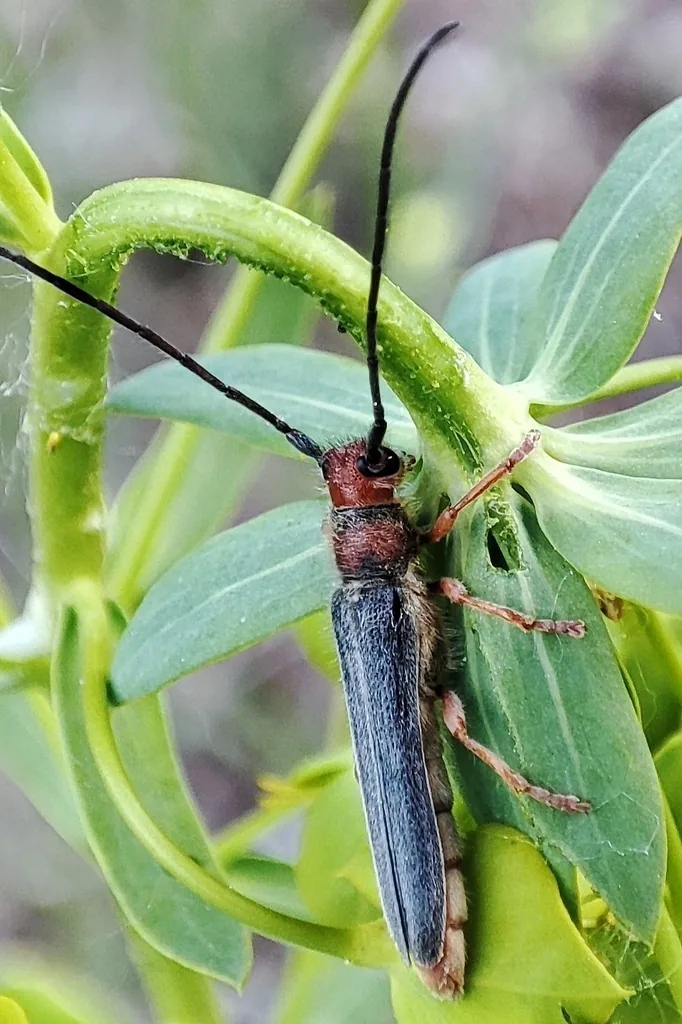
- Adults are slender beetles 10 to 12 mm long with long, dark antennae, a red head and black eyes. The body is dark gray above and lighter gray with reddish markings below, and the legs are yellowish brown. Adults emerge in early to mid-summer and feed on spurge leaves and flowers.[2]
- Girdled stems are the field sign. The female chews around a stem, makes a hole and deposits one egg, and the Washington weed board says the girdling causes stem death. Oregon's Department of Agriculture advises looking for dying upper stems.[2][1][5]
- Mature larvae are up to 20 mm long, slender and white with a yellowish head, and the body is obviously segmented with inflated segments. FHTET suggests dissecting stems and root crowns, from summer through the following spring, to find mining larvae.[2]
Look-alikes
| Look-alike | How to tell them apart |
|---|---|
| Cypress spurge clearwing moth (Chamaesphecia empiformis) | Clearwing moth larvae also mine spurge stems and roots, but they are white and up to 15 mm long, while the stem borer's larva reaches 20 mm and has obviously inflated segments. The moths are not known to be established: USDA-ARS says all three Chamaesphecia species released on leafy spurge are thought to have failed, and FHTET says a 2015 photograph from Ontario of what may be C. empiformis on cypress spurge still needs confirmation.[2][3] |
| Leafy spurge flea beetles (Aphthona spp.) | The other beetles released on leafy spurge are small jumping flea beetles whose adults eat leaves and flowers and whose larvae feed on root hairs and young roots, not inside the stems.[1] |
Where it lives
Beetles from Italy released on leafy spurge in the western US in 1980 failed to establish; new stock from Austria, Hungary and Italy was released in the West in 1982, and eastern releases began in 1985 in Iowa, Michigan, Minnesota, Nebraska, New Hampshire, New York, North Dakota, Rhode Island, South Dakota and Wisconsin. In Canada, Swiss stock was released on leafy spurge from 1979 and on cypress spurge in Manitoba and Ontario from 1986; it is now established in Canada only in Alberta, where it is considered rare, and it failed to establish on cypress spurge in eastern North America. It prefers mesic sites with tree cover, is believed to do well in riparian areas and has been shown to survive winter temperatures below freezing. Oregon's Department of Agriculture lists it as widespread in Oregon, with 1982 as its release year. GBIF holds 62 U.S. records since 1990, led by Colorado (27), Montana (14), Minnesota (8) and Wisconsin (7). In southern Idaho, Forest Service monitoring in 2002 found collectable populations at three leafy spurge release sites; it was released along the South Fork Boise River west of Featherville in 1999 and 2000, and the Boise field office found beetles in that area in 2004 and 2005.[2][5][6][10][11]
Biology and life cycle
Adults emerge in early to mid-summer and feed on spurge leaves and flowers. The female girdles a stem, chews a hole and lays a single egg, up to 40 in her lifetime. The hatching larva mines down the stem until it reaches the root crown and nearby lateral roots, overwinters and pupates in the root crown in spring. The new adult chews through the remaining plant tissue and emerges from the soil.[2]
There is one generation a year in Europe, but full development may take two years in colder parts of North America. A 2003 Forest Service report from southern Idaho likewise says 2 years are apparently required for the adult to develop in North America.[2][10]
An older, archived USDA leaflet says the beetle was brought in from Hungary and Italy, that females live between 3 and 8 weeks, and that the larva feeds from inside the stem and root crown, reducing the carbohydrate reserves stored in the roots.[9]
Damage and signs
- Larval mining kills shoots and reduces the plant's root reserves. Adult feeding is insignificant, but the Washington weed board says the girdling causes stem death. In North America it attacks only leafy spurge.[2][1]
- In the United States it was at first believed able to greatly depress leafy spurge, but densities have remained too low for significant field impact, although at some infestations it may cause declines in larger plants; FHTET adds that it may attack only specific leafy spurge biotypes. A Forest Service trial released it into caged and uncaged plots, replicated three times at six western sites, and found no demonstrable reduction in leafy spurge biomass after one or two years; evidence of egg laying declined after the release year, suggesting the populations were diminishing. In a 2022 USDA review, ARS scientists wrote that whether its populations reach densities high enough to reduce leafy spurge is still unknown. In Canada small plants can be killed at high densities, but field populations are too low to matter.[2][4][3]
- A 2003 Forest Service report from Idaho says egg laying and larval tunneling kill the top of the plant, preventing seed formation, and that the overwintering larva has consumed most of the root crown tissue by the time it is fully developed.[10]
Health risk
A stem-boring beetle of leafy spurge; none of these sources describes any risk to people from the beetle.[2][1][4]
Control
Prevention
Leafy spurge is a Class B noxious weed in Washington and on the state quarantine list, so plants, plant parts and seed may not be transported, sold or distributed into or within the state. The weed board lists the stem borer alongside Aphthona flea beetles and the tip gall midge as the biological controls in use, and notes that goats have been used to graze the weed selectively.[1]
Biological control
The stem borer is a weed biological control agent, and FHTET covers it as an insect to redistribute, not to control: adults are collected by hand or with soft forceps in early summer as spurge flowers and moved to new sites. Don't count on it alone. Field densities have mostly been too low to reduce the weed, though the Forest Service study authors note that agents sometimes pass through long lag phases before increasing.[2][4]
Forest Service monitors in Idaho used sweep nets as the main way to sample for biocontrol insects and found the method very effective for collecting Oberea on leafy spurge. Their 2005 report says the beetles are quite mobile and will likely disperse without human involvement.[10][11]
Where the sources disagree
Impact: FHTET says U.S. densities have stayed too low for significant field impact, though it may cause declines in larger plants at some infestations; the Forest Service trial found no demonstrable biomass reduction; USDA-ARS calls its impact still unknown; Oregon's Department of Agriculture rates its attack heavy and its control good in Oregon and notes it attacks larger plants. A 2003 Forest Service report from Idaho was more upbeat, describing it as able to kill leafy spurge over large areas.[2][4][3][5][10]
Name of the host: the Washington weed board and the 2022 USDA-ARS chapter call leafy spurge Euphorbia virgata, with the weed board listing E. esula as misapplied; FHTET, Oregon's Department of Agriculture and the Forest Service trial use Euphorbia esula.[1][3][2][5][4]
Development time: FHTET gives one generation a year in Europe but says two years may be needed in colder parts of North America.[2]
Eggs per female: FHTET says up to 40 in a lifetime; an older USDA leaflet says females lay an average of 60.[2][9]
Common questions
- I found girdled, dying spurge stems with a gray red-headed beetle nearby. Is it a pest?
- Probably not. A gray beetle with a red head on girdled spurge stems fits the red-headed leafy spurge stem borer, which was released on purpose against leafy spurge. The female girdles a stem to lay her egg, and the Washington weed board says the girdling causes stem death.[2][1]
- Will it clear my leafy spurge?
- Don't expect it to. FHTET says densities in the United States have stayed too low for significant field impact, a six-site Forest Service trial found no demonstrable drop in spurge biomass, and USDA-ARS scientists call its effect still unknown. FHTET credits two Aphthona flea beetles, A. lacertosa and A. nigriscutis, with reducing leafy spurge density.[2][4][3]
- How do I tell its larva from the clearwing moth larva in spurge roots?
- The stem borer's larva is bigger, up to 20 mm, white with a yellowish head and obviously inflated segments; clearwing moth larvae are white and up to 15 mm. The clearwing moths are also not known to be established on leafy spurge.[2][3]
Sources
- Washington State Noxious Weed Control Board, “Leafy spurge (Euphorbia virgata).” www.nwcb.wa.gov/weeds/leafy-spurge (accessed 2026-11-14)
- USDA Forest Service, Forest Health Technology Enterprise Team, “Winston, Randall, Blossey, Tipping, Lake and Hough-Goldstein. Field Guide for the Biological Control of Weeds in Eastern North America (FHTET-2016-04, April 2017).” www.fs.usda.gov/foresthealth/technology/pdfs/FHTET-2016-04_Biocontrol_Field_Guide.pdf (accessed 2026-11-14)
- USDA Forest Service, Forest Health Assessment and Applied Sciences Team, “West and Gaskin (USDA-ARS). Biological Control of Leafy Spurge, chapter 24 in Van Driesche, Winston, Perring and Lopez, eds. Contributions of Classical Biological Control to the U.S. Food Security, Forestry, and Biodiversity (FHAAST-2019-05, June 2022).” www.fs.usda.gov/foresthealth/technology/pdfs/FHAAST-2019-05-Contributions-Classical-Biocontrol.pdf (accessed 2026-11-14)
- USDA Forest Service, Rocky Mountain Research Station (Treesearch 44756), “Progar, Markin, Milan, Barbouletos and Rinella. Population dynamics and impacts of the red-headed leafy spurge stem borer on leafy spurge (abstract). In: Proceedings of the XIII International Symposium on Biological Control of Weeds, 2011, Session 9 (Treesearch year 2013; paper published in Invasive Plant Science and Management 4: 183-188, 2011).” research.fs.usda.gov/treesearch/44756 (accessed 2026-11-14)
- Oregon Department of Agriculture, Noxious Weed Control Program, “Biological Control of Noxious Weeds in Oregon (brochure, created June 2015).” www.oregon.gov/oda/Documents/Publications/Weeds/BiocontrolBrochure.pdf (accessed 2026-11-14)
- Global Biodiversity Information Facility (GBIF), “Oberea erythrocephala: U.S. occurrence records since 1990 by state (GBIF occurrence search).” api.gbif.org/v1/occurrence/search?taxonKey=9165522&country=US&hasGeospatialIssue=false&occurrenceStatus=PRESENT&year=1990%2C2026&facet=stateProvince&facetLimit=400&limit=0 (accessed 2026-11-14)
- Global Biodiversity Information Facility (GBIF), “Oberea erythrocephala (Schrank, 1776) (GBIF Backbone Taxonomy).” api.gbif.org/v1/species/9165522 (accessed 2026-11-14)
- iNaturalist, “Oberea erythrocephala taxon page (order and family).” www.inaturalist.org/taxa/226076 (accessed 2026-11-10)
- U.S. Department of Agriculture, via Internet Archive scan (USDA National Agricultural Library), “Biological Control of Leafy Spurge (1992).” archive.org/details/CAT31109280 (accessed 2026-11-14). NAL marks this a historic archive document; the back page reads Revised August 1992; read from the Internet Archive full text (djvu.txt).
- USDA Forest Service, Forest Health Protection, Boise Field Office, via Internet Archive, “Monitoring Biocontrol Agents in South-Central Idaho (D. D. Bennett, October 10, 2003).” archive.org/details/nfsl_1_121740 (accessed 2026-11-14). Read from the Internet Archive full text (djvu.txt).
- USDA Forest Service, Forest Health Protection, Boise Field Office, via Internet Archive, “FHP Report BFO-PR-05-02: Aphthona and Oberea monitoring west of Featherville, Idaho (D. D. Bennett, March 30, 2005).” archive.org/details/nfsl_1_121989 (accessed 2026-11-14). Read from the Internet Archive full text (djvu.txt).