On this page
How to identify it
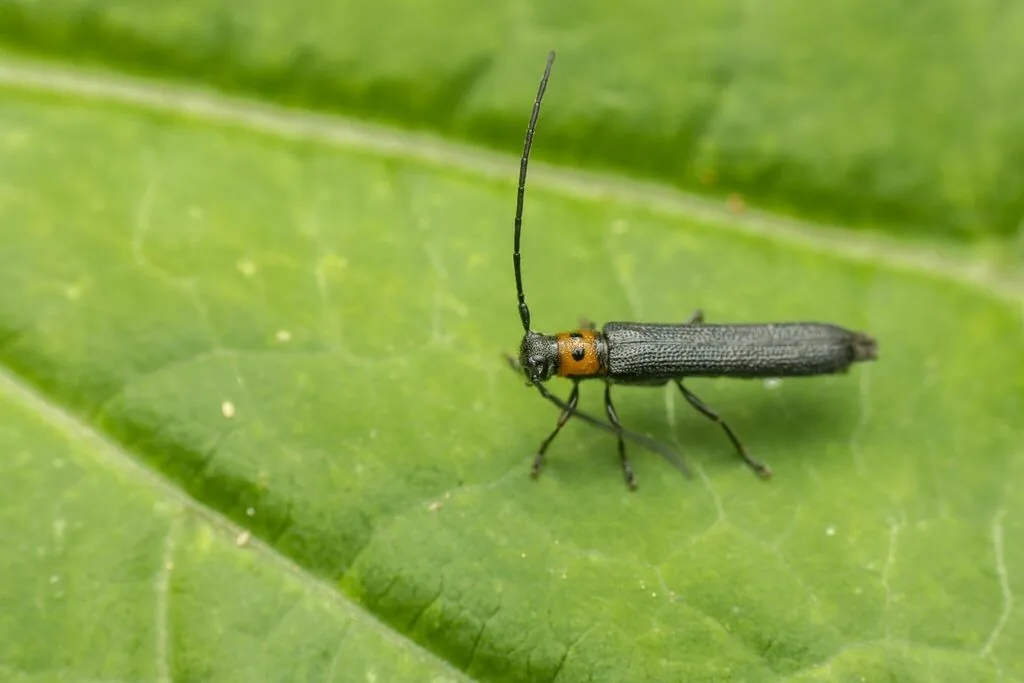
- The adult is a slender black beetle about 1/2 inch long with long antennae and a yellow to yellow-orange thorax; UK Extension says the thorax bears two or three black dots.[1][2][3]
- The telltale sign is two rings of punctures a short way apart, a few inches below the growing tip, with the tip wilting above them; see where the sources disagree on spacing.[1][3][4]
- The larva is a white, legless grub with a brown head, reaching about 3/4 inch.[1][4]
Look-alikes
| Look-alike | How to tell them apart |
|---|---|
| Rednecked cane borer | UK Extension says the rednecked cane borer is smaller, about 1/4 inch, black with a coppery-red to golden thorax, and its larvae make swollen galls 1 to 3 inches long, mostly near ground level, rather than girdling rings near the tip.[1] |
Where it lives
Kentucky, New Hampshire, Minnesota and Massachusetts extension services all cover it on brambles; UNH says it's rarely recognized and usually causes slight injury, and UMN calls it an occasional pest in Minnesota.[1][2][3][4]
Biology and life cycle
Adults appear from about June into early July. The female lays an egg in the pith between the two puncture rings, and the egg hatches in July.[1][2][3]
The larva spends its first winter in the cane a short way below the girdle, bores to the base or roots the second season and overwinters there, then pupates and emerges the following spring: a two-year cycle.[1][2][3][4]
Damage and signs
- The tip above the girdle wilts and dies, and as the larva tunnels down, the whole cane can die. UMN says damage is usually minor and infested canes can still fruit from lower side shoots; UMass says significant infestations can reduce yield.[1][3][4]
- UMN notes that a cane dead all the way from the base may have a disease instead, and suggests sending a sample to a plant disease clinic.[3]
Health risk
It feeds on cane plants. UK Extension, UNH, UMN and UMass describe plant damage only and don't mention any risk to people or pets.[1][2][3][4]
Control
Prevention
Remove nearby wild raspberries and blackberries, which can harbor the borer.[2][4]
Sanitation
Cut infested canes below the lower ring, or below the larva's tunnel, and burn or destroy them; see where the sources disagree on how far down. UMN says fall pruning removes larvae already in the canes.[1][2][3][4]
Traps and physical control
Check plantings weekly from about mid-June through July for wilting tips with the two puncture rings.[1][3][4]
Pesticides
Insecticides are usually unnecessary: UNH says chemicals aren't needed, UMass says pesticides are generally not recommended, and UMN says spraying usually isn't needed because damage is minor.[2][4][3]
Where the sources disagree
Ring spacing: UK Extension and UMN say the two rings are about 1/2 inch apart; UMass says roughly 1 inch.[1][3][4]
Where to cut: UNH says about 1 inch below the girdle, UMN about 2 inches below the holes, and UK Extension and UMass a few to several inches below the lower ring.[2][3][1][4]
Egg position: UNH says about 6 inches below the tip; UK Extension and UMN say the rings are 4 to 6 inches below it.[2][1][3]
Name: UMass calls the raspberry cane borer Oberea bimaculata, and UMN says O. perspicillata is also cited under that name. GBIF lists O. perspicillata and O. bimaculata as separate accepted species.[4][3][5][6]
Common questions
- Why did the tips of my raspberry canes suddenly wilt?
- Two rings of punctures a few inches below a wilted tip point to raspberry cane borer.[1][3][4]
- Do I need to spray for raspberry cane borer?
- Usually not. UNH, UMass and UMN say pruning infested canes below the rings and removing wild brambles is enough.[2][4][3]
Sources
- University of Kentucky Entomology (ENTFACT), “Rednecked and Raspberry Cane Borers (ENTFACT-209, R. Bessin, revised January 2026).” entomology.mgcafe.uky.edu/ef209 (accessed 2026-11-13)
- UNH Cooperative Extension, “Raspberry cane borer (fact sheet, A. Eaton).” extension.unh.edu/resource/raspberry-cane-borer-fact-sheet (accessed 2026-11-13)
- University of Minnesota Extension, Fruit and Vegetable IPM blog, “Managing raspberry cane borers this fall (A. Klodd; updated by M. Wimmer, September 2026).” blog-fruit-vegetable-ipm.extension.umn.edu/2021/10/raspberry-cane-borers-what-you-can-do.html (accessed 2026-11-13)
- UMass Amherst Extension, Fruit Program, “Raspberry Cane Borers (fact sheet RB-005, A. Madeiras).” www.umass.edu/agriculture-food-environment/sites/ag.umass.edu/files/fact-sheets/pdf/raspberry_cane_borers_fact_sheet_rb-005.pdf (accessed 2026-11-13)
- Global Biodiversity Information Facility (GBIF), “Oberea perspicillata Haldeman, 1847 (GBIF Backbone Taxonomy).” api.gbif.org/v1/species/1096440 (accessed 2026-11-13)
- Global Biodiversity Information Facility (GBIF), “Oberea bimaculata (Olivier, 1795) (GBIF Backbone Taxonomy).” api.gbif.org/v1/species/1096441 (accessed 2026-11-13)
- iNaturalist, “Oberea perspicillata taxon page (order and family).” www.inaturalist.org/taxa/226082 (accessed 2026-10-06)