On this page
How to identify it
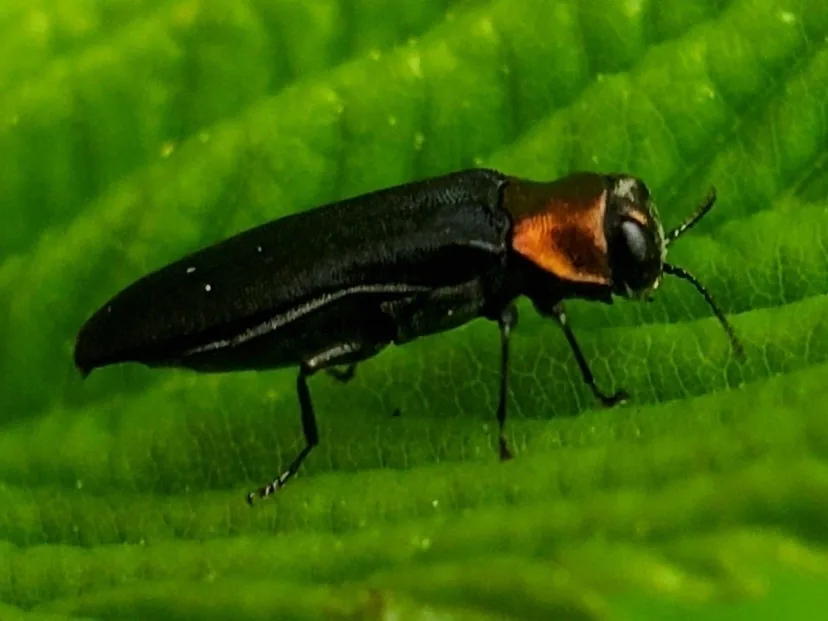
- Adults are slender metallic beetles, blue-black with a coppery thorax. UK Extension and Virginia Cooperative Extension give a length of about 1/4 inch (6 to 7 mm); NC State gives 1/2 inch.[1][3][2]
- Larvae make swellings or galls 1 to 3 inches long on the canes, often splitting the bark; the NC crop profile notes galls can be anywhere from a few inches to about 4 feet up.[1][2][4]
- Larvae are white to yellow-white grubs about 5/8 to 3/4 inch long when grown, with forceps-like prongs at the rear.[1][2][4]
Where it lives
Virginia Cooperative Extension says it occurs in eastern states from Canada to the Gulf of Mexico, and an Arkansas study calls it a pest of cultivated and wild blackberries in the midwestern and eastern U.S. Hosts include blackberry, dewberry, raspberry and other brambles.[3][5][2][1]
Biology and life cycle
Larvae overwinter in the canes, and there's one generation a year. Adult emergence varies by area: early to mid-June in Kentucky, April to July according to NC State, and late May to early August in the NC crop profile.[1][2][4][3]
Females cover their eggs, and the larvae bore straight into the cane, circle it several times, and then tunnel in the pith from about 6 inches below to 25 inches above the gall.[2][3][1]
Up to 75% of larvae die from disease, parasitic wasps such as Barichneumon and other causes.[2][1][3]
Damage and signs
Health risk
This is a plant-feeding beetle; none of the sources consulted (UK Extension, NC State, Virginia Cooperative Extension) describes any risk to people or pets.[1][2][3]
Control
Prevention
Summer pruning can reduce infestations, but the NC crop profile notes pruning late in the season can cut the next crop.[4][3]
Sanitation
During winter pruning, cut out galled canes and destroy them before bud swell. UK Extension suggests leaving pruned canes nearby if many larvae are parasitized, and Virginia Cooperative Extension suggests removing wild brambles nearby.[1][3]
Pesticides
Sprays target adults before they lay eggs, because eggs are covered and larvae are never exposed. Thresholds differ: UK Extension and Virginia Cooperative Extension use more than 10% of canes galled, NC State more than 5%. NC State says to wait until bloom has ended to protect pollinators. Follow the label.[2][1][3]
Monitoring adults
NC State suggests scouting plantings for adults in daylight during bloom.[2]
No standard trap was available; an Arkansas study testing trap types found green traps designed for emerald ash borer caught the most adults.[5]
Common questions
Sources
- University of Kentucky Entomology (ENTFACT), “Rednecked and Raspberry Cane Borers (ENTFACT-209).” entomology.mgcafe.uky.edu/ef209 (accessed 2026-11-13)
- NC State Extension, “Rednecked Cane Borer.” content.ces.ncsu.edu/rednecked-cane-borer (accessed 2026-11-13)
- Virginia Cooperative Extension (VTechWorks), “Rednecked Cane Borer, Agrilus ruficollis (F.) (VCE 3104-1562, Pfeiffer, 2011).” vtechworks.lib.vt.edu/items/ea3d513f-547b-41f1-8f86-ecc87e54e9f0 (accessed 2026-11-13)
- National IPM Database (IPM Centers), “2021 Crop Profile for Blackberry in North Carolina: Pests.” ipmdata.ipmcenters.org/source_report.cfm?template=pest&pesttypeid=1&sourceid=1382§ionid=7&view=yes (accessed 2026-11-13)
- Journal of Economic Entomology, via PubMed, “Development of a monitoring trap for the rednecked cane borer (Kim, Trammel, Lewis & Johnson, 2016).” pubmed.ncbi.nlm.nih.gov/27346633/ (accessed 2026-11-13)
- Global Biodiversity Information Facility (GBIF), “Agrilus ruficollis (Fabricius, 1787) (GBIF Backbone Taxonomy).” api.gbif.org/v1/species/6004139 (accessed 2026-11-13)
- iNaturalist, “Agrilus ruficollis taxon page (order and family).” www.inaturalist.org/taxa/130012 (accessed 2026-10-06)