On this page
How to identify it
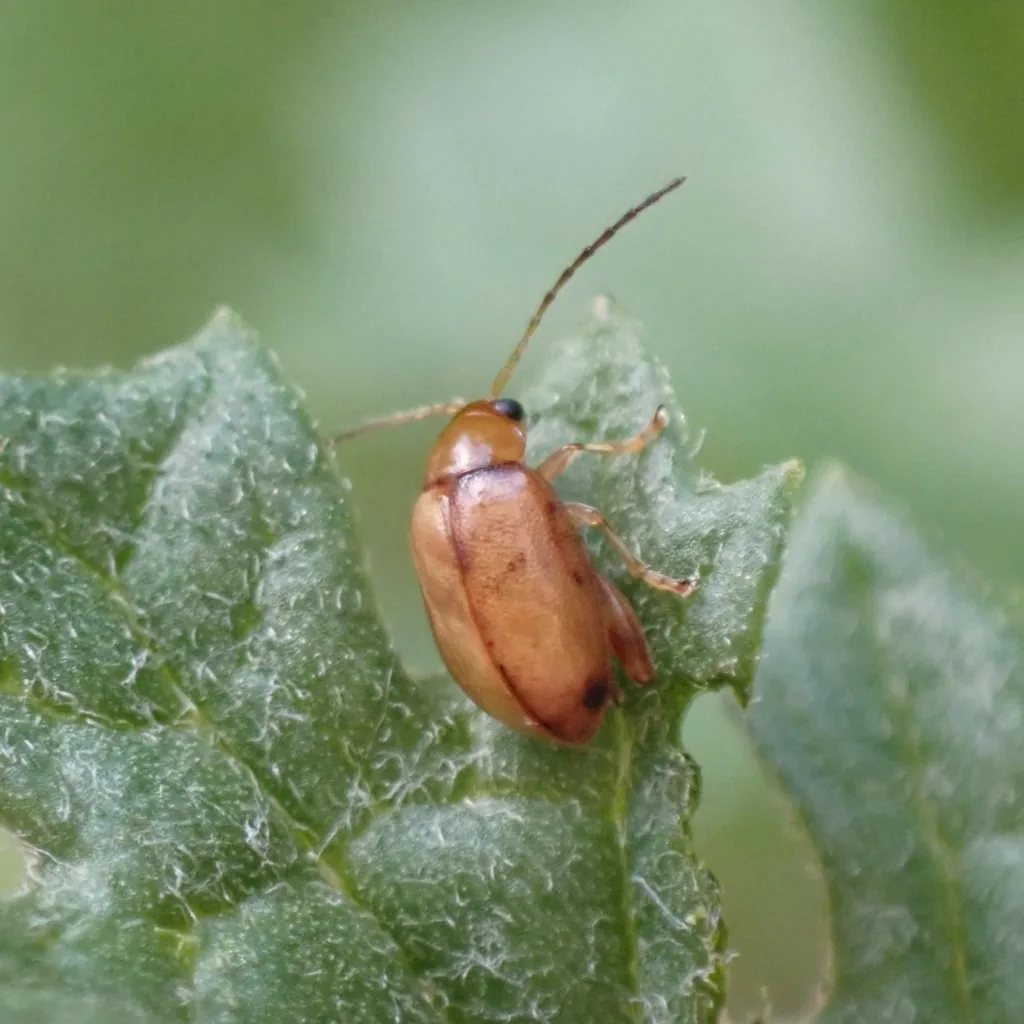
- Adults are golden brown, 2 to 4 mm long, with enlarged hind legs. IBiocontrol says they have fully developed wings and can fly but more often walk, or jump with the enlarged hind legs when disturbed, and that the Italian and Swiss strains look identical.[2][3]
- Adult feeding leaves a shot-hole pattern in the leaves. IBiocontrol says the shot-holes are typically on rosette leaves rather than on bolting plants.[2][1][3]
- Eggs are under 1 mm, whitish-yellow turning orange, laid around the bases of rosettes. Larvae are white and 1 to 4 mm long, the last instars with brown heads, inside leaf stalks and root crowns; pupae are white, 2 to 4 mm, in the soil. IBiocontrol says young larvae are translucent yellow and mature ones creamy white with brown head capsules.[2][1][3]
Look-alikes
| Look-alike | How to tell them apart |
|---|---|
| Ragwort stem and crown boring moth (Cochylis atricapitana) | Its larvae also mine tansy ragwort crowns and can be confused with early flea beetle larvae, but grown larvae are creamy white to tan with small black heads and up to 8 mm long. The Forest Service says it is not approved for release in the US.[2] |
| Cinnabar moth (Tyria jacobaeae) | The other main ragwort agent. Its orange-and-black-banded caterpillars defoliate plants in summer, a very different sight from shot-holed rosettes; Washington's weed board discourages further redistribution because it can also feed on native and horticultural Senecio and Packera.[1][4] |
| Ragwort seed head fly (Botanophila seneciella) | Its larvae feed within the seed heads, often destroying all the developing seeds, rather than in the crown.[4] |
| Longitarsus ganglbaueri | A similar flea beetle on tansy ragwort in California, Oregon and Washington; UC IPM says it is an accidentally introduced alien species that also feeds on native plants, including Packera pseudaurea.[1] |
Where it lives
Beetles from Italy were released in the western US in 1968 and redistributed to British Columbia in 1971, and Canadian stock went on to New Brunswick, Nova Scotia, Ontario and Prince Edward Island from 1978; UC IPM gives 1969 for the first release in California. Three strains are now established in the western states, two of Italian origin and one from Switzerland. A population from low-elevation Italian stock introduced to Mt. Hood, Oregon, in the early 1980s has since adapted to the cooler conditions there. GBIF holds about 2,200 records, about 760 from Great Britain and 80 from the US; its about 60 US records since 1990 come mostly from Washington (about 40) and Oregon (16).[2][1][5][6][7]
Biology and life cycle
The strains differ in timing. Adults of the Italian coastal strain (CPNW) emerge in late spring, feed briefly and go dormant for the summer, then feed again in fall and lay eggs around rosette bases, sometimes into early spring. Larvae mine the leaf stalks and then the root crowns through winter and early spring, then leave to pupate in the soil. There is one generation a year. IBiocontrol says both strains have one generation a year and three larval instars; fall adults feed for 2 to 3 weeks before mating, and larvae hatch a couple of weeks after the eggs are laid. At high elevations in the Intermountain West and Cascades, Italian beetles have a shorter summer dormancy and faster larval development, likely an adaptation to cooler conditions.[2][1][3]
In the cold-adapted Italian strain (CAD), larvae keep feeding into summer and adults emerge in late summer; in the Swiss strain, eggs laid in summer and fall do not hatch until spring.[1]
All strains do best in dense, sunny ragwort that is not seasonally flooded; flooding interferes with the larvae and pupae. Adults oversummer in sheltered places such as tree bark, under rocks, in leaf litter and even house attics.[2][1]
Damage and signs
- Larval mining of the root crown is generally the most destructive stage, reducing seed production and killing plants; adult feeding can shrink plants and even kill water-stressed ones. IBiocontrol says adult feeding interferes with photosynthesis and plant metabolism, and larval mining of the root crown depletes the plant's energy reserves and kills seedlings and small rosettes in particular.[2][1][3]
- UC IPM says the flea beetle and cinnabar moth reduced tansy ragwort by up to 99 percent in ungrazed areas of California and Oregon, but that biological control alone does not control it in grazed pastures; after a disturbance makes seed in the soil germinate, the insects bring the resurgence back under control in 1 to 3 years.[1]
- In a two-year exclusion experiment in northwest Montana, Swiss and hybrid beetles increased ragwort mortality by 42 and 45 percent and cut the fecundity of surviving plants by 44 and 72 percent.[8]
Health risk
The Forest Service and UC IPM describe it only as a plant-feeding flea beetle of tansy ragwort; no cited source describes any risk to people or pets.[2][1]
Control
Prevention
No control is needed. The flea beetle is a biological control agent of tansy ragwort, UC IPM says no non-target plant effects have been reported for it, and shot-holed rosettes are the sign that it is at work.[1]
Biological control
Strain matters. UC IPM says the Italian coastal strain has been very successful in California, the cold-adapted Italian strain has done better in the Cascades and Intermountain West up to about 1,300 feet, and the Swiss strain does well up to about 5,500 feet. Adults can be collected by sweep net or insect vacuum, in fall for the coastal strain and in summer for the others. In Montana, hybrids between Italian and Swiss beetles controlled ragwort at least as well as pure Swiss beetles.[1][8]
Where the sources disagree
First release: the Forest Service gives 1968 for the first release in the western US; UC IPM gives 1969 for the first release in California.[2][1]
Elevation: the Forest Service says the Italian coastal strain is best suited to sites at or below about 1,300 feet; UC IPM gives about 1,300 feet as the range of the cold-adapted Italian strain in the Cascades and Intermountain West, and up to about 5,500 feet for the Swiss strain.[2][1]
Hybrids: the 2019 Montana study found Italian-Swiss hybrids at 5 to 69 percent in seven of the populations it sampled and suggests hybridization may improve control at high elevations; the Forest Service and UC IPM describe the strains separately.[8][2][1]
Records: GBIF holds one US record each from Pennsylvania and Virginia, while the Forest Service says the beetle is established in eastern North America only in Canada; and GBIF holds no US records since 1990 from California, where UC IPM calls the coastal strain very successful.[7][2][1]
Common questions
- What is making tiny holes all over my tansy ragwort rosettes?
- Probably adult tansy ragwort flea beetles. In fall or spring look for the shot-holes, or split open rosettes to look for root-crown damage from the larvae, which is where the plant really suffers.[1][2]
- Why did the beetles work on the coast but not in the mountains?
- The original Italian strain suits low elevations, at or below about 1,300 feet according to the Forest Service, with warm summers and mild, moist winters, and goes dormant in summer. Colder sites need the cold-adapted Italian or the Swiss strain; a population of Italian stock introduced to Mt. Hood, Oregon, in the early 1980s changed its summer dormancy and timing there, coming to resemble the Swiss beetles.[2][1][5]
- Does the flea beetle kill tansy ragwort or just weaken it?
- Both. Root-crown mining reduces seed production and can kill plants. In a Montana experiment the beetles raised plant mortality by 42 to 45 percent and cut the fecundity of survivors by 44 to 72 percent.[2][8]
Sources
- University of California Statewide IPM Program, “Weed Control User Tool (WeedCUT): Biological Control of Tansy Ragwort.” weedcut.ipm.ucanr.edu/biological-control/tansy-ragwort/ (accessed 2026-11-14)
- USDA Forest Service, Forest Health Technology Enterprise Team, “Field Guide for the Biological Control of Weeds in Eastern North America, FHTET-2016-04 (R. L. Winston, C. B. Randall, B. Blossey, P. W. Tipping, E. C. Lake and J. Hough-Goldstein, 2017).” www.fs.usda.gov/foresthealth/technology/pdfs/FHTET-2016-04_Biocontrol_Field_Guide.pdf (accessed 2026-11-14)
- IBiocontrol / North American Invasive Species Management Association, “Ragwort flea beetle, Italian biotype, Longitarsus jacobaeae (agent profile summarizing Szucs et al. 2022, Tansy Ragwort Biocontrol Agents: History and Ecology in North America).” ibiocontrol.org/bio/longitarsus-jacobaeae/ (accessed 2026-11-14)
- Washington State Noxious Weed Control Board, “Tansy ragwort (Jacobaea vulgaris).” www.nwcb.wa.gov/weeds/tansy-ragwort (accessed 2026-11-14)
- Evolutionary Applications (Wiley), full text in PubMed Central (PMC3552403), “Szucs, Schaffner, Price and Schwarzlander (University of Idaho). Post-introduction evolution in the biological control agent Longitarsus jacobaeae (Coleoptera: Chrysomelidae). Evolutionary Applications 5: 858-868 (2012), doi:10.1111/j.1752-4571.2012.00264.x.” pmc.ncbi.nlm.nih.gov/articles/PMC3552403/ (accessed 2026-11-14)
- Global Biodiversity Information Facility (GBIF), “Longitarsus jacobaeae: occurrence records by country (GBIF occurrence search).” api.gbif.org/v1/occurrence/search?taxonKey=4990834&facet=country&facetLimit=20&limit=0 (accessed 2026-11-14)
- Global Biodiversity Information Facility (GBIF), “Longitarsus jacobaeae: U.S. occurrence records since 1990 by state (GBIF occurrence search).” api.gbif.org/v1/occurrence/search?taxonKey=4990834&country=US&hasGeospatialIssue=false&occurrenceStatus=PRESENT&year=1990%2C2026&facet=stateProvince&facetLimit=400&limit=0 (accessed 2026-11-14)
- Evolutionary Applications (Wiley), full text in PubMed Central (PMC6383738), “Szucs, Salerno, Teller, Schaffner, Littlefield and Hufbauer (Colorado State University and Montana State University). The effects of agent hybridization on the efficacy of biological control of tansy ragwort at high elevations. Evolutionary Applications 12: 470-481 (2019), doi:10.1111/eva.12726.” pmc.ncbi.nlm.nih.gov/articles/PMC6383738/ (accessed 2026-11-14)
- Global Biodiversity Information Facility (GBIF), “Longitarsus jacobaeae Waterhouse, 1858 (GBIF Backbone Taxonomy).” api.gbif.org/v1/species/4990834 (accessed 2026-11-14)