On this page
How to identify it
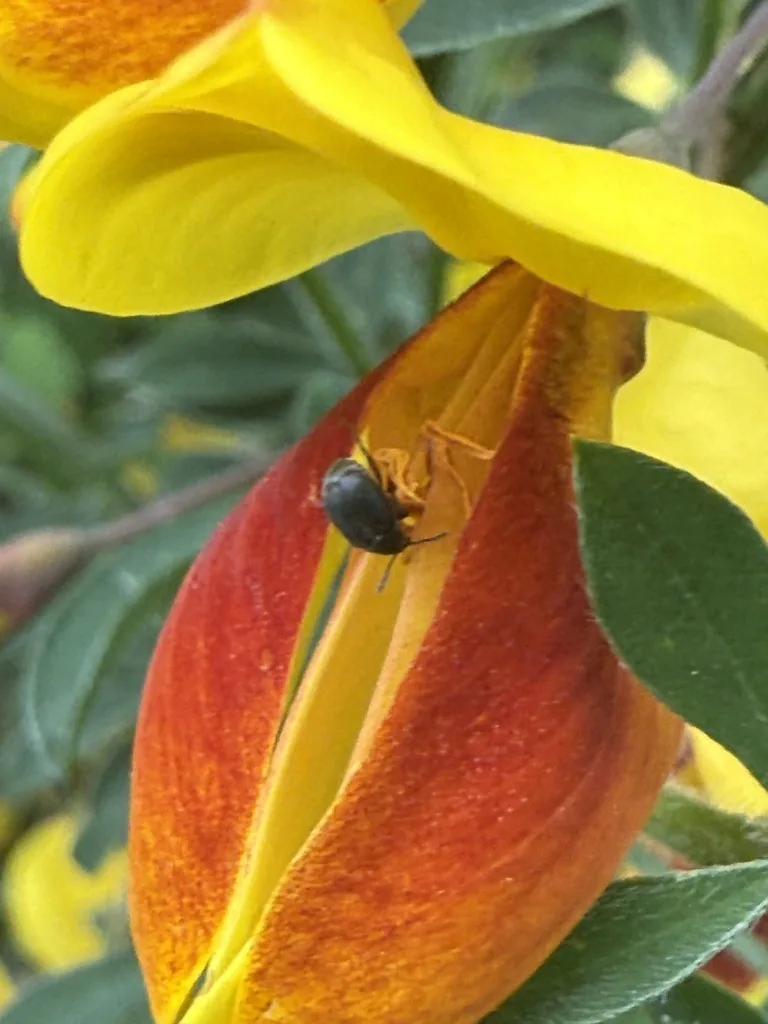
- Seed beetle adults are about 1/16 inch (up to 2 mm) long, oval to round and completely gray-black, with short wing covers and a short snout. The female glues clear, oblong eggs singly to the outside of the developing pod, where they can be seen.[1][2]
- Seed weevil adults are about 1/16 to 3/32 inch long, narrow and brown-gray, with light gray or silver bands down both sides of the back, a long curved snout and light brown legs. Their larvae are C-shaped and white-yellow with a brown head, up to 2½ mm long, and the cream pupae are up to 3 mm.[1][2]
- The damage differs: weevil larvae feed on the outside of the seed as well as inside it and the damage is easy to see, while seed beetle larvae feed completely inside the seed, which takes on a mottled look, and the new adult leaves through a hole chewed in the seed wall.[1][3]
- Seed beetle larvae are off-white with brown heads and, like the gray or brown pupae, up to 2 mm long; both stay hidden inside attacked seeds.[2]
Look-alikes
| Look-alike | How to tell them apart |
|---|---|
| Gorse pod weevil (Exapion ulicis) | A close relative released against gorse. UC IPM says the female chews a hole in a gorse pod and lays a clutch of eggs there; the Scotch broom weevil lays its eggs on individual broom seeds.[4][3] |
| Scotch broom stem moth (Leucoptera spartifoliella) | Another broom agent, but a moth: its larvae tunnel up and down green broom stems and overwinter there, then spin white cocoons on the stem ridges, instead of feeding in seeds. NAISMA calls it the Scotch broom twig miner; the white adults are only 3 to 5 mm long and seldom seen.[3][2] |
Where it lives
UC IPM says the seed beetle was accidentally introduced in the eastern US before 1919. Oregon obtained a permit to move it from North Carolina and released it from 1998; it has spread on its own since, was first found in Siskiyou County, California, in 2014 and now occurs wherever Scotch broom grows in California. The seed weevil was first released in California in 1964 and is widespread there; NAISMA calls it moderately abundant in the western USA and less abundant in Canada. GBIF holds 3,425 seed beetle records, including 687 from Great Britain, 562 from Germany, 401 from Canada and 152 from the US; its 120 US records since 1990 come mostly from Washington (58), Oregon (21) and California (12). It holds 1,525 seed weevil records, 35 of them from the US since 1990, mostly from Washington (20) and Oregon (9).[3][2][5][6][7][8]
Biology and life cycle
In spring the adults feed on broom flowers; UC IPM says the weevil also feeds on stems, petals and pollen. When the pods form and the seeds swell, the female weevil chews a hole in the pod and lays an egg on individual seeds, while the seed beetle glues its eggs to the outside of the pod wall.[1][3]
The larvae mine into the developing seeds, feed and pupate there, and the new adults leave when the pods split open in summer. UC IPM says the weevil has one generation a year and spends summer, fall and winter in sheltered sites off the plant.[1][3]
Both insects are often found in the same pods.[1]
Overwintered seed beetles feed on broom pollen in spring, which helps their ovaries mature. Hatching larvae burrow through the pod wall, sometimes leaving visible tunnels, before entering the developing seeds; the last three larval stages develop entirely inside a seed, generally one larva per seed. New adults emerge in late summer, escape when the pods burst open, and overwinter away from the host plant. There is one generation a year.[2]
Female seed weevils must feed on broom flowers to produce eggs. A late-stage weevil larva can feed into the neighboring seed and sometimes destroy two. Adults overwinter in soil litter and are often active year-round, so generations sometimes overlap.[2]
NAISMA says both insects do best in meadows or on hillsides with southern exposure. Parasitism is typically low but may limit their populations in some regions, and the seed beetle seems less affected than the weevil.[2]
Damage and signs
- Seed only. One larva per seed usually prevents germination, but neither insect harms established broom.[1]
- WSU reports up to 98 percent of seeds attacked at some sites, with attack rates varying greatly by site. In California, UC IPM says the weevil infests about 60 percent of pods on average and destroys 30 to 40 percent of viable seed, the seed beetle destroys over 60 percent of seed at some locations, and surveys from 2014 to 2019 found the two together destroying over 80 percent of seeds at some locations.[1][3]
- Washington's weed board says the weevil adults' feeding on flowers and stem tips is not significant; the damage that counts is done by the larvae in the seed.[9]
- In a 2014 study across 75 western sites, the seed beetle alone attacked 0 to 98% of seeds, averaging 59% in British Columbia, 44% in Washington, 41% in Oregon and 0.6% in California; attack rose 10 to 37% where the weevil was also present. In 2019, 10 inland western Washington populations averaged 79% (61 to 89%), and seed reduction has topped 70% at 26 Washington sites since 2012.[2]
- The weevil alone attacked 10 to 37% of seeds in the 2014 study; in California surveys from 2015 to 2019 its attack rates were often over 50%, with some sites over 90%. NAISMA says adult weevil feeding on stems causes terminal shoot dieback but does not kill the plant.[2]
Health risk
WSU Extension and UC IPM describe them only as seed-feeding beetles of broom; no cited source describes any risk to people or pets.[1][3]
Control
Prevention
In California, UC IPM says the seed beetle is not permitted for use as a biological control agent because its risk to nontarget species has not been fully evaluated; it has developed on a native California lupine (Lupinus arboreus) in France and New Zealand. The seed weevil is the permitted seed feeder there. NAISMA says no nontarget effects have been reported in North America, but studies of possible attack on Lupinus arboreus are ongoing.[3][2]
Biological control
These beetles are the control. WSU says they belong in a long-term program on large sites where mowing, pulling and herbicides are not being used together with them, since they do nothing to the stand already growing.[1]
Pesticides
Where the standing shrubs must go, the Washington Noxious Weed Control Board lists foliar sprays, basal bark treatment and cutting stems and painting the fresh cut with herbicide as effective; it refers readers to the PNW Weed Management Handbook for products.[9]
Where the sources disagree
Impact: WSU reports up to 98 percent of seeds attacked at some sites; UC IPM reports 30 to 40 percent of viable seed destroyed by the weevil in California and over 80 percent by the two insects combined at some California sites.[1][3]
Status: WSU presents the seed beetle as one of the two primary biocontrol agents of Scotch broom, and NAISMA says it is approved in the USA for release against Scotch broom; UC IPM says it is not permitted for use as a biological control agent in California. NAISMA adds that neither insect is officially approved as a biocontrol agent in Canada.[1][2][3]
Classification: UC IPM places the seed beetle in the family Bruchidae, while GBIF and NAISMA place it in the leaf beetle family Chrysomelidae, the family used here; NAISMA puts the weevil in Brentidae. GBIF lists Exapion fuscirostre as a doubtful name, but WSU, UC IPM, NAISMA and Washington's weed board all use it, so this page keeps it.[3][10][11][2][1][9]
Weevil adult feeding: Washington's weed board says the adults' feeding on flowers and stem tips is not significant; NAISMA says their stem feeding causes terminal shoot dieback, though it does not kill the plant.[9][2]
History in North America
NAISMA says the seed beetle was first reported on Scotch broom in Massachusetts in 1918 and spread naturally along the East Coast. Beginning in 1998 it was moved from North Carolina to broom in Oregon and Washington; it spread to French broom by 2001 in Oregon and by 2014 in California. It was first recorded in British Columbia in 2000, likely after spreading on its own from the USA, and in Nova Scotia in 2003.[2]
The seed weevil came from Italy and was released in California in 1964. It was moved on to Oregon beginning in 1983, Washington in 1989 and Idaho in 2007, and spread naturally into British Columbia by 2006.[2]
Common questions
- How do I know if the seed beetles are in my broom?
- In spring shake flowering plants over a white sheet; the weevils can be told from the seed beetles by their long snout, color and body shape. When the pods are full size and turning brown, split them: weevil larvae and damage are easy to see, and a seed that oozes milky juice when pressed with a fingernail holds a seed beetle larva.[1]
- Will they get rid of my Scotch broom?
- Not the plants you have now; WSU says neither insect affects current stands. They cut the seed that would replace those plants, up to 98 percent of it at some sites, so they belong in a long-term program.[1]
- Can I use the seed beetle in California?
- No. UC IPM says it is not permitted as a biological control agent in California and is not likely to be permitted, because it has developed on a native lupine elsewhere. It arrived on its own anyway and now occurs wherever Scotch broom grows in the state.[3]
- Can I move these beetles to new sites in Canada?
- Not without asking first. NAISMA says neither the seed beetle nor the seed weevil is officially approved as a biocontrol agent in Canada, and neither is recommended for redistribution there before consulting local authorities.[2]
Sources
- Washington State University Extension, “Andreas. Biological Control of Scotch Broom. Pest Watch FS203E (2016).” wpcdn.web.wsu.edu/wp-ecommerce/uploads/sites/2/product-3970-sku-FS203E.pdf (accessed 2026-11-14)
- North American Invasive Species Management Association (PDF hosted on Bugwood), “Andreas (Washington State University Extension), Pitcairn (California Department of Food and Agriculture) and Pratt (USDA ARS). Scotch Broom Biocontrol Agents: History and Ecology in North America. In: Biological Control of Weeds in North America, NAISMA-BCW-2022-7-SCOTCH BROOM-A (2022).” bugwoodcloud.org/resource/files/25363.pdf (accessed 2026-11-14)
- University of California Statewide IPM Program, “Weed Control User Tool (WeedCUT): Biological Control of Scotch Broom.” weedcut.ipm.ucanr.edu/biological-control/scotch-broom/ (accessed 2026-11-14)
- University of California Statewide IPM Program, “Weed Control User Tool (WeedCUT): Biological Control of Gorse.” weedcut.ipm.ucanr.edu/biological-control/gorse/ (accessed 2026-11-14)
- Global Biodiversity Information Facility (GBIF), “Bruchidius villosus: occurrence records by country (GBIF occurrence search).” api.gbif.org/v1/occurrence/search?taxonKey=1047567&facet=country&facetLimit=20&limit=0 (accessed 2026-11-14)
- Global Biodiversity Information Facility (GBIF), “Bruchidius villosus: U.S. occurrence records since 1990 by state (GBIF occurrence search).” api.gbif.org/v1/occurrence/search?taxonKey=1047567&country=US&hasGeospatialIssue=false&occurrenceStatus=PRESENT&year=1990%2C2026&facet=stateProvince&facetLimit=400&limit=0 (accessed 2026-11-14)
- Global Biodiversity Information Facility (GBIF), “Exapion fuscirostre: occurrence records by country (GBIF occurrence search).” api.gbif.org/v1/occurrence/search?taxonKey=4463875&facet=country&facetLimit=20&limit=0 (accessed 2026-11-14)
- Global Biodiversity Information Facility (GBIF), “Exapion fuscirostre: U.S. occurrence records since 1990 by state (GBIF occurrence search).” api.gbif.org/v1/occurrence/search?taxonKey=4463875&country=US&hasGeospatialIssue=false&occurrenceStatus=PRESENT&year=1990%2C2026&facet=stateProvince&facetLimit=400&limit=0 (accessed 2026-11-14)
- Washington State Noxious Weed Control Board, “Scotch broom (Cytisus scoparius).” www.nwcb.wa.gov/weeds/scotch-broom (accessed 2026-11-14)
- Global Biodiversity Information Facility (GBIF), “Bruchidius villosus (Fabricius, 1792) (GBIF Backbone Taxonomy).” api.gbif.org/v1/species/1047567 (accessed 2026-11-14)
- Global Biodiversity Information Facility (GBIF), “Exapion fuscirostre (Fabricius, 1775) (GBIF Backbone Taxonomy).” api.gbif.org/v1/species/4463875 (accessed 2026-11-14)