On this page
How to identify it
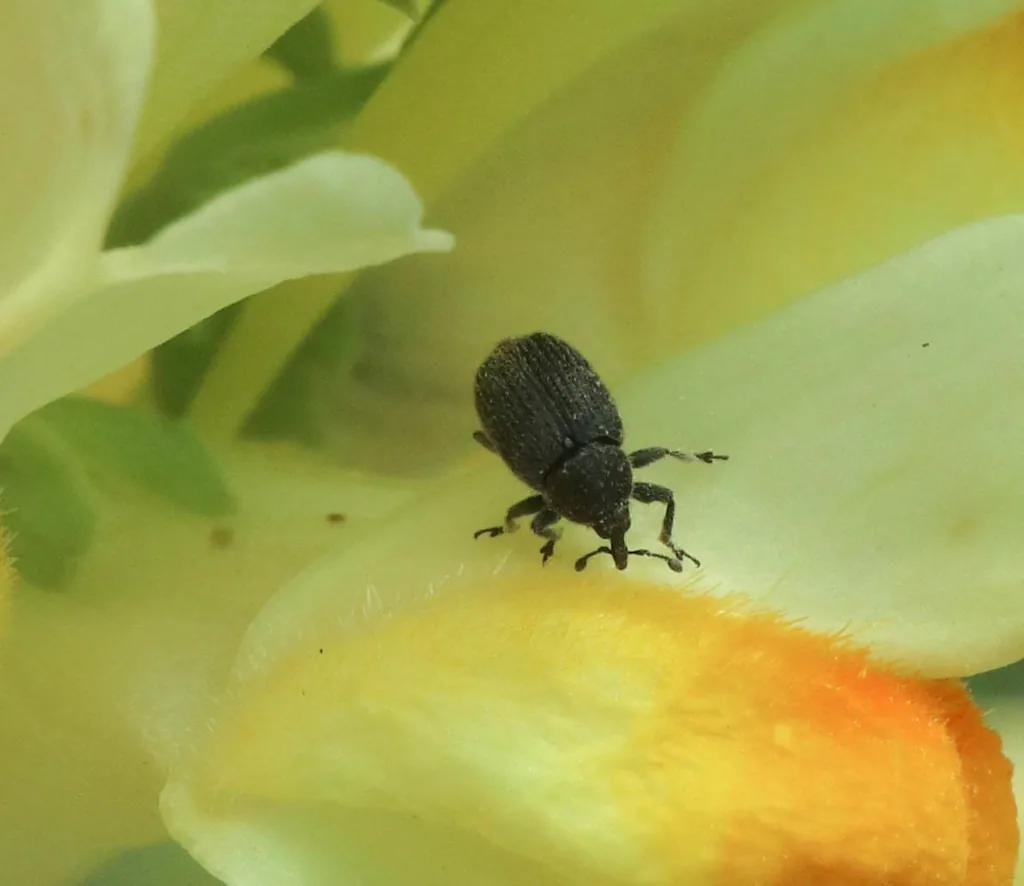
- All are small weevils with dense hairs and curved snouts. R. antirrhini adults are gray to black, with a long, distinctly curved, pointed snout and a wide body; those collected from yellow toadflax are typically 2.5 to 3 mm long, while those developing on Dalmatian toadflax reach 5 mm. R. linariae adults are small and black, averaging about 2.5 mm. R. pilosa is black with upright hairs and a hook-nosed profile; the Forest Service manual gives up to 4 mm excluding the snout and the APHIS assessment 3.2 to 4.3 mm. IBiocontrol, summarizing the 2022 NAISMA review, notes that R. antirrhini and R. dieckmanni are morphologically very similar, and describes R. pilosa adults as black, 4.3 to 5.5 mm long, with upright hairs and a hook-nosed profile.[1][2][8][11]
- The galls identify the species better than the adults do. In capsules attacked by R. antirrhini, the 8 to 17 seeds nearest the egg grow up to ten times normal size and turn watery pale yellow. R. linariae galls the roots and root crowns: European studies found 20 to 100 galls per plant, with neighbouring galls fusing into complexes of up to 40. R. pilosa makes a large green, globular to oblong gall, sometimes red-tinged, between the middle and tip of a yellow toadflax stem, averaging about 9 by 19 mm and usually holding several larvae.[1][2]
- Larvae are C-shaped grubs up to 4 mm long (creamy yellow with a dark brown head in R. antirrhini, creamy white with a brown head in R. linariae) and live inside the gall, so it must be cut open to see them. R. antirrhini pupae are dark gray, typically 2.5 mm, with two tiny 'horns' on top of the thorax.[1]
- A related species, R. neta, also arrived unintentionally (US 1937, Canada 1957), feeds in toadflax seed capsules without making the seeds swell, and is not approved for redistribution in the USA. Adults are gray or brown with a blunt, only slightly curved snout, typically 3 mm long, and its pupae carry two small bumps rather than horns.[1]
- The eggs differ too: those of the seed-gallers are oval and flattened, R. linariae lays pale yellow, smooth, pear-shaped eggs, and R. pilosa eggs are round, greenish-white and only 0.36 mm across.[8][10][11]
Look-alikes
| Look-alike | How to tell them apart |
|---|---|
| Toadflax stem weevils (Mecinus janthiniformis and M. janthinus) | Bluish-black weevils that mine toadflax stems rather than galling them; the Forest Service manual separates them by their elongated bodies, compared with the more rounded Rhinusa.[1] |
| Toadflax flower-feeding beetle (Brachypterolus pulicarius) | Another beetle established on toadflaxes, but it has no snout. Where it competes with the seed-feeding Rhinusa weevils, the two do not add up to greater impact in many places.[1] |
Where it lives
R. antirrhini is native to Eurasia and the Mediterranean. It arrived accidentally in the US (1909) and Canada (1917), was first reported on yellow toadflax in Massachusetts, and spread naturally and by redistribution throughout North America on both toadflaxes; a Dalmatian toadflax strain from the former Yugoslavia was released in Canada and the USA from 1993. It is well established on yellow toadflax and less abundant on Dalmatian toadflax. R. linariae, native to Europe, was first released in both countries in 1996, from German stock in the US and from central and southern Europe and Russia in Canada; the US introductions failed, a 2008 move of British Columbia weevils to Colorado failed too, and it is confirmed only at limited British Columbia sites on yellow toadflax. R. pilosa, native to Europe from Sweden and France to Serbia, came from a population north and east of Belgrade; limited releases were made in Alberta and British Columbia in spring 2014 and 2015.[1][2]
Biology and life cycle
R. antirrhini adults attack toadflax flowers and shoot tips. Egg laying raises a spur on the seed capsule that pushes the egg into the developing seeds and triggers the gall, and the larva feeds on the galled seeds and destroys more within the capsule. The overall habitat preferences of R. antirrhini and R. neta are unknown. IBiocontrol says the overwintered adults emerge in late spring to feed on shoot tips, leaf buds and young leaves, then on pollen and flower tissue once the flowers open. Each female lays 40 to 50 eggs singly inside flower ovaries, the larvae pass through three instars, and new adults emerge in late summer or early fall to overwinter in plant litter. There is one generation a year.[1][8]
European R. antirrhini is not one uniform population. Sequencing of a mitochondrial and a nuclear gene, together with mating trials, found substantial genetic variation within the species that is best explained by specialisation on different host plants, with the split estimated to have begun in the mid-Pliocene, about 3.77 million years ago.[3]
R. linariae adults emerge in spring and feed on new shoots, then females lay eggs singly in pockets chewed into the roots and root crowns, triggering galls. Larvae feed on the galled tissue through three instars and pupate in the gall; new adults appear in mid to late summer, often feed briefly on stems and overwinter in soil or litter, though some stay in the root galls until the following spring. One generation a year. In Europe it does well in grassland, is rare in subalpine habitats and absent from alpine zones.[1]
R. pilosa has one generation a year. Adults emerge from March to May, feed for three to five days before mating and begin laying about ten days later, in April and May, dispersing among toadflax patches. The gall is complete 8 to 10 days after egg laying, when the first instar is present; larvae feed through three instars and pupate in the gall, and new adults stay inside 10 to 15 days before chewing out. Egg to emerging adult takes 55 to 65 days. The new adults feed on stems for about ten days, shelter in litter or soil cracks through the summer with occasional evening and night feeding, feed again in late autumn and enter diapause in the soil or leaf litter.[2]
The galls are the plant's doing, provoked by the weevil. A week after R. pilosa egg laying, galls on yellow toadflax weighed three times as much as comparable stem tissue and had accumulated fructose, glucose, turanose and water-insoluble carbohydrates, consistent with the weevil reprogramming the plant to stock the gall for its larvae. Galls averaged 2.4 adults each, with a maximum of 17.[4][2]
New R. pilosa adults stay in the gall for a time, feeding on what is left of the gall tissue, then chew their way out, feed briefly on shoots and go inactive in the soil. Once temperatures cool consistently in late autumn they feed heavily on toadflax regrowth before overwintering in soil or plant litter.[11]
R. dieckmanni, the Dalmatian toadflax seed-galling weevil, is native to Europe and Asia and uses Dalmatian toadflax as its host in North America.[9]
Damage and signs
- Adult feeding by R. antirrhini is typically insignificant; the galled seeds are not viable and the larvae destroy more seed in attacked capsules, and with more than two larvae per capsule all viable seeds can be destroyed. Seed reductions of 85 to 90 percent have been reported in Washington, but reductions are typically much lower, and 30 to 40 percent attack rates in Oregon had minimal impact on plant density. Lower seed output does not kill existing plants, though it can reduce the spread and genetic diversity of toadflax populations. In Canada its wide distribution has yet to give satisfactory control, and its impact on hybrid toadflax has not been studied in North America. IBiocontrol adds that lower seed output can help reduce both the spread and the genetic diversity of toadflax populations.[1][8]
- R. linariae root galls disrupt the movement of nutrients and water to and from the roots and may act as a sink that diverts root nutrients to the larvae. In North America its populations are still too low to have a significant impact, and because they are slow to build, redistributions are made whenever possible. IBiocontrol adds that adult feeding also draws down the plant's nutrient reserves, though the overall impact of adults has not been formally studied.[1][10]
- R. pilosa galls reduce yellow toadflax height, stem number and biomass. In studies reviewed by APHIS, galled plants were 55 percent shorter, with 75 percent less below-ground biomass and fewer flowering stems. After the 2014 and 2015 Canadian releases, galling of yellow toadflax and overwintering of the first generation were confirmed.[1][2]
- The Forest Service manual reports no nontarget effects for R. antirrhini, R. neta or R. linariae. Before proposing R. pilosa for US release, APHIS reviewed European surveys of 20 Linaria species and subspecies from 290 populations, in which it was reared only from yellow toadflax, and quarantine tests on 63 native North American species, in which only four received eggs and only three larvae, all on Sairocarpus virga, reached adulthood. No threatened, endangered or sensitive North American species belongs to the tribe it could attack.[1][2]
Health risk
These are plant-feeding weevils. The USDA Forest Service manual and the APHIS environmental assessment don't mention any risk to people or pets.[1][2]
Control
Prevention
Do not count on the seed-gallers alone: lower seed output does not kill established plants, 30 to 40 percent attack in Oregon had minimal impact on density, and where the flower-feeding beetle Brachypterolus pulicarius shares the stand the insects often do not add to each other's impact.[1]
Traps and physical control
To confirm the weevils, look for swollen, pale, watery seed capsules, galls on the roots of dug plants or green stem galls between the middle and tip of yellow toadflax stems, and cut them open to find the C-shaped grubs.[1][2]
Biological control
No control is wanted. R. antirrhini is already present throughout most yellow toadflax infestations and is approved for redistribution, though the Forest Service manual says it is not a high priority because it is widespread and its impact is low. For R. pilosa in the US, the 2016 manual says a release permit had not yet been granted, and APHIS's December 2017 assessment proposed issuing permits for release in the contiguous United States. IBiocontrol, summarizing the 2022 NAISMA review, lists R. antirrhini, R. dieckmanni, R. linariae and R. pilosa as approved in both the USA and Canada.[1][2][8][9][10][11]
Where the sources disagree
R. pilosa size: the Forest Service manual gives up to 4 mm excluding the snout; the APHIS assessment gives 3.2 to 4.3 mm. IBiocontrol gives 4.3 to 5.5 mm.[1][2][11]
R. pilosa gall size: the manual says galls can be up to 9 mm wide and 20 mm long; APHIS gives an average of 9.1 by 18.7 mm.[1][2]
R. pilosa in the US: the 2016 manual says a US release permit had not yet been granted; APHIS's December 2017 assessment proposes issuing permits. Neither says whether US releases have since been made.[1][2]
Naming: GBIF's backbone credits Rhinusa antirrhini to Stephens, 1829; the Forest Service manual cites Paykull.[5][1]
R. pilosa approval: IBiocontrol now lists it as approved in the USA as well as Canada, later than the Forest Service manual's statement that no US release permit had been granted.[11][1]
Seed-galler emergence: IBiocontrol says overwintered adults emerge in late spring; the APHIS assessment has the stem-galling R. pilosa emerging from March to May.[8][2]
Common questions
- Why are the seed pods on my yellow toadflax swollen and pale?
- Most likely the seed-galling weevil R. antirrhini. Its egg makes the 8 to 17 seeds nearest it grow up to ten times normal size and turn watery pale yellow, and those abnormal seeds are not viable.[1]
- Can I get the stem-galling weevil for my property?
- R. pilosa was approved for release in Canada in March 2014. In the US, the Forest Service's 2016 manual says a release permit had not yet been granted, and APHIS's December 2017 environmental assessment proposed issuing permits for release in the contiguous United States. IBiocontrol's current agent profile, which summarizes the 2022 NAISMA review, lists R. pilosa as approved in the USA.[1][2][11]
- Do these weevils harm snapdragons or native plants?
- The Forest Service manual reports no nontarget effects for R. antirrhini, R. neta or R. linariae. In APHIS's host tests for R. pilosa, only 4 of 63 native North American species received eggs, and only three larvae, all on Sairocarpus virga, reached adulthood.[1][2]
Sources
- USDA Forest Service, “Biology and Biological Control of Dalmatian and Yellow Toadflax (FHTET-2016-01, 2nd edition), by Sing, De Clerck-Floate, Hansen, Pearce, Randall, Toševski and Ward (2016).” www.fs.usda.gov/rm/pubs_journals/2016/rmrs_2016_sing_s001.pdf (accessed 2026-11-14). Read from the Forest Service PDF; agent chapters for Rhinusa and Mecinus.
- USDA Animal and Plant Health Inspection Service, Plant Protection and Quarantine, “Field release of the stem gall weevil Rhinusa pilosa (Coleoptera: Curculionidae) for classical biological control of yellow toadflax (Linaria vulgaris) (Plantaginaceae) in the contiguous United States. Environmental Assessment, December 2017.” www.aphis.usda.gov/plant_health/ea/downloads/2017/rhinusa-pilosa-yellow-toadflax-biocontorl-ea-fonsi.pdf (accessed 2026-11-14)
- Molecular Ecology (via PubMed), “Hernandez-Vera, Mitrovic, Jovic, Tosevski, Caldara, Gassmann and Emerson. Host-associated genetic differentiation in a seed parasitic weevil Rhinusa antirrhini (Coleoptera: Curculionidae) revealed by mitochondrial and nuclear sequence data. Molecular Ecology 19: 2286-2300 (2010), doi:10.1111/j.1365-294X.2010.04639.x.” pubmed.ncbi.nlm.nih.gov/20465586/ (accessed 2026-11-14). Cited from the abstract, read through NCBI E-utilities.
- Plant Physiology and Biochemistry (via PubMed), “Zoric, Morina, Tosevski, Tosti, Jovic, Krstic and Veljovic-Jovanovic. Resource allocation in response to herbivory and gall formation in Linaria vulgaris. Plant Physiology and Biochemistry 135: 224-232 (2019), doi:10.1016/j.plaphy.2018.11.032.” pubmed.ncbi.nlm.nih.gov/30578998/ (accessed 2026-11-14). Cited from the abstract, read through NCBI E-utilities.
- Global Biodiversity Information Facility (GBIF), “Rhinusa antirrhini Stephens, 1829 (GBIF Backbone Taxonomy).” api.gbif.org/v1/species/11781037 (accessed 2026-11-14). ACCEPTED; order Coleoptera, family Curculionidae; read 2026-11-14.
- Global Biodiversity Information Facility (GBIF), “Rhinusa linariae (Panzer, 1795) (GBIF Backbone Taxonomy).” api.gbif.org/v1/species/4468967 (accessed 2026-11-14). ACCEPTED; order Coleoptera, family Curculionidae; read 2026-11-14.
- Global Biodiversity Information Facility (GBIF), “Rhinusa pilosa (Gyllenhal, 1838) (GBIF Backbone Taxonomy).” api.gbif.org/v1/species/7845863 (accessed 2026-11-14). ACCEPTED; order Coleoptera, family Curculionidae; read 2026-11-14.
- IBiocontrol / North American Invasive Species Management Association, “Toadflax seed weevil, Rhinusa antirrhini (agent profile summarizing Sing et al. 2022, Toadflax Biocontrol Agents: History and Ecology in North America, NAISMA-BCW-2022-29).” ibiocontrol.org/bio/rhinusa-antirrhini/ (accessed 2026-11-14)
- IBiocontrol / North American Invasive Species Management Association, “Dalmatian toadflax seed-galling weevil, Rhinusa dieckmanni (agent profile summarizing Sing et al. 2022, Toadflax Biocontrol Agents: History and Ecology in North America, NAISMA-BCW-2022-29).” ibiocontrol.org/bio/rhinusa-dieckmanni/ (accessed 2026-11-14)
- IBiocontrol / North American Invasive Species Management Association, “Toadflax root-galling weevil, Rhinusa linariae (agent profile summarizing Sing et al. 2022, Toadflax Biocontrol Agents: History and Ecology in North America, NAISMA-BCW-2022-29).” ibiocontrol.org/bio/rhinusa-linariae/ (accessed 2026-11-14)
- IBiocontrol / North American Invasive Species Management Association, “Shoot-galling weevil, Rhinusa pilosa (agent profile summarizing Sing et al. 2022, Toadflax Biocontrol Agents: History and Ecology in North America, NAISMA-BCW-2022-29).” ibiocontrol.org/bio/rhinusa-pilosa/ (accessed 2026-11-14)