On this page
How to identify it
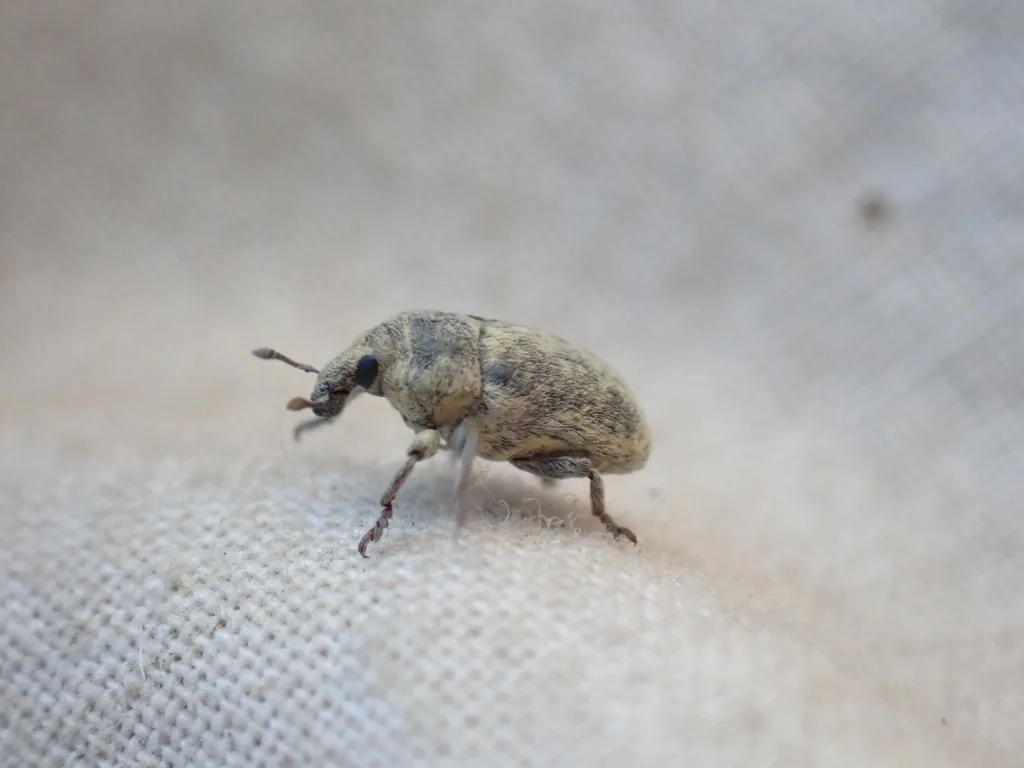
- Adults are mottled brown with a large, bent snout: 4 to 5 mm for the lesser knapweed flower weevil, 5 to 7 mm and mottled brownish-black for the blunt knapweed flower weevil.[4]
- UC IPM says the two species are very difficult to distinguish; L. obtusus is a little larger.[5]
- Larvae are white, C-shaped and brown-headed, about 8 mm long, inside the seed heads; the white 6 mm pupae turn brown shortly before the adult emerges. New adults chew their way out, leaving an open pupal chamber of chewed seeds and pappus hairs.[4]
- Eggs are elongate and yellow, laid in the flower head between the pappus hairs.[4]
Look-alikes
| Look-alike | How to tell them apart |
|---|---|
| Broad-nosed seedhead weevil (Bangasternus fausti) | Another weevil whose larvae feed in knapweed seed heads; the larvae are hard to tell apart, but adult B. fausti have a shorter, blunter snout.[4][5] |
| Knapweed root weevil (Cyphocleonus achates) | A much bigger weevil, 13 to 15 mm, brown-gray mottled with a short thick snout, whose larvae live in the roots rather than the flower heads.[4] |
Where it lives
The lesser knapweed flower weevil came from Greece and Romania and was released in the western US in 1991 and in the eastern US from 1992; the blunt knapweed flower weevil came from Romania and Serbia and was released in the western US in 1992 and the eastern US from 1995. UC IPM says knapweed agents have been most extensively released in Colorado, Montana and Oregon. GBIF holds about 850 records of L. minutus, about 250 from Canada and 200 from the US, and about 2,600 of L. obtusus, about 1,000 of them from the US; since 1990 L. minutus records come mostly from Montana, Washington, Colorado and Oregon and L. obtusus records mostly from Michigan, New York and Massachusetts.[4][5][7][8][10][11]
Biology and life cycle
Overwintering adults emerge from plant litter throughout the summer and feed on knapweed leaves, outer stem tissue and flowers before laying eggs. A lesser knapweed flower weevil female lays 28 to 130 eggs in her lifetime, up to five per flower head.[4]
Larvae hatch in three days, feed first on the pappus hairs and then on the seeds and receptacle tissue, and pass through three instars in about four weeks (3 to 4 weeks for the blunt weevil). Pupation is in a chamber of chewed seeds and pappus hairs inside the head; the new adults feed on foliage and florets and move to the plant base to overwinter. One generation a year.[4]
The lesser knapweed flower weevil prefers hotter, drier sites, dense knapweed with little competition and well-drained coarse soil, and avoids compacted soil and prolonged rainfall. The blunt knapweed flower weevil favors moister, cooler sites on south and west slopes, often near water.[4]
Damage and signs
- Larvae consume large portions of the developing seed, reducing the rate of knapweed spread, and adult defoliation can be severe enough to stunt and even kill plants.[4]
- In western Montana, where five seedhead agents became established between 1973 and 1992, seed-head insects cut spotted knapweed seed production per head by about 84 percent in a 2006 experiment, and at two long-term sites the reproductive potential (seeds per square meter) was 96 to 99 percent lower in 2004-05 than in 1974-75. Seedhead flies alone had reduced seeds per head by roughly a third to a half; adding the Larinus weevils pushed the reduction to 84 to 90 percent.[2]
- In Arkansas the lesser knapweed flower weevil was found in about 36 percent of spotted knapweed heads over three years and reduced seed in a head more effectively than the seedhead fly Urophora quadrifasciata; heads holding both agents produced no less seed than heads with the weevil alone.[3]
- In the western US the lesser knapweed flower weevil causes widespread decreases in diffuse knapweed density; on spotted knapweed its impact is variable. In California, L. minutus attacked an average of 43 percent of spotted knapweed heads in a 3-year study, and on meadow knapweed the two Larinus species attacked 74 to 78 percent of heads two years after release.[4][5]
- UC IPM says no damage to non-target species has been reported from the knapweed agents.[5]
Health risk
The Forest Service and UC IPM describe them only as seed-feeding weevils of knapweeds; no cited source describes any risk to people or pets.[4][5]
Control
Prevention
Match the weevil to the site: hot, dry, well-drained ground with dense knapweed for the lesser knapweed flower weevil, cooler and moister ground for the blunt one. Avoid compacted soil, especially where livestock graze during bolting.[4]
Biological control
The weevils are the control. Minnesota's program pairs seedhead weevils with the knapweed root weevil, collecting both from established sites and releasing them at new ones; many sites are considered controlled, but large ones have taken up to a decade.[1]
Where the sources disagree
Species: the Forest Service notes evidence that L. minutus and L. obtusus may be variants of one species and that releases were often mixtures; GBIF lists both as accepted species.[4][6][9]
Size: the Forest Service gives 4 to 5 mm for L. minutus and 5 to 7 mm for L. obtusus; UC IPM says only that L. obtusus is a little larger.[4][5]
Impact on spotted knapweed: the Forest Service calls it variable, while the Montana study found seed-head insects with Larinus cut seed per head by 84 to 90 percent.[4][2]
Common questions
- How do I know the seedhead weevils are present?
- Look for the mottled brown, long-snouted adults around the flower heads in summer, or open mature heads for larvae and the open pupal chambers left by emerged adults.[4][5]
- Which species do I have?
- Possibly both. UC IPM says they are very difficult to distinguish, and the Forest Service notes the lesser weevil prefers hotter, drier sites and the blunt weevil moister, cooler ones.[5][4]
- The weevils are everywhere but the knapweed is still thick. Why?
- Seedhead agents cut seed production, not standing plants, and the Montana work suggests density may not drop until the seed bank falls below a threshold. Minnesota pairs them with the root weevil, which can weaken or kill existing plants.[2][1]
Sources
- Minnesota Department of Agriculture and Minnesota Department of Natural Resources, “Biological Control of Invasive Plants in Minnesota (Chandler, Skinner and Van Riper).” files.dnr.state.mn.us/natural_resources/invasives/biocontrolofplants.pdf (accessed 2026-11-14)
- Environmental Entomology (Entomological Society of America), “Story, Smith, Corn and White (Montana Agricultural Experiment Station). Influence of seed head-attacking biological control agents on spotted knapweed reproductive potential in western Montana over a 30-year period. Environmental Entomology 37: 510 (2008), doi:10.1603/0046-225X(2008)37[510:IOSHBC]2.0.CO;2.” pubmed.ncbi.nlm.nih.gov/18419924/ (accessed 2026-11-14)
- Environmental Entomology (Entomological Society of America), “Minteer (USDA-ARS), Kring and Wiedenmann (University of Arkansas). Larinus minutus (Coleoptera: Curculionidae) and Urophora quadrifasciata (Diptera: Tephritidae), evidence for interaction and impact on spotted knapweed in Arkansas. Environmental Entomology (2016), doi:10.1093/ee/nvw011.” pubmed.ncbi.nlm.nih.gov/27016002/ (accessed 2026-11-14)
- USDA Forest Service, Forest Health Technology Enterprise Team, “Field Guide for the Biological Control of Weeds in Eastern North America, FHTET-2016-04 (R. L. Winston, C. B. Randall, B. Blossey, P. W. Tipping, E. C. Lake and J. Hough-Goldstein, 2017).” www.fs.usda.gov/foresthealth/technology/pdfs/FHTET-2016-04_Biocontrol_Field_Guide.pdf (accessed 2026-11-14)
- University of California Statewide IPM Program, “Weed Control User Tool (WeedCUT): Biological Control of Knapweed.” weedcut.ipm.ucanr.edu/biological-control/knapweed/ (accessed 2026-11-14)
- Global Biodiversity Information Facility (GBIF), “Larinus minutus Gyllenhal, 1836 (GBIF Backbone Taxonomy).” api.gbif.org/v1/species/1183691 (accessed 2026-11-14)
- Global Biodiversity Information Facility (GBIF), “Larinus minutus: occurrence records by country (GBIF occurrence search).” api.gbif.org/v1/occurrence/search?taxonKey=1183691&facet=country&facetLimit=20&limit=0 (accessed 2026-11-14)
- Global Biodiversity Information Facility (GBIF), “Larinus minutus: U.S. occurrence records since 1990 by state (GBIF occurrence search).” api.gbif.org/v1/occurrence/search?taxonKey=1183691&country=US&hasGeospatialIssue=false&occurrenceStatus=PRESENT&year=1990%2C2026&facet=stateProvince&facetLimit=400&limit=0 (accessed 2026-11-14)
- Global Biodiversity Information Facility (GBIF), “Larinus obtusus Gyllenhal, 1835 (GBIF Backbone Taxonomy).” api.gbif.org/v1/species/1183688 (accessed 2026-11-14)
- Global Biodiversity Information Facility (GBIF), “Larinus obtusus: occurrence records by country (GBIF occurrence search).” api.gbif.org/v1/occurrence/search?taxonKey=1183688&facet=country&facetLimit=20&limit=0 (accessed 2026-11-14)
- Global Biodiversity Information Facility (GBIF), “Larinus obtusus: U.S. occurrence records since 1990 by state (GBIF occurrence search).” api.gbif.org/v1/occurrence/search?taxonKey=1183688&country=US&hasGeospatialIssue=false&occurrenceStatus=PRESENT&year=1990%2C2026&facet=stateProvince&facetLimit=400&limit=0 (accessed 2026-11-14)