On this page
How to identify it
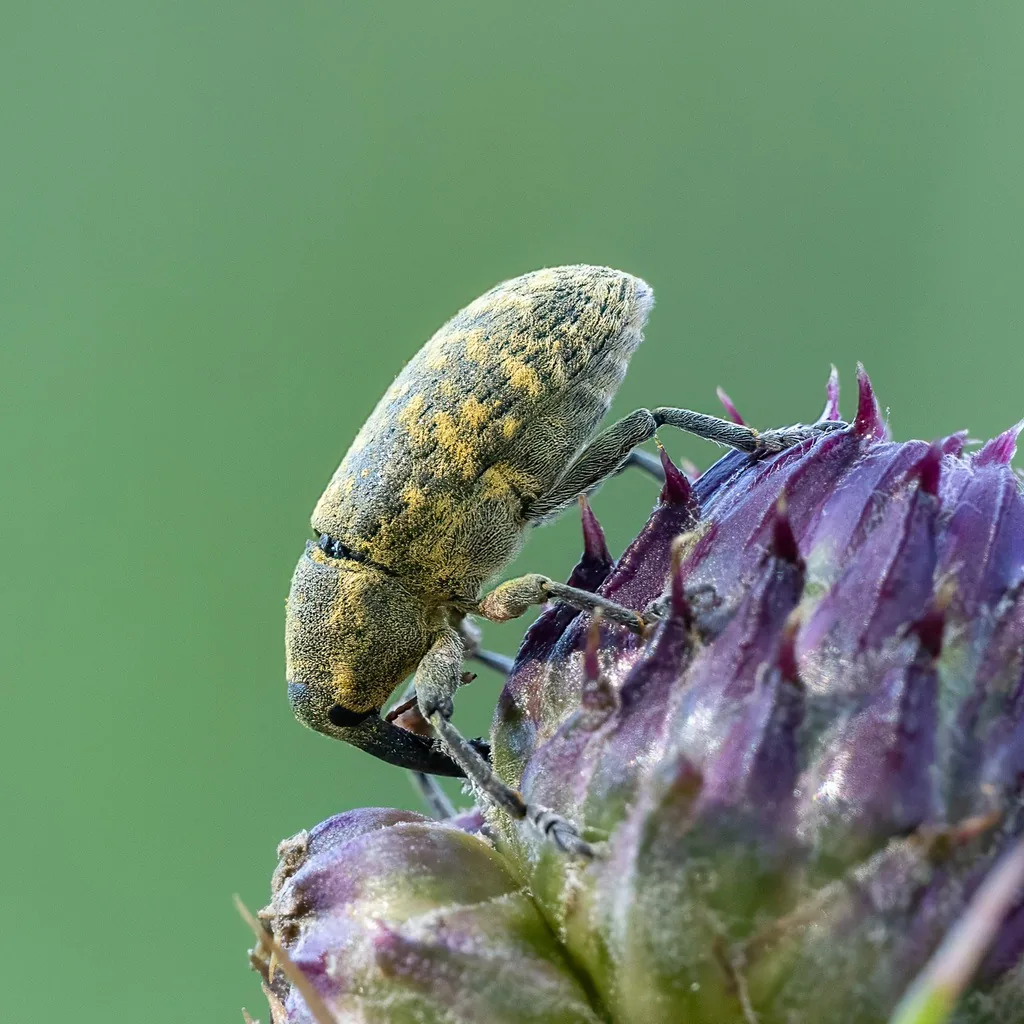
- Adults are elongate weevils up to 8 mm long with a long snout. The body is black with mottled tan-yellow hairs. The hairs can rub off.[2][8]
- Larvae are white with a brown head, up to 5 mm long, inside thistle flower heads in summer. They are C-shaped grubs.[2][8]
- Adult feeding in spring leaves holes in young leaves and deformed bracts and seed heads.[2]
Look-alikes
| Look-alike | How to tell them apart |
|---|---|
| Thistle seedhead weevil (Rhinocyllus conicus) | Also a dark weevil with yellowish tufts whose larvae develop in thistle heads, but adults are up to 6 mm, against up to 8 mm for the bud weevil. The Oregon refuge researchers at first took bud weevils in Canada thistle heads for R. conicus until rearing showed otherwise.[2][1] |
| Knapweed flower weevils (Larinus minutus and L. obtusus) | Same genus and the same habit of developing in flower heads, but these two were released against knapweeds and develop in knapweed heads.[2] |
Where it lives
Recorded in the US by 1968 and Canada by 1988. The Forest Service lists it as established on Canada thistle in the eastern US (Indiana, Maryland, New York, Ohio, Pennsylvania and West Virginia) and Nova Scotia, and on bull, Canada, musk and plumeless thistle in western Canada; it was already established at the Oregon refuge when a Forest Service study began there in 1995. GBIF holds about 3,400 records under Larinus carlinae, about 1,240 of them from the US, 740 from Canada and 340 from Great Britain; its US records since 1990 come from 31 states, most from Colorado, Ohio, Michigan and Pennsylvania. Its native range is Europe.[2][1][4][5][8]
Biology and life cycle
Adults emerge in early spring and feed on young foliage. When flower buds are forming, the female inserts an egg into the bud, and the larva mines into the flower.[2][1]
Larvae feed on developing seeds and receptacle tissue through the summer and pupate inside the head. IBiocontrol, summarizing the 2024 NAISMA review, says the larvae pass through three instars.[2][8]
New adults emerge in late summer and early fall and overwinter in plant litter. There is one generation a year.[2][1]
It is established on Canada thistle in the eastern US and on bull, Canada, musk and plumeless thistle in western Canada, and it attacks numerous native thistles. On bull thistle it prefers other species and has only a minor impact.[2]
Damage and signs
- Larval feeding destroys developing seed. On the Oregon refuge, samples of Canada thistle heads in four different years showed 28 to 43 percent attacked by this weevil.[1]
- Over ten years of monitoring at that refuge, with the Canada thistle stem weevil and the stem gall fly also present, Canada thistle fell from about 50 to about 8 plants per square metre, plants grew shorter, and after 2004 the refuge stopped spraying herbicide for it. The authors credited the combined stress from all the agents, which let grasses outcompete the weakened thistles; the bud weevil's share of that result was not separated out.[1]
- It attacks numerous native thistle species, and its damage to natives often exceeds its damage to the exotic thistles. The Forest Service says it is not approved for redistribution in the US and is no longer permitted for interstate redistribution.[2]
- Adult feeding on foliage is typically minor. Larval mining and feeding on receptacle and seed tissue reduces viable seed production; IBiocontrol says this does not kill existing plants but does slow the spread of the thistle.[8]
Health risk
The Forest Service describes it only as a seed-feeding weevil of thistles; no cited source describes any risk to people or pets.[2]
Control
Prevention
Do not collect or move this weevil. The Forest Service lists it among unapproved non-indigenous natural enemies and says it is illegal to intentionally move these species to new areas in the US; the Oregon study notes it is not an approved biological control agent.[2][1]
Biological control
Where it already occurs in Canada thistle heads, it is one of several insects feeding on the weed and needs no control itself.[1]
Where the sources disagree
Name: the Forest Service treats Larinus carlinae and L. planus as one species and the Oregon study uses L. planus, but GBIF lists both names as separate accepted species, with about 2,300 records under L. planus.[2][1][3][6][7]
Identity: the Oregon researchers first believed the refuge weevil was Rhinocyllus conicus and only rearing showed it to be L. planus.[1]
Location: the Oregon study places Ladd Marsh in northwestern Oregon in one passage and eastern Oregon in another; the refuge is in Union County, east of La Grande.[1]
Hosts: IBiocontrol lists Canada, musk, plumeless and bull thistle as its North American hosts without separating the eastern US from western Canada, while the Forest Service field guide records it on Canada thistle only in the eastern US.[8][2]
Common questions
- Is the bud weevil in my Canada thistle an approved biocontrol insect?
- No. It was recorded in the US by 1968, the Oregon study says it is not an approved biological control agent, and the Forest Service says it is no longer permitted for interstate redistribution in the US.[2][1]
- Does it hurt native thistles?
- Yes. It attacks numerous native thistle species, and the damage to natives often exceeds the damage to the exotic thistles.[2]
- How much seed does it destroy?
- On an Oregon refuge, 28 to 43 percent of sampled Canada thistle heads were attacked in four years of sampling. Each larva develops inside a head and eats the developing seed.[1][2]
- Is it approved anywhere?
- IBiocontrol, which summarizes the 2024 NAISMA review, lists it as approved in Canada but not approved in the USA, where the Forest Service says it is no longer permitted for interstate redistribution.[8][2]
Sources
- USDA Forest Service (Treesearch 44760), “Markin (USDA Forest Service, Rocky Mountain Research Station) and Larson (Ladd Marsh Wildlife Refuge). Effective landscape scale management of Cirsium arvense (Canada thistle) utilizing biological control. In: Proceedings of the XIII International Symposium on Biological Control of Weeds, Session 9, pp. 423-428. USDA Forest Service, Forest Health Technology Enterprise Team (2013).” research.fs.usda.gov/treesearch/44760 (accessed 2026-11-14)
- USDA Forest Service, Forest Health Technology Enterprise Team, “Field Guide for the Biological Control of Weeds in Eastern North America, FHTET-2016-04 (R. L. Winston, C. B. Randall, B. Blossey, P. W. Tipping, E. C. Lake and J. Hough-Goldstein, 2017).” www.fs.usda.gov/foresthealth/technology/pdfs/FHTET-2016-04_Biocontrol_Field_Guide.pdf (accessed 2026-11-14)
- Global Biodiversity Information Facility (GBIF), “Larinus carlinae (A.G.Olivier, 1807) (GBIF Backbone Taxonomy).” api.gbif.org/v1/species/1183708 (accessed 2026-11-14)
- Global Biodiversity Information Facility (GBIF), “Larinus carlinae: occurrence records by country (GBIF occurrence search).” api.gbif.org/v1/occurrence/search?taxonKey=1183708&facet=country&facetLimit=20&limit=0 (accessed 2026-11-14)
- Global Biodiversity Information Facility (GBIF), “Larinus carlinae: U.S. occurrence records since 1990 by state (GBIF occurrence search).” api.gbif.org/v1/occurrence/search?taxonKey=1183708&country=US&hasGeospatialIssue=false&occurrenceStatus=PRESENT&year=1990%2C2026&facet=stateProvince&facetLimit=400&limit=0 (accessed 2026-11-14)
- Global Biodiversity Information Facility (GBIF), “Larinus planus (J.C.Fabricius, 1792) (GBIF Backbone Taxonomy).” api.gbif.org/v1/species/1183775 (accessed 2026-11-14)
- Global Biodiversity Information Facility (GBIF), “Larinus planus: occurrence records by country (GBIF occurrence search).” api.gbif.org/v1/occurrence/search?taxonKey=1183775&facet=country&facetLimit=20&limit=0 (accessed 2026-11-14)
- IBiocontrol / North American Invasive Species Management Association, “Canada thistle bud weevil, Larinus carlinae (agent profile summarizing Randall et al. 2024, Introduced Thistle Biocontrol Agents: History and Ecology in North America, NAISMA-BCW-2024-8).” ibiocontrol.org/bio/larinus-carlinae/ (accessed 2026-11-14)