On this page
How to identify it
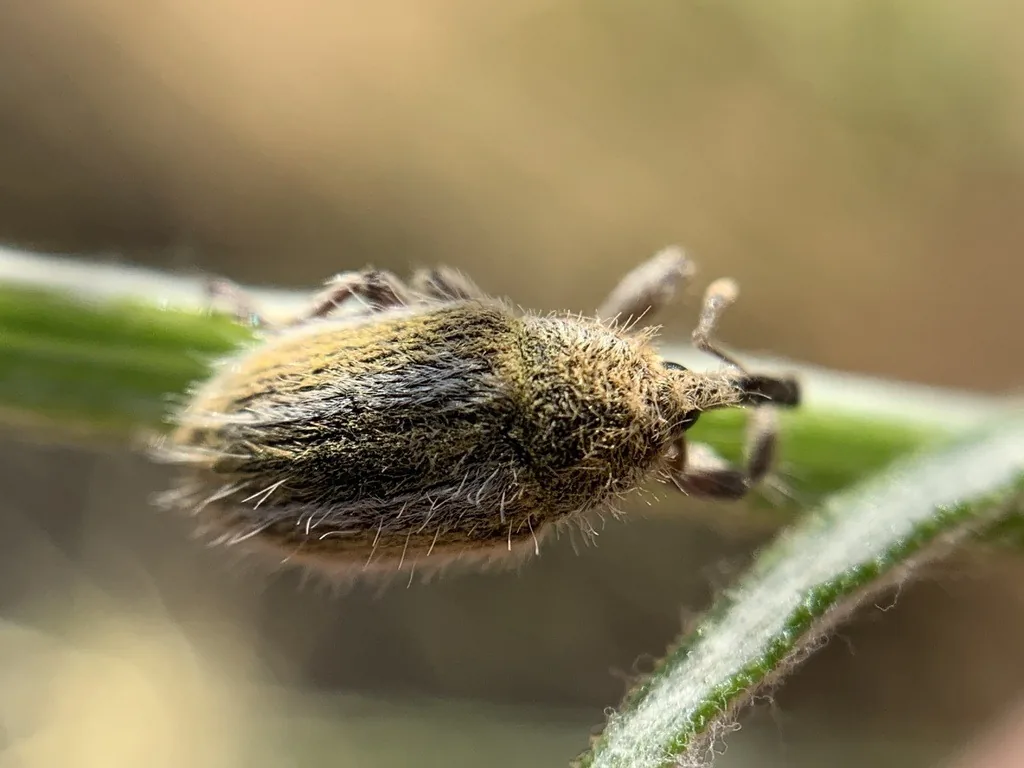
- Hairy weevil (Eustenopus villosus): 4 to 6 mm, oblong and cylindrical, brown with lighter lengthwise stripes and covered in long hairs, with a long, slender snout. Females chew a hole in the side of a mature, closed bud, lay an egg inside and cap the hole with a dark substance; WeedCUT says these egg sites are readily seen on the flower heads.[2][3]
- Bud weevil (Bangasternus orientalis): also 4 to 6 mm, with a somewhat flattened, cylinder-shaped body and short snout, brown with yellow-white hairs that give it a mottled look. Its eggs, laid singly just below the buds, are tiny yellow spheres under dark caps that look like black lumps on the stem or leaf, and emerging adults leave a 'bullet hole' in the flower head.[2][3]
- Flower weevil (Larinus curtus): 5 to 6 mm, oval-bodied with a medium-length snout, brown with white hairs that give a mottled look, the hairs often yellow with starthistle pollen. It is often seen on an open flower with its head buried deep among the florets.[2][3]
- Rosette weevil (Ceratapion basicorne): the newest agent, which attacks the rosette rather than the flower heads; its larval damage shows in the root crown.[3]
- Larvae of the three seed-head weevils are white, C-shaped grubs with brown heads, up to 6 mm long, hidden inside the heads; open mature flower heads to look for larvae or damage. Rosette weevil larvae feed inside the upper root, and more than one can develop in a plant.[2][3]
Look-alikes
| Look-alike | How to tell them apart |
|---|---|
| Yellow starthistle seed-head flies (Chaetorellia australis, C. succinea, Urophora sirunaseva) | Fruit flies whose larvae also eat the developing seeds, the gall fly Urophora making a hard, nut-like gall from the flower ovary. Adults are small flies with patterned wings, not snouted beetles. The false peacock fly, C. succinea, was introduced by mistake in 1991 and is not permitted for release, but it is the most widespread yellow starthistle insect in California and, with the hairy weevil, provides the most impact.[2][3][4] |
| Knapweed flower weevils (Larinus minutus and L. obtusus) | Related Larinus seed-head weevils released against knapweeds rather than yellow starthistle.[5] |
Where it lives
The three seed-head weevils all came from Greece: the bud weevil is native to Eurasia and the Mediterranean, the hairy weevil to Europe and the Mediterranean and the flower weevil to Eurasia and the Mediterranean. The bud weevil initially established in most western US infestations; the hairy weevil is abundant and widespread in the western US, and in California most common in the foothills; the flower weevil is abundant in parts of Oregon, moderate in Washington and more limited in Idaho and California. The rosette weevil, native to the Mediterranean from Spain to Azerbaijan, was first released in North America in April 2020 in Solano County, California, with a second release in El Dorado County in April 2021. UC IPM counts six insects and one rust fungus established on yellow starthistle in California, with the bud weevil, hairy weevil and gall fly widespread.[2][1][4]
Biology and life cycle
The hairy weevil overwinters as an adult and emerges in spring as the plant enters the spiny bud stage, feeding heavily on early immature buds. In early to midsummer females chew holes in the sides of mature, closed buds, lay eggs inside and cap the holes. Larvae hatch throughout summer, feed on developing seeds through three instars and pupate in the head in a chamber of damaged seed and receptacle tissue; adults emerge in late summer. One generation a year.[2]
In a 2014-2015 study in eastern Washington, sampled from early May to mid-August, overwintered hairy and flower weevil adults went through three phases: not yet detected, appearing and increasing, then declining. The hairy weevil's increase was most strongly associated with warming temperatures in both years; the flower weevil's tracked rising starthistle cover in 2014 and warming temperatures and drying soils in 2015; and both declined as the plants advanced and the buds and flowers they feed and breed in dwindled.[6]
The bud weevil resumes activity as the plant bolts. Females lay up to 470 eggs in a lifetime, singly just below the buds, covered with a dark protective substance. Larvae hatch in late spring and tunnel through the stem into the developing head, feeding on bracts, receptacle and seeds; the first instar mines the stem and bracts and instars two to four feed inside the head. Pupation is in the head, adults emerge in late summer and overwinter in soil litter, with one generation a year.[2]
The flower weevil is the late one: overwintered adults emerge in summer, when the plant is in bud and flower, and feed on florets and pollen. Females lay eggs singly in open flower heads at the base of the florets, the larvae hatch in late summer and eat developing seeds through three instars, pupate in the head, and the new adults overwinter in soil litter. One generation a year.[2]
The rosette weevil has one generation a year. Adults feed on rosette leaves in spring and lay eggs in the leaf blades and midribs; larvae tunnel down the leaf stalk, feed inside the upper root and pupate inside the plant. Adults emerge as the plant bolts (late May to June), feed and mate on it for a week or two, then disappear until the next spring.[3]
Damage and signs
- The hairy weevil has the largest total impact on yellow starthistle's reproductive output of the biocontrol insects: its larvae destroy up to 100 percent of seeds in attacked heads, and adult feeding often kills young buds and delays mature flowers by 2 to 3 weeks. In a 1993-1995 study at two central California sites, adult feeding stopped 60 to 70 percent of early buds from developing, 69 to 92 percent of heads were punctured, larvae occurred in 27 to 49 percent and larval feeding cost 34 to 47 percent of total seed. In a long-term CDFA study it attacked 20 to 80 percent of flower heads, varying from year to year.[2][7][3]
- With the false peacock fly (Chaetorellia succinea), the hairy weevil can reduce seed production by more than 70 percent overall, which is believed to have contributed to significant declines at some undisturbed sites with competition from grasses and other forbs. No declines have been seen at several other areas, especially disturbed ones such as roadsides, and at many sites the plants compensate by growing larger and producing more seed heads. Parasitism and predation may negate the weevil's impact at some sites, and its killing of early buds makes the plant less synchronized with other seed predators.[2]
- The bud weevil's larvae typically destroy 60 percent of seeds in attacked heads, but its numbers have declined since their peak a few years after release, and its current attack rate is only 1 percent of available heads, limited by predation, parasitism and displacement by other agents. The flower weevil's larvae destroy up to 100 percent of seeds in attacked heads, but attack rates are typically low. Adult feeding by both is superficial or minor. Seed feeding does not kill existing plants; it reduces seed output, which may slow spread.[2]
- WeedCUT says the seed-head agents do little to reduce the growth or size of existing plants, and that the rosette weevil should help reduce plant size and survival but, because its populations grow slowly and it is hard to rear, will take several years to become available for general distribution. UC IPM says the hairy weevil and false peacock fly are the most effective agents, reducing seed production by about 50 percent, yet seed counts per plant remain high.[3][4]
Health risk
These are plant-feeding weevils. UC IPM, UC WeedCUT and the USDA Forest Service manual don't mention any risk to people or pets.[4][3][2]
Control
Prevention
Do not expect the insects to finish the job. UC IPM recommends combining control methods because even a 50 percent seed reduction leaves high seed counts. WeedCUT notes that spring mowing delays flowering and may reduce the insects' effectiveness, and that fall grazing of flower heads kills the flies overwintering inside them but not the weevils, which overwinter away from the plant.[4][3]
Traps and physical control
To check for the weevils, look for flagged small buds and capped egg holes in the sides of larger closed buds (hairy weevil), black egg lumps on the stem or leaf below a head and 'bullet' exit holes (bud weevil) and weevils with their heads buried among the florets of open flowers (flower weevil), and open mature flower heads for larvae or damage.[3][2]
Biological control
The weevils need no control. UC IPM says USDA and CDFA run the California biocontrol program, and WeedCUT advises checking which insects are already present at a site first, since it is not worth releasing insects that are already there. The rosette weevil was permitted for release in 2019 but will take several years to become generally available.[4][3]
Where the sources disagree
Which weevils are most abundant: the UC Weed Science blog says the hairy and flower weevils are generally the most abundant agents; in the CDFA study WeedCUT cites, the flower weevil attacked only 0 to 1 percent of flower heads, and the Forest Service manual calls it less abundant than the other seed-feeding agents.[1][3][2]
Where the weevils overwinter: the Forest Service manual says in soil litter; WeedCUT says it is not known, but likely in sheltered places such as tree bark, under rocks or in leaf litter.[2][3]
Flowering delay: the Forest Service manual says hairy weevil feeding delays mature flowers by 2 to 3 weeks; the 1993-1995 California study found regrowth delayed flower-head production by 9 days and extended it by 4 weeks at season end.[2][7]
Names: GBIF's backbone treats Eustenopus villosus as a synonym of Larinus villosus, but the biocontrol sources cited here all use Eustenopus, so this page keeps that name. GBIF also places the rosette weevil in the family Apionidae, while WeedCUT lists it under Curculionidae.[8][9][2][3]
Common questions
- Which yellow starthistle weevil am I looking at?
- Body shape and snout settle most cases: a striped, hairy 4 to 6 mm weevil with a long, slender snout is the hairy weevil; a mottled, somewhat flattened 4 to 6 mm one with a short snout is the bud weevil; and a 5 to 6 mm oval one with a medium snout, often yellow with pollen and head-down in an open flower, is the flower weevil. Rosette weevil larvae are found in the leaf stalks and upper root rather than the flower heads.[2][3]
- Why is there still so much yellow starthistle if the weevils are everywhere?
- Seed feeding does not kill plants, the best agents cut seed by only about half, and at many sites the plants compensate by growing larger and producing more seed heads. Declines have come at undisturbed sites with competition from grasses and other forbs, and WeedCUT reports decreases especially in ungrazed grasslands with dense grass cover.[4][2][3]
- Can the weevils move to my pasture grasses or native plants?
- UC IPM says all the yellow starthistle agents are host-specific and do not harm crops or native plants, and the Forest Service manual reports no nontarget effects for the three seed-head weevils; flower weevil adults have been found feeding on safflower flowers, but with no egg laying or development. For the rosette weevil, USDA researcher Lincoln Smith says the only nontarget plant at risk is bachelor's button. WeedCUT notes the hairy weevil also attacks two other non-native starthistles, tocalote and Sicilian starthistle.[4][2][1][3]
Sources
- University of California Agriculture and Natural Resources, “A New Warrior Released in the Battle to Control Yellow Starthistle (UC Weed Science blog).” ucanr.edu/blog/uc-weed-science-weed-control-management-ecology-and-minutia/article/new-warrior-released (accessed 2026-11-14)
- USDA Forest Service, Forest Health Technology Enterprise Team, “Biology and Biological Control of Yellow Starthistle (FHTET-2016-08, 4th edition), by Randall, Winston, Jette, Pitcairn and DiTomaso (2017).” www.fs.usda.gov/foresthealth/technology/pdfs/FHTET-2016-08_Biocontrol_Yellow_Starthistle.pdf (accessed 2026-11-14). Read from the Forest Service PDF; chapter 3 weevil entries.
- University of California Statewide IPM Program, “WeedCUT: Biological control of yellow starthistle.” weedcut.ipm.ucanr.edu/biological-control/yellow-starthistle/ (accessed 2026-11-14)
- University of California Statewide IPM Program, “Yellow Starthistle (Home and Landscape).” ipm.ucanr.edu/home-and-landscape/yellow-starthistle/ (accessed 2026-11-14)
- USDA Forest Service, Forest Health Technology Enterprise Team, “Field Guide for the Biological Control of Weeds in Eastern North America (FHTET-2016-04), by Winston, Randall, Blossey, Tipping, Lake and Hough-Goldstein (2017).” www.fs.usda.gov/foresthealth/technology/pdfs/FHTET-2016-04_Biocontrol_Field_Guide.pdf (accessed 2026-11-14). Read from the Forest Service PDF; agent entries for each weed.
- Environmental Entomology (via PubMed), “Woodley, Zamora and Coffey (Washington State University). Environmental variables influence the association of Eustenopus villosus and Larinus curtus (Coleoptera: Curculionidae) adults with different growth stages of the invasive thistle Centaurea solstitialis (Asteraceae: Cardueae) in Washington State. Environmental Entomology 46: 383-392 (2017), doi:10.1093/ee/nvx033.” pubmed.ncbi.nlm.nih.gov/28334195/ (accessed 2026-11-14). Cited from the abstract, read through NCBI E-utilities. Volume, pages and DOI corrected from the PubMed record.
- Insects (via PubMed), “Pitcairn, Woods, Joley and Turner (California Department of Food and Agriculture, USDA-ARS). Evaluation of the impact of Eustenopus villosus on Centaurea solstitialis seed production in California. Insects 12: 606 (2021), doi:10.3390/insects12070606.” pubmed.ncbi.nlm.nih.gov/34357266/ (accessed 2026-11-14). Cited from the abstract, read through NCBI E-utilities.
- Global Biodiversity Information Facility (GBIF), “Eustenopus villosus (Boheman, 1843) (GBIF Backbone Taxonomy).” api.gbif.org/v1/species/4465015 (accessed 2026-11-14). HOMOTYPIC_SYNONYM of Larinus villosus Boheman, 1843 (GBIF key 1183755); order Coleoptera, family Curculionidae; read 2026-11-14.
- Global Biodiversity Information Facility (GBIF), “Ceratapion basicorne (Illiger, 1807) (GBIF Backbone Taxonomy).” api.gbif.org/v1/species/4463244 (accessed 2026-11-14). ACCEPTED; order Coleoptera, family Apionidae; read 2026-11-14.
- Global Biodiversity Information Facility (GBIF), “Bangasternus orientalis Capiomont, 1873 (GBIF Backbone Taxonomy).” api.gbif.org/v1/species/4465029 (accessed 2026-11-14). ACCEPTED; order Coleoptera, family Curculionidae; read 2026-11-14.
- Global Biodiversity Information Facility (GBIF), “Larinus curtus Hochhuth, 1851 (GBIF Backbone Taxonomy).” api.gbif.org/v1/species/4464872 (accessed 2026-11-14). ACCEPTED; order Coleoptera, family Curculionidae; read 2026-11-14.