On this page
How to identify it
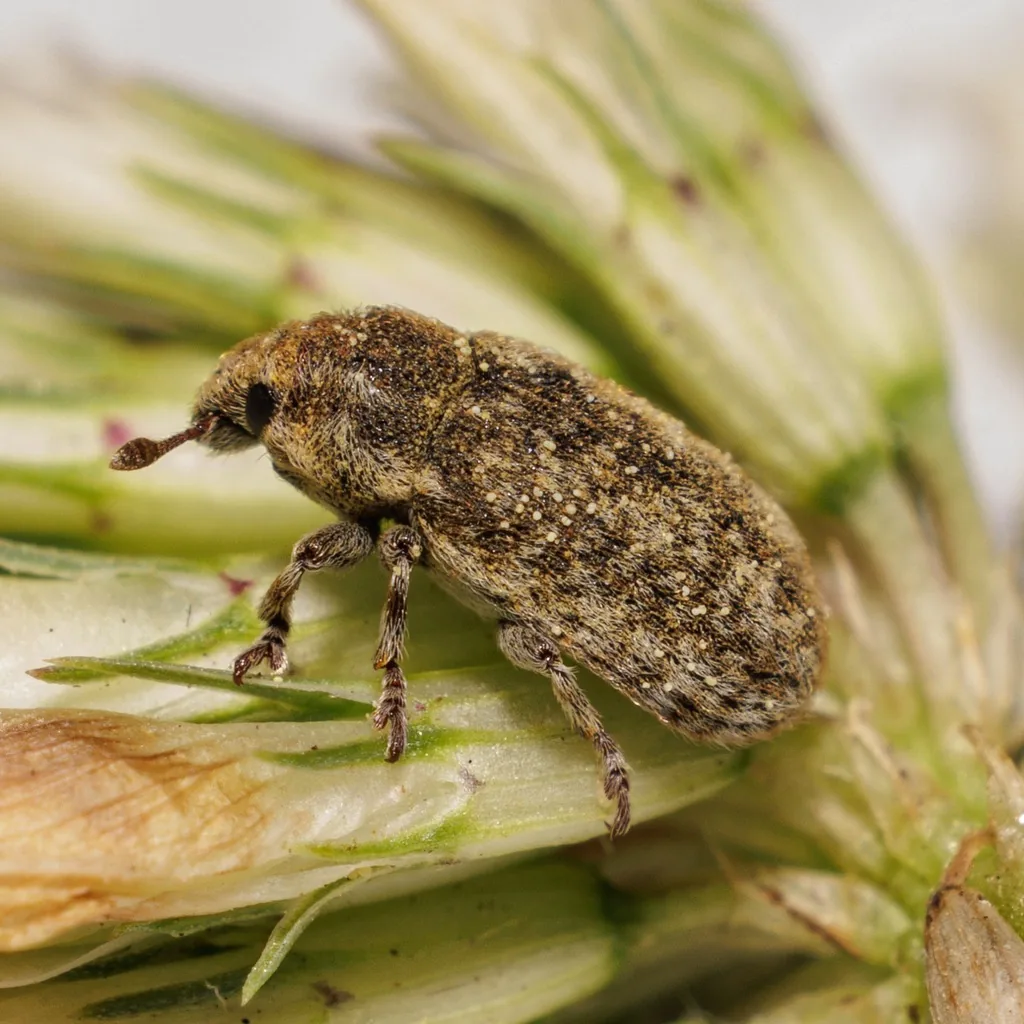
- Adults are small and gray to brown or black, and can be 4 mm long, with a shorter, blunter snout than the Larinus knapweed weevils.[1][2]
- Eggs are yellow ovals laid singly on the underside of leaflets or on stems below a developing flower head, each covered with chewed plant tissue that forms a black cap; UC IPM describes the covering as a black anal excretion.[1][2]
- Larvae are white, C-shaped and brown-headed, up to 8 mm long, and pupae are white and up to 5 mm, inside the flower head. Feeding larvae are difficult to tell from those of the other knapweed seed-feeding weevils.[1]
Look-alikes
| Look-alike | How to tell them apart |
|---|---|
| Knapweed flower weevils (Larinus minutus and L. obtusus) | Seedhead weevils whose larvae also eat knapweed seed, but with longer snouts than the broad-nosed weevil; UC IPM says the two Larinus species are very difficult to tell apart from each other.[1][2] |
| Knapweed root weevil (Cyphocleonus achates) | A much larger weevil, 13 to 15 mm, with a short, thick snout, whose larvae feed in the root rather than the seed head.[1][2] |
Where it lives
Greek stock was released on diffuse knapweed in the western United States in 1990 and redistributed to spotted knapweed in numerous western states, in Minnesota and Nebraska in 1992 and in New York in 2009, and to squarrose knapweed in the West in 1993; attempts on meadow knapweed and purple starthistle failed. In the East it is established only in Nebraska and Wisconsin, and the Forest Service says it has not been released and is not established in Canada. GBIF holds about 170 records, about 110 of them from Canada, 40 from Bulgaria and 20 from the US; its 20 US records since 1990 come from Washington, Montana, Oregon, Colorado and Utah.[1][3][4]
Biology and life cycle
Overwintering adults emerge from soil and plant litter in spring and feed on knapweed foliage. Eggs are laid from late spring through summer and hatch in 8 to 12 days; depending on where the egg sat, the larva mines into the leaflet midrib or the stem before tunneling into the flower head, where it feeds on developing seed through four instars.[1]
Pupation is inside the flower head, in a chamber of frass and fused seeds. Adults emerge in late summer or early fall as the knapweed senesces and drop to the ground to overwinter; UC IPM says they hibernate in sheltered sites, probably tree bark, rocks or leaf litter, though the exact place is not known. There is one generation a year.[1][2]
It prefers hot, dry areas and does poorly where rain is prolonged or at high elevations.[1]
Damage and signs
- Larval feeding destroys seeds and receptacle tissue. Eating seed does not kill existing plants, but it helps reduce the rate of knapweed spread.[1]
- Larvae can consume up to 100 percent of the seed in an attacked head, though some seed often escapes in large flower heads. The Forest Service says its abundance is low throughout the US and its overall US impact is limited. Its low abundance, the Forest Service adds, is not likely due to competition with other knapweed insects.[1]
- California reports more. On diffuse knapweed there, it and Larinus minutus attack up to 85 percent of flower heads, and knapweed densities fell to about a third over 8 years after the seedhead weevils arrived. On squarrose knapweed the two weevils generally infest more than 90 percent of seedheads, B. fausti tends to displace L. minutus over about 6 years, and squarrose knapweed has declined to very low levels.[2]
- In the West, successful diffuse and spotted knapweed control has come at some sites from combining insects that attack seeds, foliage and roots; the Forest Service names the Larinus weevils and the root weevil Cyphocleonus achates as the most important.[1]
Health risk
The Forest Service and UC IPM describe it only as a seed-feeding weevil of knapweeds; no cited source describes any risk to people or pets.[1][2]
Control
Prevention
Plan other knapweed work around it. The weevil leaves the plant in late summer and winters as an adult away from the stand, while the seed head flies winter inside the heads as larvae, so fall grazing of knapweed heads by goats kills most of the flies but does not affect the weevil.[2]
Biological control
The weevil is a weed-control agent and needs no control. Adults can be collected with a sweep net or aspirator in summer, from early bud to early flowering; the Forest Service says some Oregon and Washington populations are large enough to collect from. Presence can be checked by opening mature heads for larvae, and in California some insects may be available from the county Agricultural Commissioner.[1][2]
Where the sources disagree
Impact: UC IPM rates its impact in California as high, with the seedhead weevils attacking up to 85 percent of diffuse knapweed heads, while the Forest Service calls its overall impact in the US limited and its abundance low.[2][1]
Canada: the Forest Service says it has not been released and is not established in Canada and is not approved for release there, yet about 110 of GBIF's records come from Canada.[1][3]
Egg cap: the Forest Service describes the cap as chewed plant tissue; UC IPM calls it a black anal excretion.[1][2]
Arrival date: the Forest Service's field guide says it was first released in the western US in 1990; a 1998 paper by USDA and university researchers lists it among the knapweed seed-head insects imported in 1991.[1][5]
Common questions
- How do I tell this weevil from the Larinus weevils on the same knapweed?
- By the snout: the broad-nosed weevil's is shorter and blunter. The larvae inside the heads are hard to tell apart.[1][2]
- Will it control my spotted knapweed?
- Expect less there. Larvae can eat all the seed in a head they attack, but some seed often escapes in large flower heads, and the Forest Service rates its overall US impact as limited.[1]
- What are the black dots on my knapweed stems?
- Probably capped eggs. The female lays a yellow egg on a leaflet underside or on the stem below a bud and covers it with chewed plant tissue that forms a black cap.[1][2]
- Is the broad-nosed seedhead weevil found in the eastern US?
- Only in a few places. As of 2016 the Forest Service lists it among the few agents established on diffuse knapweed in the East, typically with small populations and limited impact, and gives its eastern records as diffuse knapweed in Nebraska and spotted knapweed in Nebraska and Wisconsin.[1]
Sources
- USDA Forest Service, Forest Health Technology Enterprise Team, “Field Guide for the Biological Control of Weeds in Eastern North America, FHTET-2016-04 (R. L. Winston, C. B. Randall, B. Blossey, P. W. Tipping, E. C. Lake and J. Hough-Goldstein, 2017).” www.fs.usda.gov/foresthealth/technology/pdfs/FHTET-2016-04_Biocontrol_Field_Guide.pdf (accessed 2026-11-14)
- University of California Statewide IPM Program, “Weed Control User Tool (WeedCUT): Biological Control of Knapweed.” weedcut.ipm.ucanr.edu/biological-control/knapweed/ (accessed 2026-11-14)
- Global Biodiversity Information Facility (GBIF), “Bangasternus fausti: occurrence records by country (GBIF occurrence search).” api.gbif.org/v1/occurrence/search?taxonKey=4465034&facet=country&facetLimit=20&limit=0 (accessed 2026-11-14)
- Global Biodiversity Information Facility (GBIF), “Bangasternus fausti: U.S. occurrence records since 1990 by state (GBIF occurrence search).” api.gbif.org/v1/occurrence/search?taxonKey=4465034&country=US&hasGeospatialIssue=false&occurrenceStatus=PRESENT&year=1990%2C2026&facet=stateProvince&facetLimit=400&limit=0 (accessed 2026-11-14)
- Pan-Pacific Entomologist (Biodiversity Heritage Library scan), “Establishment and redistribution of Sphenoptera jugoslavica Obenberger (Coleoptera: Buprestidae) for biological control of diffuse knapweed in the midwestern and western United States (R. F. Lang, G. L. Piper and E. M. Coombs), Pan-Pacific Entomologist 74(1): 27-31 (1998).” archive.org/details/biostor-244860 (accessed 2026-11-14). Scanned copy on the Internet Archive; text read from the archive.org full-text (djvu.txt) file.
- Global Biodiversity Information Facility (GBIF), “Bangasternus fausti Reitter, 1890 (GBIF Backbone Taxonomy).” api.gbif.org/v1/species/4465034 (accessed 2026-11-14)