On this page
How to identify it
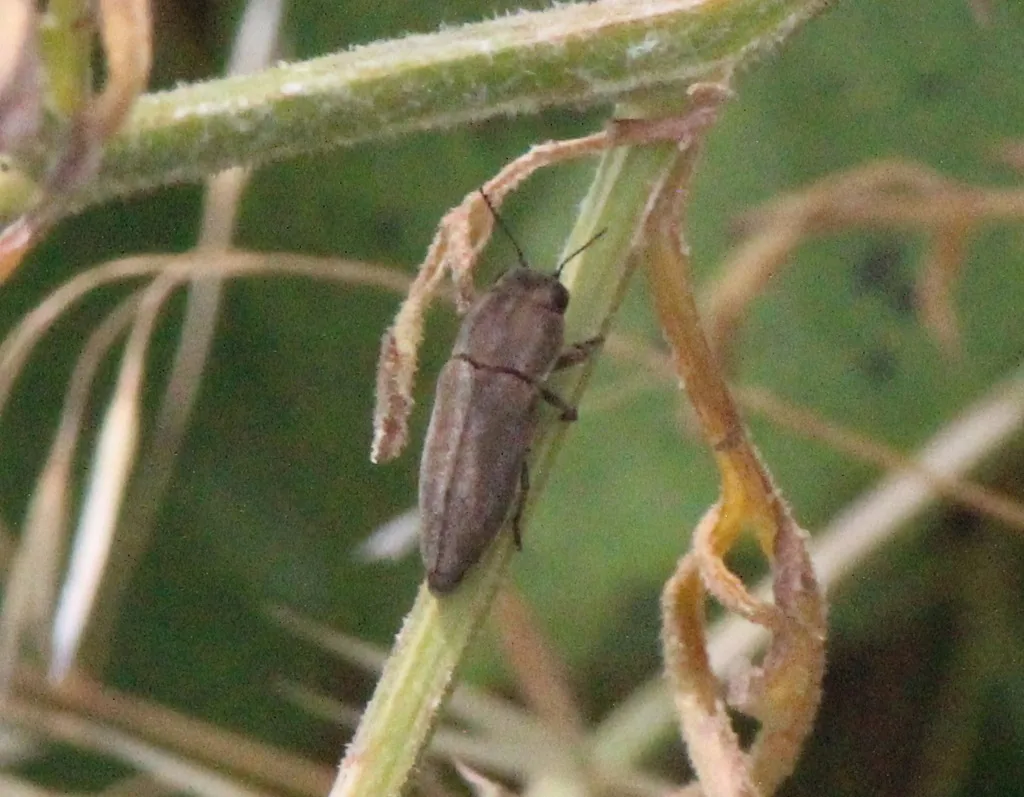
- Adults are metallic bronze, somewhat flattened and up to 10 mm long, tapering toward the narrowed tip of the abdomen. Their feeding leaves characteristic circular and oval holes over the whole leaf.[1]
- Larvae have an enlarged head and a long, thin, cylindrical body that tapers to the end, whitish with inflated segments and a dark brown head; UC IPM describes the swollen thorax and J shape. They are found in swollen galls and frass-filled tunnels in the upper root.[1][2]
- Eggs are flat and white when laid and turn dark bluish purple after five days, laid between the bases of rosette leaves in late summer.[1]
Look-alikes
| Look-alike | How to tell them apart |
|---|---|
| Knapweed root weevil (Cyphocleonus achates) | The other beetle whose larvae feed in knapweed roots; it is a weevil with a short, thick snout, and its larvae are C-shaped rather than long and tapering.[1] |
| Knapweed root moths (Agapeta zoegana, Pelochrista medullana, Pterolonche inspersa) | Three introduced moths whose larvae also destroy knapweed roots. The Forest Service notes P. inspersa can share a root with the borer by feeding below its gall, and that root damage without larvae present is hard to tell apart among root feeders.[3][1] |
Where it lives
Greek stock was released in British Columbia on diffuse knapweed from 1976 and in the western US in 1980, reaching spotted knapweed by 1987 and squarrose knapweed by 1996; it was not intentionally introduced in the eastern US. UC IPM gives its first California release as 1980 and its distribution there as wide. GBIF holds 35 records, 18 of them from the US and 8 from Canada; its 14 US records since 1990 come from Washington, Idaho, Montana, Colorado and Oregon. USDA APHIS approved it for release against diffuse knapweed on 17 May 1979. A 1998 paper reports releases in 11 states and 61 counties from 1980 to 1996, with establishment confirmed in 8 states and 48 counties; releases in Arizona, Nebraska and Nevada did not establish.[1][2][4][5][3]
Biology and life cycle
Adults emerge in summer as knapweed flowers and feed on the leaves for 2 to 3 days before mating. In late summer the female lays several eggs at a time between the bases of rosette leaves, preferring leaf stems 3 to 6 mm across, and averages 50 eggs in her life. Larvae hatch after two weeks, and as the knapweed sets seed the second instars mine into the upper root.[1]
Larvae overwinter in the root. Pupation takes nine days inside the feeding chamber in early summer of the following year. One generation a year. The Forest Service adds that plants rarely support more than one larva; if two develop in one root, the lower one is usually smaller.[1]
It prefers arid places with a summer drought and well-drained, coarse soils with a southern aspect; exposed soil between plants makes a site warmer and better.[1]
The 1998 paper, citing earlier European work, says adults live up to 30 days and start mating within 1 to 2 days. A female produces about 47 eggs, laying 1 to 7 per plant, and normally only one larva develops in a root. The plant forms a spindle-shaped gall around the larva, which feeds on the tissue lining it.[3]
Pupation begins in late May. Emergence is staggered from May to July, and new adults wait 2 to 5 days in the pupal chamber before chewing an exit hole near the root crown. Adults are strong fliers and have readily colonized uninfested knapweed stands in Oregon.[3]
Damage and signs
- Larval feeding consumes roots and may kill plants outright, prevent rosettes from flowering or decrease the seed output of flowering stalks.[1]
- Diffuse knapweed is the preferred host, on which it reduces plant density and seed output, especially among competing vegetation, but its overall impact is moderate because it is largely restricted to hot, dry sites. It is slightly to moderately effective on squarrose knapweed, and most spotted knapweed infestations are too moist to support it.[1]
- UC IPM rates its impact in California as moderate and says it occurs at low levels on diffuse knapweed there.[2]
- In Canada it is established only in British Columbia, where diffuse knapweed is again the preferred host. High beetle numbers occur throughout the driest part of the weed's range there and, together with other agents, can reduce plant stature, seed production and rosette density, though most impact is local.[1]
Health risk
The Forest Service and UC IPM describe it only as a root-boring beetle of knapweeds; no cited source describes any risk to people or pets.[1][2]
Control
Prevention
Do not expect it on moist ground: the Forest Service says it thrives on hot, dry, coarse-soiled sites and that most spotted knapweed infestations are too moist for it.[1]
Biological control
The borer is a weed-control agent and needs no control. Adults can be collected with a sweep net or aspirator in summer while knapweed flowers, presence can be confirmed by opening roots for larvae and galls, and in California some insects may be available from the county Agricultural Commissioner. The 1998 paper recommends collecting adults for redistribution once 25% of a 20-root sample has larvae.[1][2][3]
Where the sources disagree
Family: UC IPM labels it Coleoptera: Curculionidae; the Forest Service and GBIF place it in the Buprestidae, the metallic wood-boring beetles.[2][1][6]
Adult emergence: the Forest Service says adults emerge in summer as knapweed flowers; UC IPM says mid-summer.[1][2]
Impact: the Forest Service and UC IPM both rate it moderate on diffuse knapweed, but UC IPM says it occurs only at low levels on diffuse knapweed in California.[1][2]
Eggs: the Forest Service gives an average of 50 eggs per female; the 1998 paper gives about 47.[1][3]
Pupation: the Forest Service says pupation takes nine days; the 1998 paper, citing a 1996 review, gives 15 to 21 days.[1][3]
Common questions
- How can I tell the root borer's larva from the root weevil's?
- The borer larva is long, thin and tapering with an enlarged head and inflated segments, a J shape in UC IPM's description, in a swollen, frass-filled gall in the upper root; the knapweed root weevil's larva is plump and C-shaped.[1][2]
- Is it worth moving the beetle to my spotted knapweed?
- Only on hot, dry, well-drained sites. Spotted knapweed can be attacked, but the Forest Service says the beetle's distribution and impact on it are typically limited and most spotted infestations are too moist.[1]
- What are the round holes all over my knapweed leaves?
- Possibly adult root borer feeding, which leaves characteristic circular and oval holes over the whole leaf in summer.[1]
- Will the root borer spread on its own?
- Yes. The 1998 paper calls the adults strong fliers, says the beetle is redistributing itself naturally and expects it to keep spreading unaided to other diffuse knapweed stands in the West and Midwest.[3]
Sources
- USDA Forest Service, Forest Health Technology Enterprise Team, “Field Guide for the Biological Control of Weeds in Eastern North America, FHTET-2016-04 (R. L. Winston, C. B. Randall, B. Blossey, P. W. Tipping, E. C. Lake and J. Hough-Goldstein, 2017).” www.fs.usda.gov/foresthealth/technology/pdfs/FHTET-2016-04_Biocontrol_Field_Guide.pdf (accessed 2026-11-14)
- University of California Statewide IPM Program, “Weed Control User Tool (WeedCUT): Biological Control of Knapweed.” weedcut.ipm.ucanr.edu/biological-control/knapweed/ (accessed 2026-11-14)
- Pan-Pacific Entomologist (Biodiversity Heritage Library scan), “Establishment and redistribution of Sphenoptera jugoslavica Obenberger (Coleoptera: Buprestidae) for biological control of diffuse knapweed in the midwestern and western United States (R. F. Lang, G. L. Piper and E. M. Coombs), Pan-Pacific Entomologist 74(1): 27-31 (1998).” archive.org/details/biostor-244860 (accessed 2026-11-14). Scanned copy on the Internet Archive; text read from the archive.org full-text (djvu.txt) file.
- Global Biodiversity Information Facility (GBIF), “Sphenoptera jugoslavica: occurrence records by country (GBIF occurrence search).” api.gbif.org/v1/occurrence/search?taxonKey=5744808&facet=country&facetLimit=20&limit=0 (accessed 2026-11-14)
- Global Biodiversity Information Facility (GBIF), “Sphenoptera jugoslavica: U.S. occurrence records since 1990 by state (GBIF occurrence search).” api.gbif.org/v1/occurrence/search?taxonKey=5744808&country=US&hasGeospatialIssue=false&occurrenceStatus=PRESENT&year=1990%2C2026&facet=stateProvince&facetLimit=400&limit=0 (accessed 2026-11-14)
- Global Biodiversity Information Facility (GBIF), “Sphenoptera jugoslavica Obenberger, 1926 (GBIF Backbone Taxonomy).” api.gbif.org/v1/species/5744808 (accessed 2026-11-14)