On this page
How to identify it
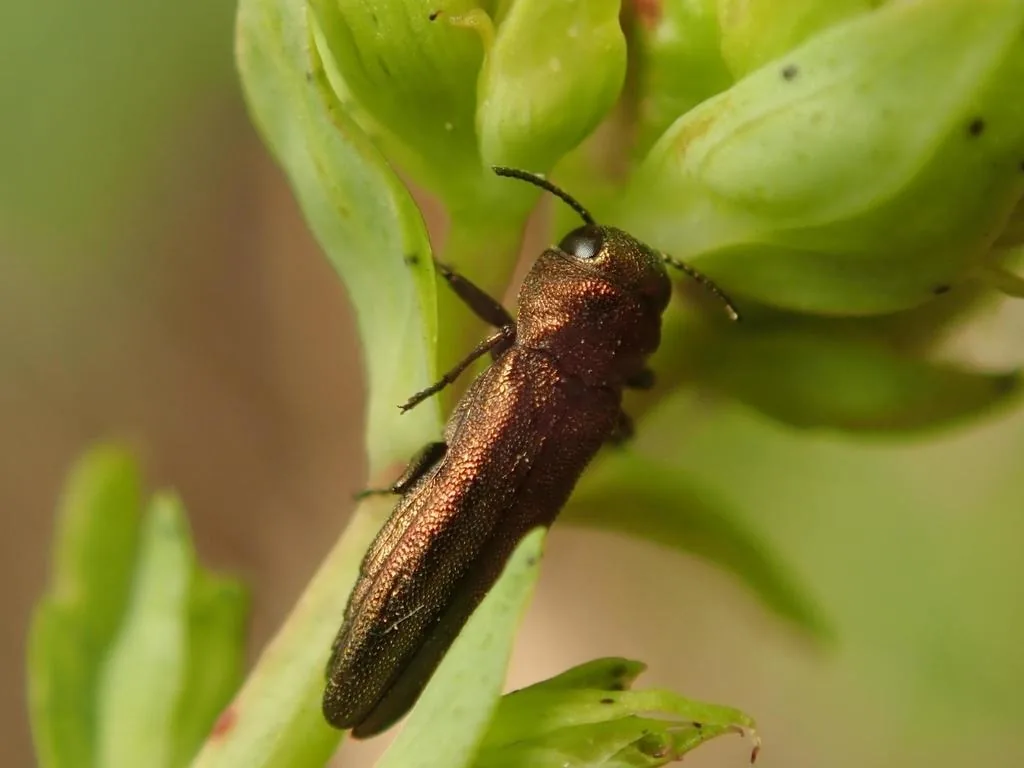
- Adults are metallic brown, flattened and tapered toward the rear, and up to 5 mm (1/5 inch) long; males' heads are slightly greener than the rest of the body. IBiocontrol adds that females are all one color.[1][2][4]
- Larvae are white with brown mouthparts and inflated segments and reach 11 mm (2/5 inch), inside the roots.[1][2]
- Adults are most active in the heat of the day, while St. Johnswort is flowering.[1][2]
Look-alikes
| Look-alike | How to tell them apart |
|---|---|
| Klamathweed beetles (Chrysolina quadrigemina and C. hyperici) | The leaf beetles released on the same weed; their adults and larvae feed on the leaves and can completely defoliate plants, rather than boring the roots.[3][5] |
| St. Johnswort inchworm (Aplocera plagiata) | A moth whose caterpillars feed on the leaves; the gall midge Zeuxidiplosis giardi, another agent, forms galls in the leaf buds instead.[3][5] |
Where it lives
Native to Europe; the Forest Service's 2010 manual says the beetle is found mostly in mountainous regions in North America and in drier, more southern parts of Europe. It was introduced from France and first released in California in 1950, and the manual lists it as established in California, Idaho, Montana, Oregon and Washington; US beetles were also redistributed to British Columbia several times between 1955 and 1987. It is established only in the West. GBIF holds about 630 records, about 210 from France, 130 from Switzerland and 40 from the US; only 5 of its US records date from 1990 or later, 4 of them from California.[1][2][6][7]
Biology and life cycle
Larvae overwinter inside the roots and feed again in spring as the plants bolt, pupating in the roots after the fourth instar. Adults emerge through early summer as the plant flowers.[1][2]
Eggs are laid near the base of the plants in late summer, over about six weeks according to the 2010 manual, and the new larvae burrow into the roots to feed and overwinter. There is one generation a year. In California, UC IPM says larvae attack the roots from August to the following May or June and adults are active from July to early August.[1][2][5]
It prefers large plants with multiple stems and, unlike some other St. Johnswort agents, attacks plants in shade. Damp sites suit it less because the larvae are often attacked by fungus.[1][2][5]
Damage and signs
- Larvae can consume the root tissue completely. Stems from attacked roots and crowns are stunted and produce fewer flowers, and the plant sometimes dies outright; UC IPM says many attacked plants die.[1][2][5]
- Results vary. The Forest Service says the beetle at first destroyed St. Johnswort at many locations but was displaced by the Chrysolina leaf beetles and persisted only in some areas; it contributed significantly to suppression in Idaho, where it is still abundant, and its overall impact is unknown. In California, UC IPM names it and the Klamathweed beetle as the agents with the most impact, together keeping the weed at low densities.[1][5]
- It has been observed attacking Hypericum concinnum, a small shrub endemic to California; long-term impacts on that species have not been recorded.[1][2][5]
Health risk
The Forest Service, UC IPM and Washington's weed board describe it only as a root-feeding beetle of common St. Johnswort; no cited source describes any risk to people or pets.[1][5][3]
Control
Prevention
Pick a site the beetle can live on: it does poorly at damp sites where the larvae are attacked by fungus, prefers dry mountainous sites with large, many-stemmed plants and tolerates shade better than the other agents. The 2010 manual advises making new releases where Chrysolina leaf beetle densities are low.[1][2][5]
Biological control
The borer is a weed-control agent and needs no control. In California, UC IPM says the root beetle and the Klamathweed beetle are probably already at your site, that it can take several years for beetles to find a new infestation, and that adult root borers can be collected for redistribution by sweep net on hot days from July to early August; the county advisor or CDFA's Biological Control program can help.[5]
Where the sources disagree
Impact: UC IPM rates its impact in California as high and says many attacked plants die; the Forest Service calls its overall impact unknown, and the 2010 manual says US populations are small, with the beetle most widespread in northern Idaho.[5][1][2]
Adult season: the Forest Service says adults emerge through early summer as the plant flowers; UC IPM gives July to early August for adults in California. IBiocontrol says adults emerge throughout summer as the plant flowers.[1][2][5][4]
Competition with leaf beetles: the 2010 manual says root borer populations fell sharply in Australia under competition from Chrysolina, while a study in Idaho found Chrysolina densities there too low for negative interactions to be likely.[2]
Records: UC IPM calls the root borer widespread in California, but GBIF holds only 5 US records since 1990.[5][7]
Adult color: the Forest Service field guide calls adults metallic brown; IBiocontrol's summary of the 2024 NAISMA chapter calls them metallic bronze.[1][4]
Common questions
- My St. Johnswort is stunted and barely flowering. Is the root borer in it?
- Maybe, but stunting has other causes. The Forest Service suggests dissecting roots from autumn through spring: white grubs up to 11 mm with brown mouthparts, or larval mining in the root, point to the borer.[1][2]
- Which is doing more good on my St. Johnswort, this beetle or the leaf beetles?
- UC IPM names the Klamathweed beetle and the root borer as the two agents with the most impact in California and credits them together with keeping the weed at low densities. The Forest Service says the root borer's overall impact is unknown because the Chrysolina beetles were so abundant where it was released.[5][1]
- Does it attack anything but St. Johnswort?
- It has been observed attacking Hypericum concinnum, a related plant endemic to California; long-term impacts on that species have not been recorded.[1][2][5]
Sources
- USDA Forest Service, Forest Health Technology Enterprise Team, “Field Guide for the Biological Control of Weeds in Eastern North America, FHTET-2016-04 (R. L. Winston, C. B. Randall, B. Blossey, P. W. Tipping, E. C. Lake and J. Hough-Goldstein, 2017).” www.fs.usda.gov/foresthealth/technology/pdfs/FHTET-2016-04_Biocontrol_Field_Guide.pdf (accessed 2026-11-14)
- USDA Forest Service, Forest Health Technology Enterprise Team, “Biology and Biological Control of Common St. Johnswort, FHTET-2010-05 (R. Winston, M. Schwarzländer, C. B. Randall and R. Reardon, 2nd ed. 2012).” www.fs.usda.gov/foresthealth/technology/pdfs/FHTET-2010-05_StJohnswort.pdf (accessed 2026-11-14)
- Washington State Noxious Weed Control Board, “Common St. Johnswort (Hypericum perforatum).” www.nwcb.wa.gov/weeds/common-st-johnswort (accessed 2026-11-14)
- IBiocontrol / North American Invasive Species Management Association, “St. John's wort beetle, Agrilus hyperici (agent profile summarizing Randall et al. 2024, Common St. Johnswort Biocontrol Agents: History and Ecology in North America, NAISMA-BCW-2024-18).” ibiocontrol.org/bio/agrilus-hyperici/ (accessed 2026-11-14)
- University of California Statewide IPM Program, “Weed Control User Tool (WeedCUT): Biological Control of St. Johnswort.” weedcut.ipm.ucanr.edu/biological-control/st-johnswort/ (accessed 2026-11-14)
- Global Biodiversity Information Facility (GBIF), “Agrilus hyperici: occurrence records by country (GBIF occurrence search).” api.gbif.org/v1/occurrence/search?taxonKey=4432690&facet=country&facetLimit=20&limit=0 (accessed 2026-11-14)
- Global Biodiversity Information Facility (GBIF), “Agrilus hyperici: U.S. occurrence records since 1990 by state (GBIF occurrence search).” api.gbif.org/v1/occurrence/search?taxonKey=4432690&country=US&hasGeospatialIssue=false&occurrenceStatus=PRESENT&year=1990%2C2026&facet=stateProvince&facetLimit=400&limit=0 (accessed 2026-11-14)
- Global Biodiversity Information Facility (GBIF), “Agrilus hyperici (Creutzer, 1799) (GBIF Backbone Taxonomy).” api.gbif.org/v1/species/4432690 (accessed 2026-11-14)