On this page
How to identify it
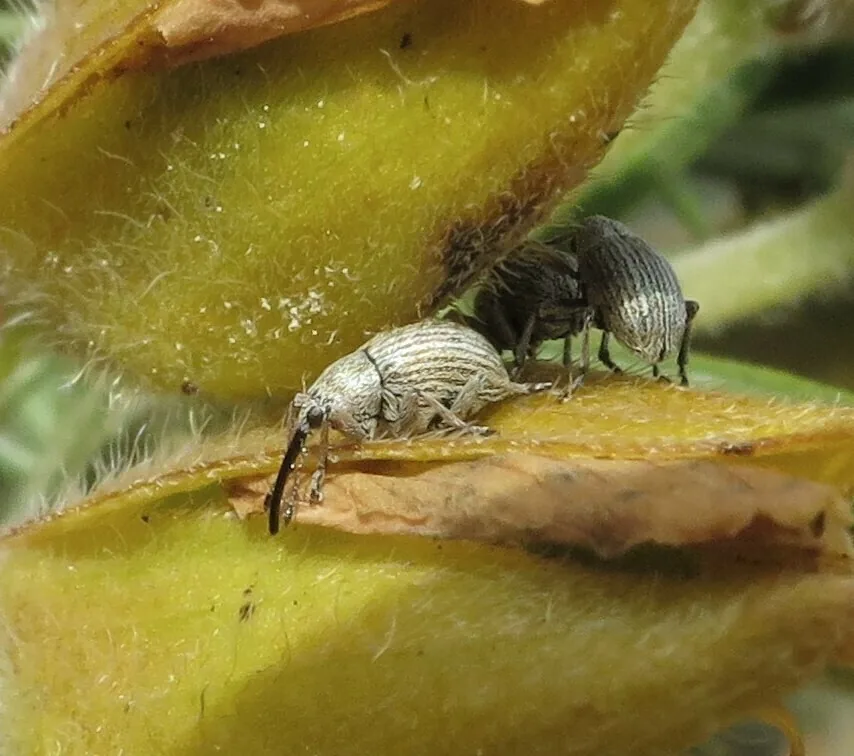
- Adults are gray, typically 2 to 3 mm long, with very long, slightly curved snouts and brownish gray legs; faint stripes are sometimes visible on the wing covers. NAISMA places it in the Brentidae, the straight-snouted weevils.[7]
- A small weevil of the family Brentidae. In early spring, when gorse is in flower, adults feed on the yellow petals and pollen, and they are on the plants from March through July.[2]
- Overwintered adults are readily visible in early spring feeding on gorse stems and flowers. They are relatively fast for their size and on warm days can be seen scurrying around the flowers; their feeding leaves shot-holes in the petals.[7]
- Eggs are round, small and translucent yellow, laid inside young pods, so they are not normally visible in the field. Larvae are cream-colored with brown heads, C-shaped and up to 3 mm long; in an opened pod they feed partly inside and partly outside a seed. Pupae are typically 3 mm and cream-colored, turning dark gray with age.[7]
- Larvae live inside the pods and eat the developing seeds from within; new adults leave when the mature pod dries and splits open. A pod collected in June before it splits may hold weevils that will emerge from it.[2]
Look-alikes
| Look-alike | How to tell them apart |
|---|---|
| Gorse spider mite (Tetranychus lintearius) | The other gorse agent approved in Oregon; a mite, not an insect, that feeds on the leaf tissue. In California it now occurs at low levels around its release sites, and UC IPM does not recommend it because predatory mites usually subdue it.[1][2] |
| Gorse thrips (Sericothrips staphylinus) | A third gorse agent, approved in 2019 and first released in California on June 5, 2020; females lay eggs in slits in young stems and nymphs and adults feed on leaves and stems.[2] |
| Gorse leaf moth (Agonopterix nervosa) | An accidental introduction first recovered in the 1920s, whose larvae tie gorse leaves together with silk and can severely damage growing tips. It is not a permitted agent.[2] |
| Apion sp. (possibly Apion uliciperda) | A closely related, morphologically similar weevil from Spain and Portugal released on Maui in 1958 that did not establish; its adults were described as slightly larger and a darker gray than the gorse seed weevil.[7] |
Where it lives
Native to Western Europe. NAISMA says a population from France was released in California in 1953 and Oregon in 1956 and redistributed to Washington, establishing in all three states, and that it is now widespread and abundant on gorse in the western US; UC IPM gives its first California release as 1964 and calls it widespread there, likely wherever gorse grows. In Hawaii, releases from England (1926) and from England via New Zealand (1949) failed, but stock from more southerly parts of France released from 1955 and a fourth release from England in 1956 established on Maui and Hawaii Island. It is not known to be present in Canada. GBIF holds about 5,500 records, about 4,500 of them from Great Britain, followed by New Zealand, France and Australia, and 32 from the US; its 21 US records since 1990 come from Hawaii, California and Washington. Gorse itself reached Oregon by 1916.[7][2][1][5][6]
Biology and life cycle
The female emerges from overwintering in early spring, when gorse is in flower, and feeds on the petals and pollen. When the pods form and the seeds begin to swell, she chews a hole in a pod and lays a clutch of eggs; the larvae burrow into the developing seeds and develop to adults inside the pod.[2]
Adults leave when the mature pod dries and splits open, emerging in July, and shelter in places such as soil litter through summer and winter until gorse flowers again in spring.[2]
NAISMA describes one generation a year. Larvae hatch from early to late spring and develop through three instars, pupation is in the pod, and new adults do not chew their way out but wait for the ripe pod to dry and burst open. The new adults feed on gorse spines and stems before overwintering among the gorse foliage.[7]
In Hawaii, where gorse follows a different annual pattern, every life stage occurs earlier in the year and some adults are active year-round.[7]
Like its host, it does best in open, sunny sites with dense gorse; NAISMA says it is limited in regions with cold winters, in shade and where gorse is only scattered, and UC IPM adds that it does poorly where sites are exposed to saltwater spray.[7][2]
Parasitism may limit its numbers in some regions. In Hawaii, its feeding damage may make gorse more susceptible to a Colletotrichum fungus.[7]
Damage and signs
- Adult feeding on flowers and foliage destroys some stem tissue without significantly harming the plant. Larval seed feeding may reduce seed output, which does not kill existing gorse but can slow its spread.[7]
- NAISMA puts the share of pods attacked in the western US at 30 to 95 percent, and a 2019 study at three Oregon sites found 51 percent of seeds attacked; UC IPM reports about 60 percent of pods infested in California, destroying 30 to 40 percent of viable seed, and rates the weevil's impact as moderate.[7][2]
- Even so, NAISMA says the seed loss likely does not reduce established stand densities, at best slowing the spread, and the weevil is ineffective on seed maturing in autumn or winter. In Hawaii, annual attack of up to 95 percent of pods has had only limited impact, and chemical and burning programs that destroyed gorse at some locations also collapsed the weevil populations, which recovered slowly.[7]
- The seed bank limits what it can do. Gorse seeds stay viable in the soil for over 30 years, the pods burst and scatter seed for several feet, and Oregon State says disturbance stimulates germination and the shrub resprouts.[3][1]
Health risk
NAISMA and UC IPM describe it only as a seed-feeding weevil of gorse; no cited source describes any risk to people or pets.[7][2]
Control
Prevention
Oregon State treats gorse as a shrub that is very difficult to eradicate once established: it resprouts when cut, disturbance such as clearing, logging or fire triggers the buried seed, and the most effective control combines chemical, mechanical and biological methods, with equipment cleaned of seed before it moves to another site.[1]
Traps and physical control
Washington's Noxious Weed Control Board describes gorse control in two stages, first the established plants and then new plants from the seed bank, usually combining herbicides with cultivation or mowing; repeated mowing may be needed, and goats can control seedlings.[3]
Biological control
The weevil needs no control. There are no commercial sources; UC IPM says adults can be knocked off plants in spring by beating branches over a sheet or sweep net, best early in the morning when it is cold, or reared from mature pods collected in June before they split.[2]
Pesticides
Herbicides are part of Oregon State's recommended combination for gorse; on Oregon forest land a notification of operations must be filed before applying them.[1]
Where the sources disagree
Effect: Oregon State says the gorse agents approved in Oregon have not been effective and NAISMA calls the weevil's overall efficacy questionable because of gorse's high seed output and long-lived seed bank; UC IPM rates its impact in California as moderate.[1][7][2]
Name: Oregon State and NAISMA call it the seed weevil; UC IPM calls it the gorse pod weevil.[1][7][2]
Spider mite: Oregon State lists it among the agents approved in Oregon; UC IPM says it is not recommended in California because predatory mites usually subdue it.[1][2]
Seed life: Oregon State says gorse seed stays viable for 30 years; Washington's weed board says over 30 years.[1][3]
First California release: NAISMA gives 1953; UC IPM gives 1964.[7][2]
Pod attack: NAISMA gives 30 to 95 percent of pods in the western US; UC IPM gives about 60 percent in California.[7][2]
Where adults spend the winter: NAISMA says among the gorse foliage; UC IPM says in places such as soil litter.[7][2]
Common questions
- The weevils are all over my gorse. Will it die back?
- Unlikely. The weevil eats seed inside the pods, about 30 to 40 percent of viable seed in California, and Oregon State says the gorse agents approved there have not been effective.[2][1]
- How do I check whether the weevil is in my gorse?
- Watch the flowers on a warm early-spring day for the fast little gray long-snouted adults, or beat a branch over a sheet early in the morning. Later, open pods that have turned brown but not yet split and look for C-shaped larvae feeding half in and half out of a seed, or keep mature pods collected in June in a screened container to see if adults emerge.[7][2]
- Does the gorse seed weevil attack other plants?
- NAISMA reports no nontarget effects, and lists it as approved in the USA for release against common gorse.[7]
Sources
- Oregon State University Extension Service, “Invasive Weeds in Forest Land: Gorse (Ulex europaeus). EC 1593-E (September 2008).” extension.oregonstate.edu/sites/extd8/files/documents/ec1593.pdf (accessed 2026-11-14)
- University of California Statewide IPM Program, “Weed Control User Tool (WeedCUT): Biological Control of Gorse.” weedcut.ipm.ucanr.edu/biological-control/gorse/ (accessed 2026-11-14)
- Washington State Noxious Weed Control Board, “Gorse (Ulex europaeus).” www.nwcb.wa.gov/weeds/gorse (accessed 2026-11-14)
- Global Biodiversity Information Facility (GBIF), “Exapion ulicis (Forster, 1771) (GBIF Backbone Taxonomy).” api.gbif.org/v1/species/4290691 (accessed 2026-11-14)
- Global Biodiversity Information Facility (GBIF), “Exapion ulicis: occurrence records by country (GBIF occurrence search).” api.gbif.org/v1/occurrence/search?taxonKey=4290691&facet=country&facetLimit=20&limit=0 (accessed 2026-11-14)
- Global Biodiversity Information Facility (GBIF), “Exapion ulicis: U.S. occurrence records since 1990 by state (GBIF occurrence search).” api.gbif.org/v1/occurrence/search?taxonKey=4290691&country=US&hasGeospatialIssue=false&occurrenceStatus=PRESENT&year=1990%2C2026&facet=stateProvince&facetLimit=400&limit=0 (accessed 2026-11-14)
- North American Invasive Species Management Association (PDF hosted on Bugwood), “Andreas (Washington State University Extension), Price and Grevstad. Common Gorse Biocontrol Agents: History and Ecology in North America. In: Winston, ed., Biological Control of Weeds in North America, NAISMA-BCW-2022-12-GORSE-A (2022).” bugwoodcloud.org/resource/files/25362.pdf (accessed 2026-11-14)