On this page
How to identify it
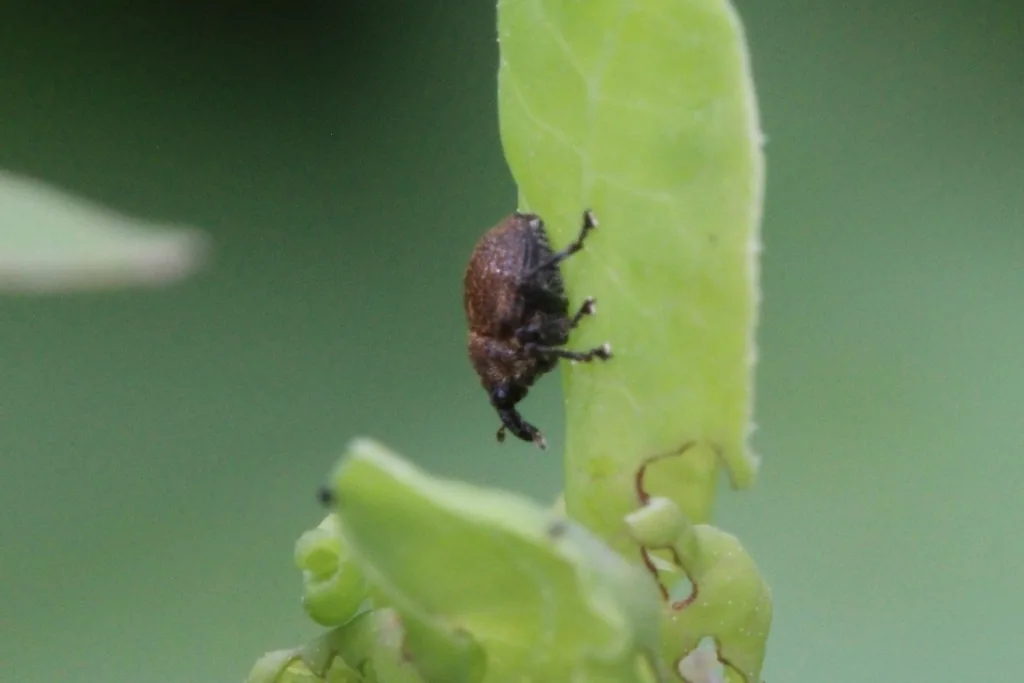
- Adults are 2 mm long with lengthwise ridges on the wing covers. They are black when they emerge, then after a few days of feeding become coated in a rust-colored layer from plant sap.[2]
- Overwintered adults feeding on young leaves in early spring leave a 'shot-hole' pattern.[2]
- Eggs are tan and cylindrical, covered with thin strips of frass, and laid singly on buds, stems and leaf undersides. Larvae are creamy yellow with a brown head, up to 3 mm long, and feed inside the stems.[2]
Where it lives
Native to Asia. Weevils from China were released from 2004 in Connecticut, Delaware, Maryland, Massachusetts, New Jersey, New York, North Carolina, Pennsylvania, Rhode Island, Virginia and West Virginia. Populations increased and dispersed rapidly; in New Jersey it has spread to all known infestations.[2]
Biology and life cycle
A female lays 40 to 130 eggs singly. Larvae burrow into the nodes and feed in the stems through three instars, then drop to the soil to pupate. Egg to adult takes 3 to 4 weeks, with 3 to 4 generations a year, and last-generation adults overwinter in soil or litter.[2]
It prefers sunny habitats and survives in dry and moist conditions, and its impact is highest at warm, dry locations.[2]
It hunts along edges. University of Delaware researchers released weevils at a forest edge and found more than twice as many on potted vines 2 metres away as at 6 or 14 metres; at 14 metres, six to eight times as many weevils reached vines along the forest edge as vines in the open field or inside the woods. Weevils released in the open flew off in all directions but still ended up mostly on edge plants. The weevil seems adapted to find its host where the vine grows, in riparian corridors in Asia and along forest edges here, so it moves well between patches along wooded edges but may not find isolated patches in the open or deep in the forest.[3]
The weevil has been mass reared for release for 8 to 9 years, 24 to 36 generations, without any new wild stock. Compared with field weevils, the colony insects laid more eggs, survived less well and responded less to the cues that trigger reproductive diapause; for both, exposure to older plants mattered more than day length or temperature in inducing diapause, and at least part of the lab population overwintered successfully, so the researchers saw no need yet to add wild genes.[4]
Damage and signs
- Larval mining weakens and stunts the stems, adult feeding at the tips reduces growth and seed production, and defoliation makes leaves and stems curl and wither; at high densities the combination kills the vines.[2]
- Its impact has been substantial but varies from year to year. It decreases mile-a-minute density, cover and seed production, with the greatest reductions where other vegetation competes; impact is highest in warm, dry years and lower in cool, moist years, especially in spring. Penn State says it does not eradicate the vine but severely stunts it.[2][1]
Health risk
It is a plant-feeding weevil. The USFS field guide and Penn State don't mention any risk to people or pets.[2][1]
Control
Prevention
The field guide says impact is greatest where other vegetation competes with the vine and at sunny, warm, dry sites, and University of Delaware researchers found the weevil reaches new patches along wooded edges far more readily than isolated patches in the open or inside a forest.[2][3]
Traps and physical control
Small infestations of the vine can simply be pulled, with long sleeves and leather gloves against the barbs; before June, when the seed begins to mature, pulled plants can be left on site to dry.[1]
Biological control
The weevil is the control. Sale of the weevil is regulated by USDA APHIS, but Penn State notes it is legal to move weevil-infested plant material to new sites within the same state.[1]
Where the sources disagree
Life cycle: Penn State says the life cycle spans about one month with several generations per season; the field guide gives 3 to 4 weeks from egg to adult and 3 to 4 generations a year.[1][2]
Common questions
- Why are the weevils on my vines orange instead of black?
- Freshly emerged adults are black. After a few days of feeding they become coated in a rust-colored layer from plant sap.[2]
- Can I collect weevils and move them to another patch?
- Within the same state, Penn State notes that moving weevil-infested plant material to new sites is legal, while sale of the weevil is regulated by USDA APHIS. Eggs are laid on buds, stems and leaves, so infested vines carry the next generation.[1][2]
- The weevils were abundant last year but the vine came back. Why?
- Impact varies from year to year: it is highest in warm, dry years, lower in cool, moist years (especially in spring), and greatest where other plants compete with the vine.[2]
Sources
- Penn State Extension, “Mile-a-Minute.” extension.psu.edu/mile-a-minute (accessed 2026-11-14)
- USDA Forest Service, Forest Health Technology Enterprise Team, “Field Guide for the Biological Control of Weeds in Eastern North America (FHTET-2016-04), by Winston, Randall, Blossey, Tipping, Lake and Hough-Goldstein (2017).” www.fs.usda.gov/foresthealth/technology/pdfs/FHTET-2016-04_Biocontrol_Field_Guide.pdf (accessed 2026-11-14). Read from the Forest Service PDF; agent entries for each weed.
- Environmental Entomology (Entomological Society of America), “Hough-Goldstein, Lake, D'Amico and Berg (University of Delaware). Preferential edge habitat colonization by a specialist weevil, Rhinoncomimus latipes (Coleoptera: Curculionidae). Environmental Entomology 41: 1466-1473 (2012), doi:10.1603/EN12090.” doi.org/10.1603/EN12090 (accessed 2026-11-14)
- Environmental Entomology (Entomological Society of America), “Hough-Goldstein, Stout and Schoenstein (University of Delaware). Fitness and field performance of a mass-reared biological control agent, Rhinoncomimus latipes (Coleoptera: Curculionidae). Environmental Entomology 43: 923-931 (2014), doi:10.1603/EN14019.” doi.org/10.1603/EN14019 (accessed 2026-11-14)
- Global Biodiversity Information Facility (GBIF), “Rhinoncomimus latipes (GBIF Backbone Taxonomy).” api.gbif.org/v1/species/8687167 (accessed 2026-11-14). ACCEPTED; order Coleoptera, family Curculionidae; read 2026-11-14.