On this page
How to identify it
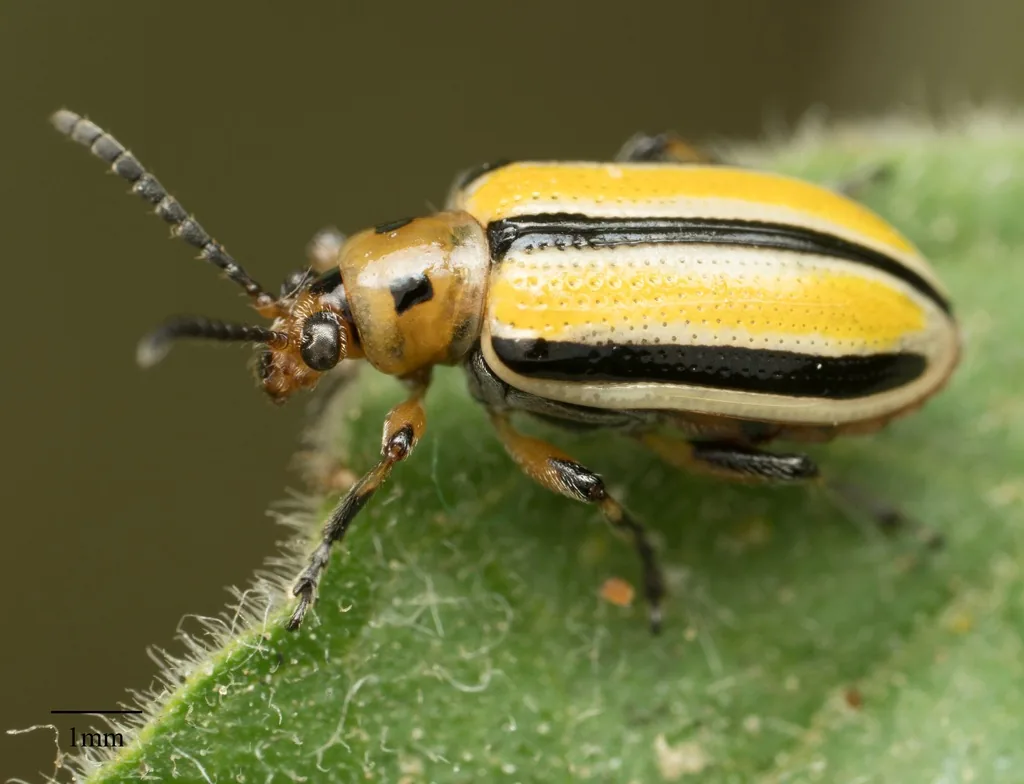
- Adults are about 1/4 inch (7 to 8 mm) long with three black stripes running down the wing covers. Minnesota describes the wing covers as cream to reddish yellow and Utah State as mustard yellow; Utah State also notes orange thighs and darker lower legs.[1][3]
- The reddish-orange area behind the head has two small black dots.[1][4]
- Larvae have black heads and cover themselves with their own feces, probably as a defense against being eaten. Their color is described three ways: green (Minnesota), dark grayish and slug-like (Utah State fact sheet) and yellow-green (Utah State IPM notes).[1][3][4]
- Eggs are orange, elongated and laid in clusters on leaf undersides.[1][3][4]
Look-alikes
| Look-alike | How to tell them apart |
|---|---|
| Striped cucumber beetle | The striped cucumber beetle is slightly larger (8 to 9 mm) and bright yellow with three black stripes, and Minnesota notes the two feed on different plants.[3][1] |
| Western corn rootworm | Smaller, 4 to 7 mm, yellow with dark stripes, and found mainly on corn and cucurbits rather than nightshades.[3] |
| Colorado potato beetle | Shares the name and some host plants, but Utah State notes both the adults and larvae differ clearly in shape and color.[3] |
Where it lives
It originated in North and Central America and has since caused crop damage abroad, including on cape gooseberry in South Africa and potato in Australia. In Minnesota it is active from May through August, usually in low numbers. In Utah it is uncommon, but in August 2020 it caused economic damage to tomatillos on a farm in Box Elder County.[3][1]
Biology and life cycle
Adults lay egg clusters on the foliage, and larvae hatch in late June or July. Minnesota reports that most new adults emerge in August.[3][1]
It spends the winter in the soil, as an adult or pupa depending on the region. Minnesota isn't sure whether there are one or two generations a year there; Utah State says up to two are possible, but one is more likely in Utah.[1][3][4]
Like related leaf beetles, it can tolerate the toxic tropane alkaloids in nightshade plants.[3]
Damage and signs
- Adults and larvae chew holes in the leaves of tomatillos, potatoes, tomatoes and other nightshades, and larvae can strip tomatillos completely, cutting plant vigor and yield.[1][3]
- Sources differ on how adults feed. Minnesota says they are often seen feeding in large groups but rarely do major damage; Utah State says adults feed alone and larvae feed in groups.[1][3]
Health risk
Neither Minnesota nor Utah State Extension mentions any risk to people or pets; both discuss it only as a garden and farm leaf beetle.[1][3]
Control
Keep them out
Row covers keep adults out if you rotate away from last year's nightshades and put the covers on before beetles emerge in spring.[1][3]
Sanitation
Remove nightshade weeds such as ground cherry, and rotate crops.[1]
Traps and physical control
Handpick beetles and larvae into soapy water and squash egg clusters. In small plantings, handpicking is often enough.[1]
Pesticides
Few pesticide labels list this beetle. Minnesota advises reading the label carefully to be sure the crop and setting you plan to treat are on it.[1]
What researchers have found
A 2025 PeerJ field study on jimsonweed in central Mexico found six parasitic fly and wasp species attacking the beetle's eggs and larvae, including the egg parasitoid Emersonella lemae.[2]
The same study found that larvae release oral secretions containing Datura alkaloids, which appear to help defend them against parasitic flies.[2]
Common questions
Sources
- University of Minnesota Extension, “Three-lined potato beetles (Yard and garden insects).” extension.umn.edu/garden-and-home/yard-and-garden/yard-and-garden-insects/threelined-potato-beetles (accessed 2026-11-13)
- Peer-reviewed literature (PubMed), “Searching for a common host: parasitoids of Lema daturaphila on Datura stramonium in Central Mexico (Villanueva-Hernández CE et al., PeerJ, 2025).” pubmed.ncbi.nlm.nih.gov/39917472/ (accessed 2026-11-13)
- Utah State University Extension, “Three-Lined Potato Beetle (fact sheet, Volesky, 2020).” extension.usu.edu/planthealth/research/three-lined-potato-beetle.pdf (accessed 2026-11-13)
- Utah State University Extension, “Three-Lined Potato Beetle (Utah Vegetable IPM pest notes).” extension.usu.edu/planthealth/ipm/notes_ag/veg-three-lined-potato-beetle (accessed 2026-11-13)
- Global Biodiversity Information Facility (GBIF), “Lema daturaphila Kogan & Goeden, 1970 (GBIF Backbone Taxonomy).” api.gbif.org/v1/species/1047466 (accessed 2026-11-13)