On this page
How to identify it
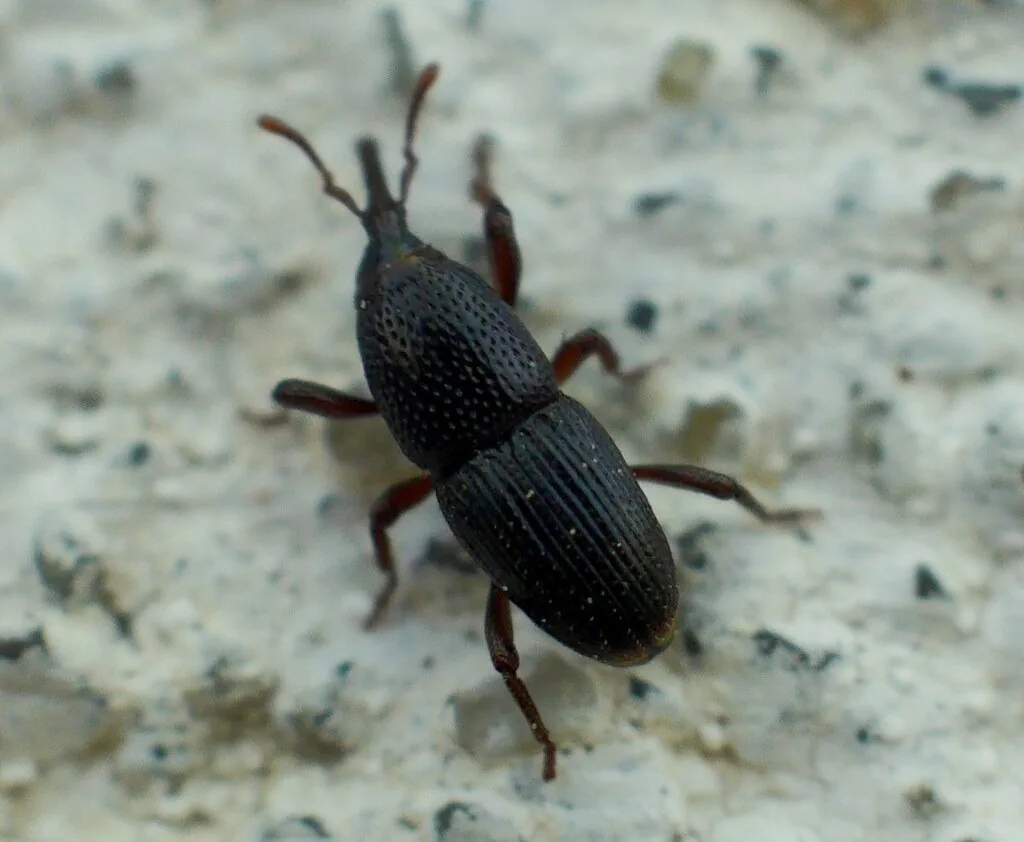
- A snout beetle: the chewing mouthparts sit at the tip of a long, slender snout.[2][4]
- Adults are about 1/8 inch long (Utah State gives 1/8 to 3/16 inch), brown to chestnut brown or black, and uniformly colored with no spots.[1][4][5][2]
- The thorax has elongated oval pits; the rice weevil's are round.[5][6]
- Adults can't fly, and when disturbed they tuck in their legs and stay still.[5][2][4]
- Larvae are small, white, legless grubs with brown heads.[5][1]
- UF/IFAS describes a shiny reddish-brown snout beetle 3 to 4 mm long with elongated oval pits on the thorax. Purdue says newly emerged adults are reddish brown before they darken.[3][7]
- Its flight wings are only rudimentary, a 1926 USDA bulletin notes, which is one reason it does poorly in the tropics, unlike the rice weevil.[8]
Look-alikes
| Look-alike | How to tell them apart |
|---|---|
| Rice weevil | Has round pits on the body, four pale yellowish to reddish spots on the wing covers, and working wings.[6][1][4][2] |
| Maize weevil | Can fly. Mississippi State says rice and granary weevils look so much like maize weevils that a microscope and an identification key are needed to tell them apart, but control is the same for all three.[9] |
Where it lives
More common in cooler climates, while the rice weevil is most abundant in warmer ones, and both do well in heated buildings. Researchers study it as a pest of cooled grain stores in temperate regions. It is spread mainly by people moving infested food. UF/IFAS says it prefers a cooler climate and in the United States is not often found south of North Carolina. A 1926 USDA bulletin says it probably came from Asia or the lands around the Mediterranean and, unlike its tropical relatives, is a temperate-climate species that soon dies out in tropical and subtropical climates.[2][10][5][3][8]
Biology and life cycle
The female chews a small hole in a kernel, lays one egg in it and seals it with a glue-like plug; Washington State says she can lay up to 250 eggs in her lifetime of about eight months.[2][5]
The larva stays inside the kernel, and there is usually no outside sign of it until the adult chews out through the seed coat.[1][2]
Iowa State says the adult usually emerges after about a month; Washington State says that in warm conditions growth from egg to adult takes about four weeks.[1][2]
UF/IFAS says egg, larva and pupa all develop inside the kernel; the life cycle takes one to five months, adults live seven to eight months, females may lay more than 200 eggs, and there are commonly four generations a year.[3]
In the 1926 USDA study, egg-laying females usually laid one or two eggs a day, and one female laid 254 eggs. Adults with food lived on average between 7 and 8 months, many lived over 1 year, and a few held between 50 and 60 degrees F lived 2 years and 5 months; near Washington, D.C., there were between three and four generations a year.[8]
It spends the winter as an adult or larva and resumes egg-laying and feeding as spring warms up, according to the 1926 USDA bulletin.[8]
Damage and signs
- Feeds on whole grains such as wheat, corn, barley and rice, plus pet food, bird seed and sunflower seeds, and occasionally old pasta, chestnuts and acorns.[5][2]
- It lives mostly in whole kernels or coarsely cracked grain. Adults may wander into flour, but they are not as likely to survive and reproduce there.[2]
- In homes the source is usually whole grain or seeds: popcorn, dried beans, saved garden seed, decorative corn, bird seed, nuts, bean bags or old grain-based mouse bait.[1][4]
- UF/IFAS adds beans, nuts, seeds and pasta to its foods. Purdue says grain weevils can't breed in finely processed grain but can in macaroni, noodles and milled cereals that have caked from moisture, and the 1926 USDA bulletin notes adults sometimes bore holes in the cartons of packaged cereals.[3][7][8]
Health risk
Granary weevils can't bite or sting and won't damage furniture, clothing or the house; the harm is to the seeds they infest. Long exposure to infested grain dust is a different matter: in studies of mill and bakery workers, many had skin-test or antibody reactions to granary weevil proteins, and a few had asthma symptoms when they inhaled weevil extract.[1][11][12]
Control
Prevention
Store seeds and grains in sealed glass, metal or heavy plastic containers, or in the refrigerator or freezer, until you're sure the problem is gone.[1][2]
Buy dried grain products in amounts you'll use up quickly, use older packages first, and inspect packages for holes before buying.[2][6]
Sanitation
Find and get rid of the infested whole grain or seed; that is the only real fix in a home.[1][5]
Empty and vacuum the cupboards, paying attention to cracks and corners; washing shelves with detergent or bleach has no effect on the insects.[1][2]
Traps and physical control
Small amounts of grain can be saved by heating to 140 degrees F for 15 minutes or freezing at 0 degrees F for 3 days.[1]
Pesticides
Insecticide sprays aren't recommended in food cupboards. Sprays only reach the adults you can see, because the young are inside the kernels, and insecticides should never be applied to food.[1][6]
When to call a professional
Larger quantities of infested grain may need disposal or professional fumigation.[1]
Where sources disagree
Heat and cold: 140°F for 15 minutes or 0°F for 3 days (Iowa State), or 130°F for 30 minutes or -1°F for at least 5 hours (Washington State). Georgia's general advice for stored product pests is six days at 0 to -2°F in a household freezer.[1][2][6]
Size: about 1/8 inch (Iowa State, Washington State, Illinois) or 1/8 to 3/16 inch (Utah State).[1][2][4][5]
Size, continued: UF/IFAS gives 3 to 4 mm.[3]
Eggs per female: up to 250 (Washington State), more than 200 under favorable conditions (UF/IFAS); one female in a 1926 USDA study laid 254.[2][3][8]
Generations per year: commonly four (UF/IFAS), or between three and four near Washington, D.C. (1926 USDA bulletin).[3][8]
Common questions
- Is a granary weevil the same as a rice weevil?
- No, but they are close relatives with nearly the same habits. The granary weevil has no spots, has oval rather than round pits, and can't fly, while the rice weevil flies and has four pale spots.[2][5][6][1]
- Can I still eat grain that had weevils in it?
- Iowa State says the weevils are harmless to people and that small amounts of grain can be saved by heating or freezing it; larger amounts may need to be discarded. Washington State says heat- or cold-treated grain can be eaten, or fed to animals or composted if you'd rather not.[1][2]
- Where did granary weevils in my kitchen come from?
- Almost always from infested whole grain or seed brought into the house. Because they can't fly, Washington State notes that knowing the species helps track down the source, and Utah State says they are spread mainly by people moving infested food.[2][5][1]
- Can granary weevils live in flour?
- Not well. Washington State says adults that wander into flour are unlikely to survive and reproduce there, and Purdue says grain weevils can't breed in finely processed grain, though they can in pasta and in milled cereals that have caked from moisture.[2][7]
Sources
- Iowa State University Extension and Outreach, “Rice Weevil and Granary Weevil (Yard and Garden).” yardandgarden.extension.iastate.edu/encyclopedia/rice-weevil-and-granary-weevil (accessed 2026-11-14)
- Washington State University Extension, “The Granary Weevil (Skagit County Master Gardener column).” wpcdn.web.wsu.edu/extension/uploads/sites/57/2014/03/011411.pdf (accessed 2026-11-14)
- University of Florida, Entomology and Nematology Department, “Granary weevil, Sitophilus granarius (UF/IFAS Stored Product Pests photographs, text page).” entnemdept.ufl.edu/projex/gallery/dl/stored_product_pests/text/granary_weevil.htm (accessed 2026-11-14)
- University of Illinois Extension, “Common Pantry Pests.” extension.illinois.edu/sites/default/files/common_pantry_pests.pdf (accessed 2026-11-14)
- Utah State University Extension, “Granary Weevil (School IPM structural pest ID guide).” extension.usu.edu/planthealth/ipm/structural-pest-id-guide/granary-weevil (accessed 2026-11-14)
- University of Georgia Extension, “Stored Product Pests in the Home (Bulletin 1378).” fieldreport.caes.uga.edu/publications/B1378/ (accessed 2026-11-14)
- Purdue University Extension Entomology, “E-237: Rice, Granary, and Maize Weevils (L. J. Mason, November 2018).” www.extension.entm.purdue.edu/publications/E-237/E-237.html (accessed 2026-11-14). Used only for its description of the granary weevil and for grain-weevil food habits; its biology paragraph mixes in Angoumois grain moth details and is not used.
- U.S. Department of Agriculture (scan at Internet Archive), “The Granary Weevil (E. A. Back and R. T. Cotton, USDA Department Bulletin 1393, 1926; scanned copy).” archive.org/details/granaryweevil1393back (accessed 2026-11-14). Historic 1926 bulletin read from the Internet Archive's full text; used only for history, distribution and biology, not for its control advice.
- Mississippi State University Extension Service, “Maize Weevils, Bug's Eye View Vol. 7, No. 1.” extension.msstate.edu/taxonomy/term/4171/2021/maize-weevils-vol-7-no-1 (accessed 2026-11-14)
- Journal of Economic Entomology, via PubMed, “Hansen (2007), Biocontrol potential of Lariophagus distinguendus against Sitophilus granarius at low temperatures.” pubmed.ncbi.nlm.nih.gov/17598568/ (accessed 2026-11-14)
- British Journal of Industrial Medicine, via PubMed, “Lunn (1966), Millworkers' asthma: allergic responses to the grain weevil (Sitophilus granarius).” pubmed.ncbi.nlm.nih.gov/5929689/ (accessed 2026-11-14)
- Allergy, via PubMed, “Herling, Svendsen and Schou (1995), Identification of important allergenic proteins in extracts of the granary weevil (Sitophilus granarius).” pubmed.ncbi.nlm.nih.gov/7573834/ (accessed 2026-11-14)
- iNaturalist, “Sitophilus granarius taxon page (order and family).” www.inaturalist.org/taxa/231086 (accessed 2026-11-14)