On this page
How to identify it
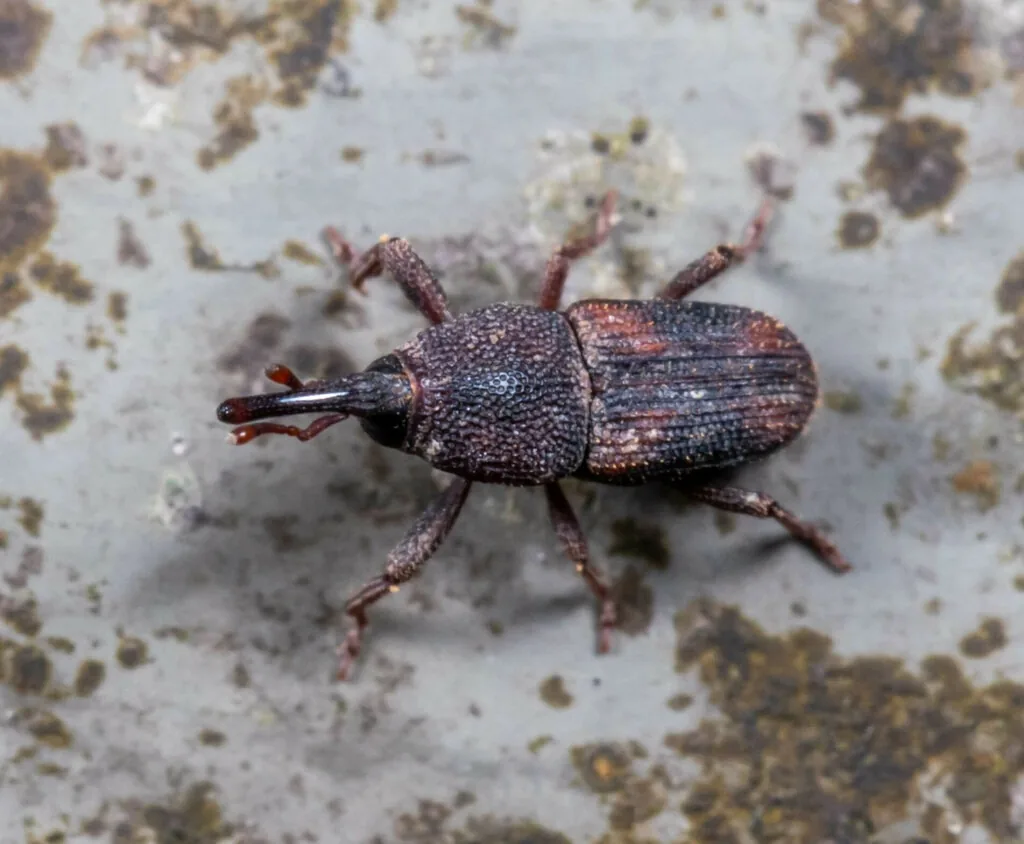
- A snout beetle: the head extends into a long snout, about 1 mm, with chewing jaws at the tip. Purdue adds that when disturbed it draws its legs up to its body and stays motionless.[2][4][3][5]
- Adults are reddish brown to nearly black, usually with four light reddish or yellowish spots at the corners of the wing covers.[3][2]
- The thorax is densely and evenly covered with round pits; in the rice weevil a smooth, narrow strip runs down the middle. UF/IFAS likewise says the maize weevil usually has pits on the midline of the thorax while the rice weevil's midline is commonly free of them, and Purdue notes small, distinct colored spots on the wing covers.[2][6][5]
- It is slightly larger and darker than the rice weevil, but the two vary so much that they are hard to tell apart; telling them apart reliably takes the pattern of the pits, internal reproductive structures or a taxonomist.[2][4][3]
- It has full wings and flies well, more strongly than the rice weevil.[2][4][3]
Look-alikes
| Look-alike | How to tell them apart |
|---|---|
| Rice weevil | Nearly identical in looks and habits. The rice weevil is usually a little smaller and has a smooth strip down the middle of its pitted thorax; Kansas State notes that most people don't need to tell the two apart.[2][4] |
| Granary weevil | Similar, but a uniform, shinier color, elongated pits on the thorax, and no wings under the wing covers, so it cannot fly and only infests grain after harvest.[2][4] |
Where it lives
Recorded from Asia, Africa, North, Central and South America, the Caribbean, Europe and Oceania. In the US it is a common pest of grain crops that causes heavy losses to corn in the South. UF/IFAS and Purdue describe it as worldwide in distribution.[3][2][6][5]
Biology and life cycle
The female chews a hole in a kernel, lays an egg and seals the hole with a gelatinous plug. Pacific Pests, Pathogens & Weeds gives up to 150 eggs per female, most laid in the first 4 to 5 weeks of a life that lasts about a year.[3][2]
The white, legless larva feeds and pupates inside the kernel, and the adult chews its way out, leaving a large exit hole.[3][2]
Its life history is like the rice weevil's but slightly slower: at least 30 days from egg to adult, about 35 days under ideal conditions.[2][3]
Adults fly from granaries to fields and start infestations there that can continue after harvest; in the South it is the weevil most often found in corn in the field.[2][4][3]
Purdue says eggs may also go in grooves or in holes made by other insects. Two or three larvae may develop in one corn kernel, but only one adult comes from a kernel of other grains; there are three larval molts, and the last larva usually spins a silken cocoon in its feeding cavity.[5]
Speed depends on temperature: Purdue gives 30 days from egg to adult at 86°F and 40 days at 77°F, with a minimum for development of 60.8°F and 30% relative humidity and an optimum near 86°F and 75% humidity. UF/IFAS says the life cycle can take as little as 30 days.[5][6]
In colder climates the larvae go dormant for four to five months over winter. Purdue says there are generally four to five generations a year, and as many as 10 to 12 in heated warehouses.[5]
Damage and signs
- It attacks a variety of grains: maize above all, plus wheat, rice and sorghum, other dried stored products such as pasta, and cassava and yam. Purdue says grain weevils can't breed in finely processed grain but readily breed in macaroni, noodles and milled cereals that have caked from moisture.[3][4][2][5]
- Badly infested corn kernels are reduced to dry powder and hulls. Pacific Pests, Pathogens & Weeds puts typical weight loss at up to 5%, and up to 40% in severe infestations.[2][3]
- Large infestations give off heat and moisture, which bring on molds and mites.[3]
- Purdue notes that air drawn through grain, especially grain with some mold, attracts egg-laying females, and that maize weevils can completely suppress Angoumois grain moth populations.[5]
Health risk
The sources describe damage to stored grain only; none describes bites, stings or disease.[2][4][3]
Control
Prevention
Move dry goods from paper, cardboard or thin plastic into jars or containers that seal tightly; for small amounts of grain, plastic containers work.[7][3]
Sanitation
General pantry-pest advice applies: find and discard the infested items, since the infestation continues as long as the source remains.[7]
Check every grain product, including forgotten bags at the back of shelves, decorative items and bird seed, then vacuum shelves and cracks with a crevice tool.[7]
Traps and physical control
Decorative items such as Indian corn can be heated at 155 degrees F for about 20 minutes or frozen at 0 degrees F for 4 days.[7]
When to call a professional
Because the larvae live entirely inside kernels, cleaning grain does not remove them. Bulk grain is fumigated under covers by certified operators. Purdue adds that residual insecticides kill only exposed adults, and that heating grain to 60°C can kill larvae but may lower germination and the baking quality of flour.[2][3][5]
Where sources disagree
Adult size: USDA gives up to 1/8 inch; Pacific Pests, Pathogens & Weeds gives 3 to 4 mm. UF/IFAS gives 2.3 to 2.9 mm and calls it slightly smaller than the rice weevil, the reverse of USDA's comparison.[2][3][6]
Why it dominates in some places: a Brazilian survey found the maize weevil prevalent across the country and suggested two explanations, a preference for maize and the maize weevil's prevalence in the tropics compared with the rice weevil, which is more widespread in subtropical and temperate regions.[8]
Which grain it favors: UF/IFAS says the maize weevil is more commonly found in wheat and the rice weevil in corn, while USDA says the maize weevil is the weevil most often found in field corn in the South, and Pacific Pests, Pathogens & Weeds names maize as its main food.[6][2][3]
Eggs per female: Pacific Pests, Pathogens & Weeds gives up to 150; Purdue gives 80 to 200 for the grain weevils in this genus.[3][5]
Common questions
- How can I tell a maize weevil from a rice weevil?
- Not easily. They look and behave almost the same; the maize weevil is slightly larger and darker, with an evenly pitted thorax, but reliable identification needs a specialist. Kansas State notes most people don't need to tell them apart.[2][4][3]
- Why do I keep seeing weevils after cleaning the pantry?
- Larvae develop hidden inside kernels, so an infested item you missed keeps producing adults. Kentucky stresses a thorough search, including decorations and bird seed.[2][7]
- Can maize weevils live in flour?
- Not as a rule. Purdue says grain weevils can't breed in finely processed grain, though they readily breed in pasta and in milled cereals that have caked from moisture.[5]
Sources
- Scientific Data, via PubMed, “Chromosome-level genome assembly and annotation of the maize weevil (Bai et al. 2025).” pubmed.ncbi.nlm.nih.gov/40490451/ (accessed 2026-11-11)
- USDA Agricultural Research Service, “Stored-Grain Insects (Agriculture Handbook No. 500, issued 1978, revised 1986).” www.ars.usda.gov/ARSUserFiles/2863/pdfdocuments/StoredGrainInsects.pdf (accessed 2026-11-11)
- Pacific Pests, Pathogens & Weeds (University of Queensland and the Pacific Community), “Maize (greater grain) weevil (Fact Sheet 339).” apps.lucidcentral.org/pppw_v10/text/web_full/entities/maize_greater_grain_weevil_339.htm (accessed 2026-11-11). Compiled fact sheet; its references include CABI, BioNET-EAFRINET and Wikipedia. Cited here only for lines a second publisher supports or for figures given as its own.
- Kansas State University Research and Extension, “Stored Products Pest Control (Pesticide Application Training, Category 7B, S-16).” bookstore.ksre.ksu.edu/download/stored-products-pest-control-7b_S16 (accessed 2026-11-11)
- Purdue University Extension Entomology, “E-237: Rice, Granary, and Maize Weevils (L. J. Mason, November 2018).” www.extension.entm.purdue.edu/publications/E-237/E-237.html (accessed 2026-11-14)
- University of Florida, Department of Entomology and Nematology, “Maize weevil, Sitophilus zeamais (Stored Product Pests photo gallery).” entnemdept.ufl.edu/projex/gallery/dl/stored_product_pests/text/maize_weevil.htm (accessed 2026-11-14)
- University of Kentucky Entomology, “ENTFACT-612: Stored Product Pests in the Pantry.” entomology.mgcafe.uky.edu/ef612 (accessed 2026-11-11)
- Insect Science, via PubMed, “Distribution of the related weevil species Sitophilus oryzae and S. zeamais in Brazil (Correa et al. 2013).” pubmed.ncbi.nlm.nih.gov/23956213/ (accessed 2026-11-11)
- iNaturalist, “Sitophilus zeamais taxon page (order and family).” www.inaturalist.org/taxa/231088 (accessed 2026-11-11)