On this page
How to identify it
- The caterpillar is usually black or almost black, with two prominent stripes and many fine, bright yellow stripes along each side. The sources give slightly different sizes (see Where the sources disagree).[1][2][4]
- Eggs are laid in clusters on the upper side of leaves and covered with gray, cottony material.[1]
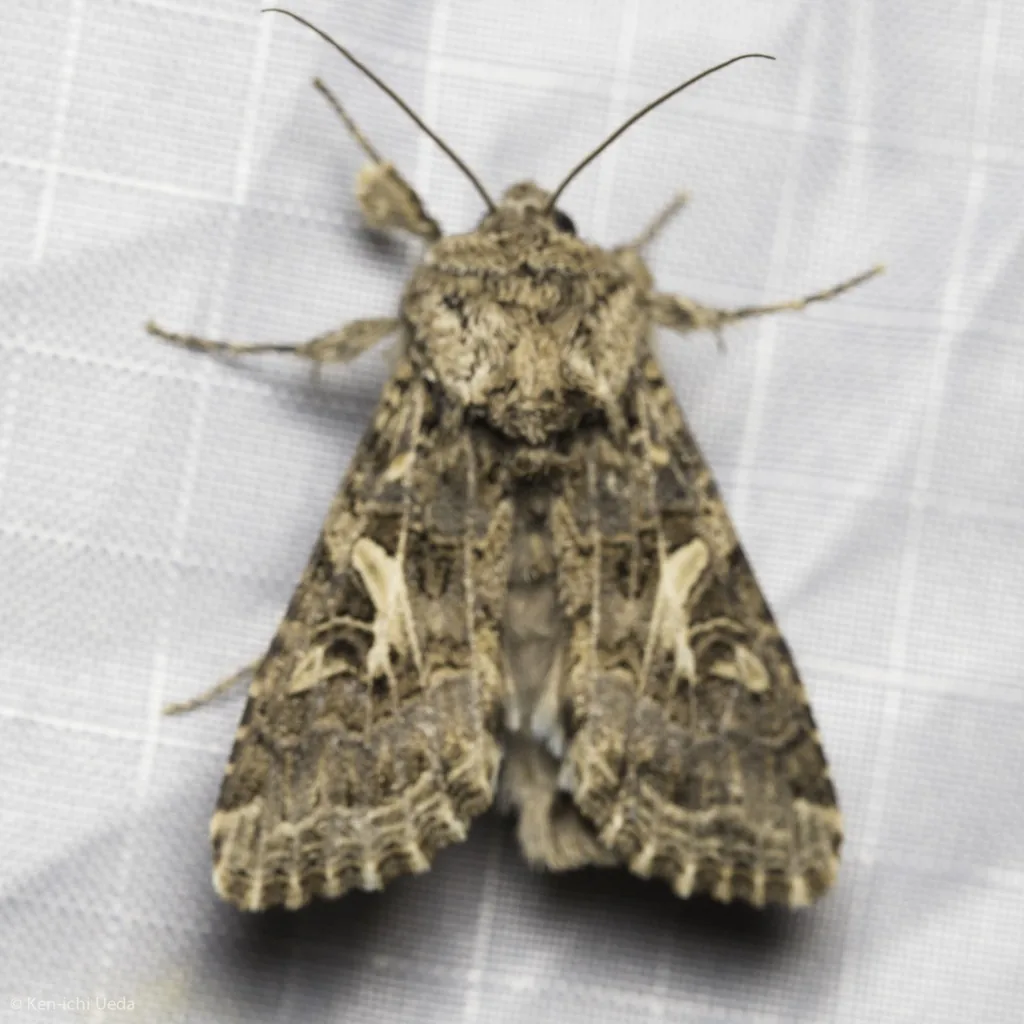
- The adult is a brown moth that flies mostly at night, though moths may flush up as you walk through an infested field.[1]
- Oregon State gives the moth a wingspan of about 1.5 inches, with brownish-gray front wings and silver-gray hind wings.[4]
Look-alikes
| Look-alike | How to tell them apart |
|---|---|
| Beet armyworm | UC IPM notes that the western yellowstriped armyworm is the larger of the two caterpillars in tomatoes, which makes it harder to control.[2] |
Where it lives
It is native to the Pacific Northwest. In California it can be abundant in Central Valley alfalfa from June to early September and also breeds in the low desert; damage reports are newer in northeastern Oregon. GBIF's 554 U.S. records since 1990 are led by Montana (203), California (164) and Washington (78), with others from Idaho, Oregon, Utah, Nevada, Wyoming, Colorado, New Mexico and South Dakota.[4][1][6]
Biology and life cycle
Eggs hatch quickly (see Where the sources disagree for how quickly). The caterpillars reach full size in 2 to 3 weeks (14-21 days in Oregon State's words) and pupate on or just under the soil surface; the whole cycle from egg to adult takes approximately 40 days.[1][4]
The number of generations a year varies with climate (see Where the sources disagree).[1][4]
Populations are cyclic and reach large numbers only every few years.[1]
In the Pacific Northwest handbook's account, weeds such as lambsquarters and wild mustard attract egg-laying females and feed the caterpillars, and the insect spends the winter as a pupa.[3]
Late-season larvae spend the winter as pupae in the soil, so several warm, dry winters in a row can build populations. In hot, dry summers the larvae crowd into green fields, forming an army that can cause extensive crop damage. Oregon State adds that adult moths can migrate from the southern regions of the United States.[4][3]
Damage and signs
- In alfalfa, the caterpillars skeletonize leaves, eating the tissue and leaving the veins largely intact.[1]
- In tomatoes it feeds on both leaves and fruit. It rarely bores deep into fruit but eats at the surface, leaving irregular holes. Damage is sporadic and worst from July to mid-September in California.[2]
- Caterpillars often move into tomatoes from alfalfa fields when the alfalfa is cut, or from beans and other crops when they are harvested or dry out. As weeds dry up, large numbers can also march onto crops.[2][3]
Health risk
These crop guides treat it only as a plant pest; no cited source describes any risk to people or pets.[1][2][3]
Control
Prevention
In alfalfa, early harvest and cutting the field borders are among the main ways to prevent armyworm damage. Be aware that mowing an infested alfalfa field can send armyworms moving into nearby crops.[1][3]
Sanitation
Control weeds such as lambsquarters and wild mustard in and around plantings, since they attract egg-laying females and feed the caterpillars.[3]
In hay fields, Oregon State suggests cutting instead of spraying if the infestation is found within one week of a planned cutting, storing baled hay for one to three weeks before transport, inspecting hay before delivery and cleaning cutters, rakes and balers after working in infested fields.[4]
Traps and physical control
Fall tillage can help destroy pupae overwintering in the soil.[3]
Biological control
Natural enemies often keep armyworms under control. Predators include bigeyed bugs, spiders, minute pirate bugs, damsel bugs, assassin bugs and lacewings, and at least ten parasites attack it; the small wasp Hyposoter exiguae is thought to be the most important. Viral diseases, including a nucleopolyhedrovirus, can also knock populations down. How much to rely on them differs by source (see Where the sources disagree).[1][2][3]
Avoid broad-spectrum insecticides so the natural enemies survive; the University of Idaho lists big-eyed bugs, damsel bugs, ground beetles, rove beetles and parasitic wasps and flies, and notes that fungal diseases also hold armyworms in check. Bt and spinosad are biological insecticide options.[5][4]
Pesticides
Bacillus thuringiensis (Bt) works much better on small caterpillars, so watch for infestations early. Bt and, in tomatoes, the Entrust formulation of spinosad are acceptable for organic crops. Home-use options listed in the Pacific Northwest handbook include azadirachtin (neem oil), carbaryl, plant-derived essential oils and pyrethrins; follow the label for your crop.[3][1][2]
Writing about armyworms generally, including this species, the University of Idaho says insecticides should be considered only when defoliation is severe or plants are at a vulnerable stage, and that foliar sprays work best at night, when most larvae are feeding.[5]
Checking fields and gardens
In alfalfa, UC IPM recommends sweeping fields two to three times a week from early summer through September, counting healthy and parasitized caterpillars. A pesticide is suggested only if cutting is not practical soon and counts average 15 or more nonparasitized armyworms per sweep.[1]
A parasitized caterpillar can be spotted by pulling off the head of an older caterpillar and squeezing the body contents toward the head end: the larva of the Hyposoter wasp is light, translucent green.[1]
In tomatoes, start checking for caterpillars when fruit reaches about an inch across. Pheromone traps show when the main moth flights happen but do not predict damage.[2]
Where the sources disagree
Egg hatch: UC IPM says eggs hatch in a few days; Oregon State says they may hatch within a week.[1][4]
Generations: UC IPM gives at least five a year in California's low desert and four in the Central Valley; Oregon State says there are likely two in northeastern Oregon, with a possible third depending on elevation, the frost-free period and June temperatures; the University of Idaho says armyworms generally have one to three generations per growing season.[1][4][5]
Caterpillar size: UC IPM says full-grown caterpillars are about 1.5 to 2 inches long; Oregon State says they grow from 1/8 inch to 2 inches at maturity.[1][4]
Natural enemies: UC IPM says armyworms are frequently controlled by natural enemies; the Pacific Northwest handbook says none of them can be counted upon to achieve adequate control in any given year.[1][3]
Common questions
- Why did armyworms suddenly show up in my tomatoes?
- Western yellowstriped armyworms often move in from nearby alfalfa when it is cut, or from beans and other crops as they are harvested or dry out.[2]
- Do I need to spray every armyworm I see?
- Not usually. Natural enemies frequently keep this armyworm under control, and it reaches large numbers only every few years. Bt sprays work best when caterpillars are small.[1][3]
- Why are they called armyworms?
- Because they march. When weeds or a cut field dry out, large numbers of caterpillars move together onto nearby green crops, and in hot, dry summers they crowd into green fields, forming an army.[3][4]
Sources
- University of California Statewide IPM Program, “Western Yellowstriped Armyworm (Alfalfa Pest Management Guidelines).” ipm.ucanr.edu/agriculture/alfalfa/western-yellowstriped-armyworm/ (accessed 2026-11-13)
- University of California Statewide IPM Program, “Western Yellowstriped Armyworm (Tomato Pest Management Guidelines).” ipm.ucanr.edu/agriculture/tomato/western-yellowstriped-armyworm/ (accessed 2026-11-13)
- Pacific Northwest Pest Management Handbooks (Oregon State, Washington State and University of Idaho Extension), “Lentil-Western yellowstriped armyworm (Pacific Northwest Insect Management Handbook).” pnwhandbooks.org/insect/vegetable/vegetable-pests/hosts-pests/lentil-western-yellowstriped-armyworm (accessed 2026-11-13)
- Oregon State University Extension Service, “Western yellow-striped armyworm: Biology and management basics (EM 9445).” extension.oregonstate.edu/es/catalog/em-9445-western-yellow-striped-armyworm-biology-management-basics (accessed 2026-11-13)
- University of Idaho Extension, “Armyworms (Integrated Pest Management: agricultural pests).” www.uidaho.edu/extension/food/ipm/ag-pests/armyworms (accessed 2026-11-13)
- Global Biodiversity Information Facility (GBIF), “Spodoptera praefica: U.S. occurrence records since 1990 by state (GBIF occurrence search).” api.gbif.org/v1/occurrence/search?taxonKey=5109852&country=US&hasGeospatialIssue=false&occurrenceStatus=PRESENT&year=1990%2C2026&facet=stateProvince&facetLimit=400&limit=0 (accessed 2026-11-13). Fetched 2026-11-13: 554 U.S. records since 1990; Montana 203, California 164, Washington 78. Counts are records reported, not abundance.
- Global Biodiversity Information Facility (GBIF), “Spodoptera praefica Grote, 1875 (GBIF Backbone Taxonomy).” api.gbif.org/v1/species/5109852 (accessed 2026-11-13)